Close Menu

    Subscribe to Updates

    Get the latest creative news from FooBar about art, design and business.

    What's Hot

    Brian Cushing’s Luxe Houston House: Inside the NFL Star’s $5M Retreat

    February 27, 2026

    Arthur T Demoulas House: Inside the Lowell MA Market Basket Billionaire Estate

    February 27, 2026

    Which Way Should Vinyl Plank Flooring Run in a Hallway? Best House Layout Guide
    February 27, 2026
    Facebook X (Twitter) Instagram
    Facebook X (Twitter) Instagram
    Crazzy Homes
    Button
    • HOME
    • HOME IMPROVEMENT
      • HOME DECOR
      • ARCHITECTURE
      • FURNITURE
      • FLOORING
      • CLEANING
      • INTERIOR
        • BEDROOM
        • BATHROOM
        • DOORS
        • WINDOW
      • EXTERIOR
        • GARDENING
    • CELEBRITY HOME

      Brian Cushing’s Luxe Houston House: Inside the NFL Star’s $5M Retreat

      February 27, 2026

      Arthur T Demoulas House: Inside the Lowell MA Market Basket Billionaire Estate

      February 27, 2026

      Rachel Meghan Markle House: Inside Her $14.65M Montecito Mansion

      February 26, 2026

      Anita Zucker House: Inside the $20M Charleston Mansion

      February 25, 2026

      Andrew Wiggins’ Miami Heat House: Inside the NBA Star’s Luxe Florida Retreat

      February 21, 2026
    • Real Estate
    • PLUMBING
    • KITCHEN
      • APPLIANCES
    • LIFE STYLE
    Crazzy Homes
    Home » Which Way Should Vinyl Plank Flooring Run in a Hallway? Best House Layout Guide
    FLOORING

    Which Way Should Vinyl Plank Flooring Run in a Hallway? Best House Layout Guide

    Stella VictoriaBy Stella VictoriaFebruary 27, 2026No Comments12 Mins Read
    Facebook Twitter Pinterest LinkedIn Tumblr Email
    Which Way Should Vinyl Plank Flooring Run in a Hallway
    Share
    Facebook Twitter LinkedIn Pinterest Email

    Planning your hallway remodel? You have picked out the perfect color, you have your tools ready, and you are staring at that empty subfloor. Then, the panic sets in. The top question that halts DIYers and homeowners in their tracks is: Which way should vinyl plank flooring run in a hallway?

    It seems like a small detail. It isn’t. The direction you lay your planks can completely transform the look of your home. Get it right, and your hallway looks expansive, welcoming, and professionally designed. Get it wrong, and you might end up with a “bowling alley” effect or a choppy, ladder-like appearance that makes the space feel cramped.

    Table of Contents

    Toggle
    • Vinyl Plank Flooring Basics: Why Direction Counts
      • The Optical Illusion of Flooring
      • Factors That Influence Your Decision
    • The Golden Rules: Which Way Should Vinyl Plank Flooring Run in a Hallway?
      • Follow the Longest Wall
      • Run Toward the Main Light Source
      • The Verdict
    • Layout Options: Pros, Cons, and Visuals
      • Visualizing the “Ladder” Effect
    • Hallway-Specific Layout Guide by House Type
      • The Narrow Hallway Less than 4 ft wide
      • The Long, Never-Ending Hallway (>15 ft)
      • The L-Shaped Hallway
      • Open Plan to Living Room
    • Integrating with Other Rooms: Whole-House Flow
      • The Transition Dilemma
      • Doorway Alignment
      • Pro Tip for Kitchen Connections
    • Installation Tips for Perfect Vinyl Plank Direction
      • Acclimate Your Planks
      • The Dry Fit
      • Snap a Chalk Line
      • Stagger Your Seams
    • Choosing the Best Vinyl Plank for Hallways
      • Thickness and Wear Layer
      • Material: SPC vs. WPC
      • Cost Expectations
    • Common Mistakes and How to Avoid Them
    • Cost and Timeline for Hallway Vinyl Install
    • FAQs: Which Way Should Vinyl Plank Flooring Run in a Hallway?

    Vinyl Plank Flooring Basics: Why Direction Counts

    Which Way Should Vinyl Plank Flooring Run in a Hallway

    Before we start snapping chalk lines, we need to understand the material we are working with. Vinyl plank flooring is designed to mimic the natural grain and texture of real hardwood. Because it has a grain pattern and a rectangular shape, it acts like a visual arrow.

    The Optical Illusion of Flooring

    Flooring is more than a surface; it is an optical illusion.

    • Lengthwise Installation: When planks run parallel to the longest walls, they draw the eye forward. This creates a sense of depth and can make a short hallway feel longer.
    • Widthwise Installation: When planks run across the hallway (perpendicular to the long walls), they act like horizontal stripes on a shirt. They can make a narrow hallway feel wider, but they also create a “ladder” effect that visually stops the eye.

    Factors That Influence Your Decision

    Deciding which way vinyl plank flooring should run in a hallway isn’t just about the hallway itself. You have to consider:

    • Light Sources: How does the sunlight hit the floor?
    • Adjoining Rooms: Which way is the floor running in the living room or bedrooms?
    • Subfloor Quality: Is your floor level? Uneven subfloors can sometimes dictate direction to prevent planks from popping up.

    Key Benefits of the Right Direction:

    • Seamless Flow: It connects rooms without jarring visual breaks.
    • Hiding Seams: Proper lighting direction can make seams disappear.
    • Perceived Space: It can boost the feeling of square footage by 10% simply by guiding the eye correctly.

    The Golden Rules: Which Way Should Vinyl Plank Flooring Run in a Hallway?

    If you are looking for the short answer, here it is. While design rules are made to be broken, there are two “Golden Rules” that professional installers follow 90% of the time.

    Follow the Longest Wall

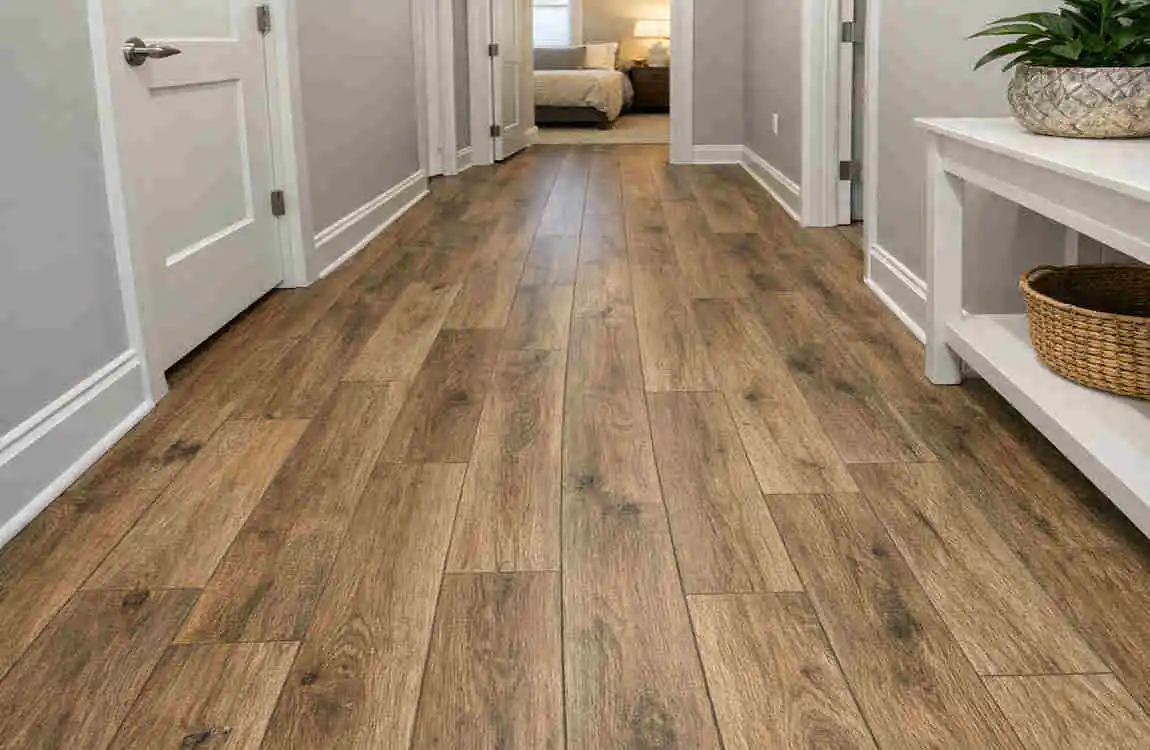
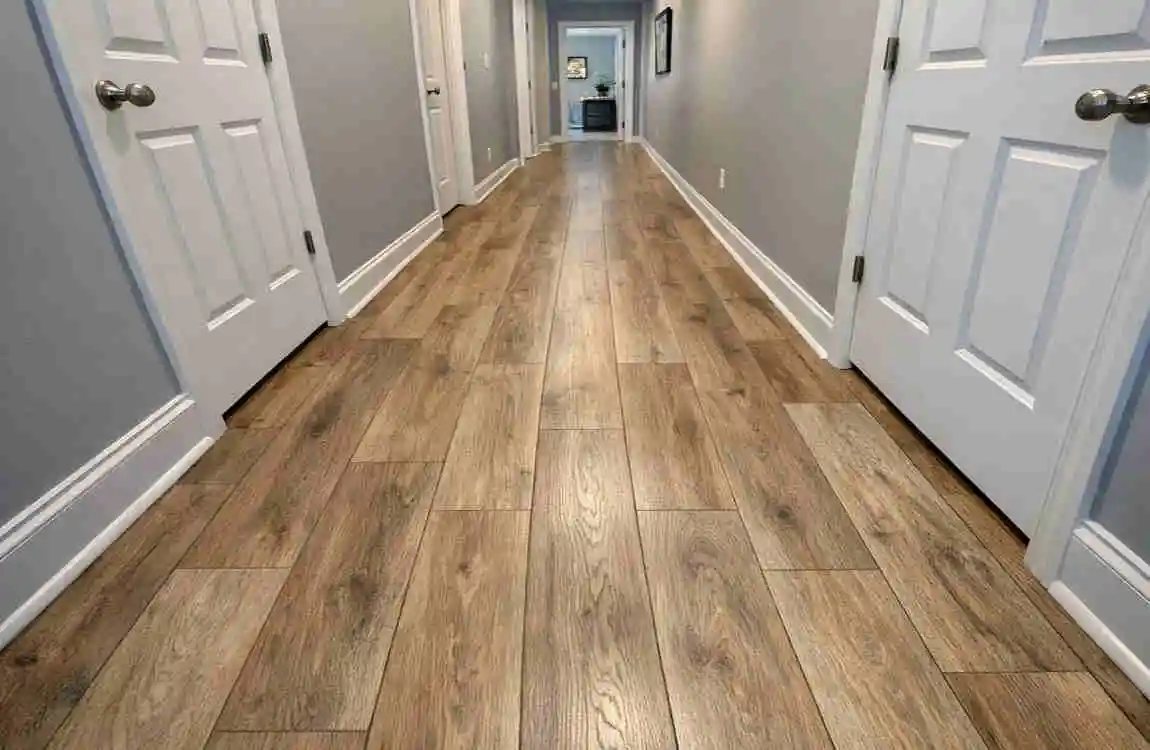
    The most common answer to which way vinyl plank flooring should run in a hallway is lengthwise. You should almost always run the planks parallel to the longest wall in the hallway.

    • Why? Hallways are essentially long, narrow rectangles. Running the planks lengthwise works with the shape of the room, not against it. It creates a smooth, continuous flow that leads you into the rest of the house.
    • The Vibe: It feels natural. Think of a river flowing downstream; you want your floor to carry you through the space rather than create resistance.

    Run Toward the Main Light Source

    This rule applies more to large rooms, but it affects hallways that end in a window or a glass door.

    • The Logic: If you have a large window at the end of the hallway, run the planks toward the window.
    • The Science: When light streams in parallel to the long joints of the planks, the light glides over the floor. If the light hits the joints perpendicularly (across them), it casts tiny shadows at every seam. This highlights the texture—but it also highlights any slight height differences between planks, making the floor look uneven.

    The Verdict

    For hallways, Rule #1 (The Longest Wall) usually trumps everything else. Because hallways are so narrow, running planks across the width (widthwise) creates too many short, choppy boards. It looks busy and increases your material waste significantly because you are constantly cutting planks.

    Pro Consensus: Ask any veteran installer, and 80% will tell you to run vinyl plank flooring lengthwise down a hallway.

    Layout Options: Pros, Cons, and Visuals

    To help you visualize which way vinyl plank flooring should run in a hallway, let’s break down the four main layout options. Every home is different, and sometimes the “wrong” way is actually the right way for your specific design goals.

    Here is a comparison table to help you weigh your options:

    DirectionProsConsBest For

    Lengthwise (Along the Hall): elongates the space, creates a natural flow, is easiest to install, and generates the least waste. It can create a “bowling alley” look in extremely long, empty halls. 95% of hallways, especially narrow or standard-width halls.

    Widthwise (Across the Hall) Visually widens very narrow spaces; slows down the pace of the room. Creates a “ladder” effect; requires extensive cutting; choppy visual—very short, wide entry vestibules or connectors.

    Diagonal (45-Degree Angle): extremely stylish; it makes a small space look huge; hides uneven walls. High waste (expect 20%+ waste factor); difficult and expensive to install—luxury foyers or square entry halls.

    Herringbone / Parquet High-end, classic aesthetic; adds texture and interest. Very busy for a narrow hall; requires specific “A” and “B” planks; costly. Wide, grand hallways in historic or luxury homes.

    Visualizing the “Ladder” Effect

    Imagine climbing a ladder. You look at the rungs one by one. That is what happens when you install flooring widthwise in a hallway. Your eye stops at every single board joint. It makes the hallway feel shorter and chopped up. Contrast this with the “Lengthwise” approach. Your eye shoots straight down the lines of the wood grain to the destination (usually a bedroom or living area). It feels faster, cleaner, and more modern.

    Hallway-Specific Layout Guide by House Type

    Not all hallways are created equal. The answer to which way vinyl plank flooring should run in a hallway might change depending on your floor plan. Let’s look at specific scenarios.

    The Narrow Hallway Less than 4 ft wide

    Recommendation: Lengthwise. If your hallway is tight, you need to minimize visual clutter. Running boards lengthwise reduces the number of visible joints. It draws a long line that says, “Look, there is space here!

    • Tip: Use wider planks (7-9 inches). Using wide planks lengthwise in a narrow hall means you might only have 4 or 5 rows of planks total. This looks incredibly sleek and uncrowded.

    The Long, Never-Ending Hallway (>15 ft)

    Recommendation: Lengthwise with a Twist. If you run planks lengthwise down a 20-foot hallway, it can look like a runway.

    • The Fix: You still run them lengthwise, but pay attention to your stagger. Ensure the ends of the planks are randomly spaced (at least 6-8 inches apart). Consider adding a runner rug to break up the visual “speed” of the floor.

    The L-Shaped Hallway

    This is the boss battle of flooring. You have one leg of the “L” running North-South, and the other running East-West. Option A: The Continuous Run (Best Flow) Pick the direction of the longest leg of the hallway. Run the flooring in that direction for the entire “L”. This means one part of the hall will be lengthwise, and the other will be widthwise. This is modern and eliminates transition strips (those annoying bumps on the floor). Option B: The 45-Degree Transition (Old School) You cut the planks at a 45-degree angle where the hallway turns, changing the floor’s direction so it is always lengthwise.

    • Verdict: Avoid Option B unless you are a master carpenter. It is hard to get right and can look dated. Go with Option A.

    Open Plan to Living Room

    If your hallway spills directly into a large living room without a door, you should prioritize the living room.

    • The Rule: Determine the best direction for the living room (usually toward the main windows). Continue that direction into the hallway.
    • Why? A seamless transition makes the house feel like one giant mansion rather than a collection of small boxes.

    Integrating with Other Rooms: Whole-House Flow

    One of the biggest mistakes homeowners make is treating the hallway as an island. It is not. It is the connector. When deciding which way vinyl plank flooring should run in a hallway, you have to consider the bedrooms and bathrooms it connects to.

    The Transition Dilemma

    Ideally, you want the flooring to flow continuously from the hallway into the bedrooms without any “transition strips” or “T-moldings.”

    • Why? Transition strips are trip hazards and gather dust. A seamless floor looks cleaner.
    • The Consequence: To achieve this, the hallway direction dictates the bedroom direction. If you run the hall lengthwise, the bedrooms will have the flooring running into the room from the door. This is actually a very classic, welcoming look. It invites you into the room.

    Doorway Alignment

    When the flooring runs through a doorway, you want to make sure you don’t end up with a tiny sliver of a plank right at the threshold.

    • Planning: Measure the width of the hallway and the location of the doors. Shift your starting line so that you have a nice, full plank crossing the doorway threshold.

    Pro Tip for Kitchen Connections

    If your hallway connects a kitchen with an island, use the island as your guide. The flooring should usually run parallel to the island’s longest side. If the hallway feeds into the kitchen, try to match that alignment for a cohesive look.

    Installation Tips for Perfect Vinyl Plank Direction

    You have made your choice. You are going lengthwise. Now, how do you ensure it looks professional?

    Acclimate Your Planks

    This is critical, especially in regions with distinct climates, such as Lahore. Vinyl plank is stable, but it still reacts to temperature.

    • The Step: Bring the boxes of flooring into the hallway or adjacent rooms at least 48 hours before installation. Open the ends of the boxes. Let the material adjust to the humidity and temperature of your home. If you skip this, the planks might shrink or expand later, creating gaps.

    The Dry Fit

    Before you glue or click anything, lay out a few rows loose on the floor.

    • The Check: Look at the pattern. Does the “wood grain” look natural running this way? Are the ends staggered nicely? This is your last chance to change your mind about which way vinyl plank flooring should run in a hallway.

    Snap a Chalk Line

    Never trust your walls to be straight. Walls are notoriously crooked.

    • The Step: Measure to the center of the hallway at both ends. Snap a chalk line down the middle. Build your floor out from this center line. This ensures that the cut planks on both sides of the wall are equal in size, creating a perfectly symmetrical hallway.

    Stagger Your Seams

    Avoid the “H” pattern where seams line up in every other row. It looks like a brick wall and screams “amateur.”

    • The Rule: Keep end joints at least 6 inches apart. Ideally, aim for a random stair-step pattern.

    Choosing the Best Vinyl Plank for Hallways

    Since hallways are high-traffic zones (the “highway” of your home), the durability of the plank is just as important as the direction.

    Thickness and Wear Layer

    • Wear Layer: This is the clear top coat that protects the picture of the wood. For a hallway, you want a minimum of 20 mil wear layer. Anything less (like 6 mil or 12 mil) will show scratch marks from shoes and pet claws within a year.
    • Total Thickness: Look for 5mm to 8mm thickness. Thicker planks have better locking mechanisms that won’t break under the stress of heavy foot traffic.

    Material: SPC vs. WPC

    • SPC (Stone Plastic Composite): This is the “rigid core” stuff. It is harder, denser, and better for heavy traffic. It is the best choice for hallways.
    • WPC (Wood Plastic Composite): This is softer and warmer underfoot, but it dents more easily. Save this for the bedroom.

    Cost Expectations

    In the current market (2025-2026), quality vinyl plank flooring varies.

    • USA: $3.00 – $7.00 per square foot.
    • Pakistan (PKR): Roughly PKR 1,500 – 3,000 per square meter for high-quality Chinese or European brands available in local markets.

    Common Mistakes and How to Avoid Them

    We have seen many DIY disasters. Here is how to avoid them when deciding which direction the plank flooring should run in a hallway.

    • The “Boxy” Effect: Running planks widthwise in a square hallway makes it look like a tiny box. Fix: Run them diagonally or lengthwise to expand the visual space.
    • The “Zipper” Seam: Not staggering the planks enough, creating a distinct line running across the floor. Fix: Use cut pieces from the end of one row to start the next row.
    • Ignoring the Subfloor: Vinyl plank is flexible. If your subfloor has a dip, the vinyl will dip. If it has a bump, the vinyl will wear out right there. Fix: Use a self-leveling compound to flatten the hallway floor before installing.
    • No Underlayment: Even if the plank has a pad attached, a thin vapor barrier is essential on concrete subfloors (common in Pakistan) to prevent moisture from rising and causing mildew.

    Cost and Timeline for Hallway Vinyl Install

    Which Way Should Vinyl Plank Flooring Run in a Hallway

    Planning your budget? Hallways are small, so they are generally affordable, but the cuts take time.

    The Cost For a standard hallway (approx. 50-100 sq ft):

    • Materials: $150 – $400 (PKR 40,000 – 100,000 depending on quality).
    • Labor: If hiring a pro, add $2-$3 per sq ft.
    • Waste Factor: Buy 10-15% extra material. Hallways require a lot of cuts around door jambs, and you will ruin a few planks.

    The Timeline

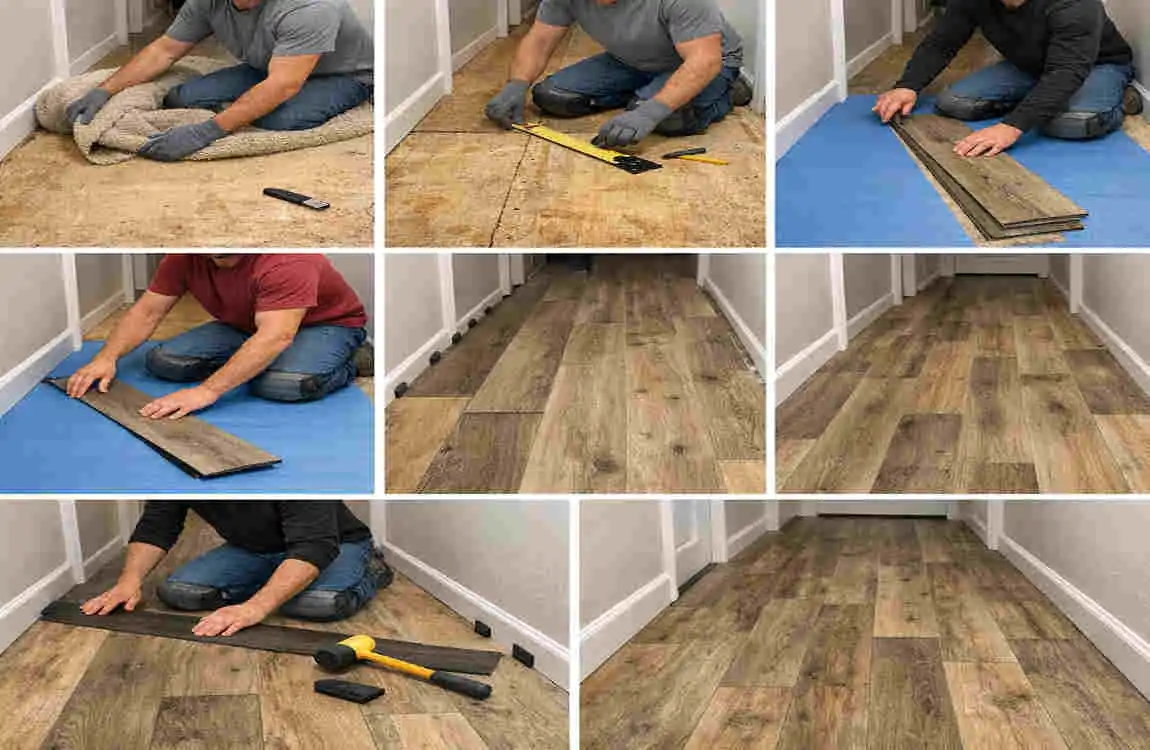
    • Prep: 1/2 Day (Removing carpet, leveling).
    • Install: 1 Day. Hallways are slow because of the doorways. You have to undercut the door casings for a clean look, which takes finesse.

    FAQs: Which Way Should Vinyl Plank Flooring Run in a Hallway?

    Which way should vinyl plank flooring run in a hallway vs. a living room? Ideally, they should run in the same direction. If the living room runs North-South, the hallway should too. If this creates an awkward flow in the hallway (like running widthwise), use a transition strip at the hallway entrance and switch the hallway to run lengthwise.

    Does the direction of vinyl plank flooring affect the warranty? Generally, no. Manufacturers care about installation quality (expansion gaps, flat subfloor), not aesthetic direction. However, always read the manual. Some “drop and lock” floors have maximum run lengths (e.g., 40 feet) before they need a break.

    Best pattern for a narrow hallway? Without a doubt, standard straight lay, running parallel to the long walls (lengthwise). Use the widest plank you can find to reduce the number of visible seams.

    Share. Facebook Twitter Pinterest LinkedIn Tumblr Email
    Stella Victoria

    Related Posts

    What Size Vinyl Plank Flooring is Best for Your House? Top Trends Revealed

    February 21, 2026

    What Is Cabin Grade Hardwood Flooring? Rustic House Upgrade Guide

    February 20, 2026

    How Much Do Polished Floors Cost Per Square Foot Home Upgrade Pricing Guide

    February 13, 2026
    Leave A Reply Cancel Reply

    Top Posts

    Blueface House costs how much?

    May 24, 2024

    Unveiling the Secret of Luke Combs House in Nashville

    June 16, 2024

    Brian Cushing’s Luxe Houston House: Inside the NFL Star’s $5M Retreat

    February 27, 2026
    Stay In Touch
    • Facebook
    • YouTube
    • TikTok
    • WhatsApp
    • Twitter
    • Instagram
    Latest Reviews

    Stay Connected

    Fill the form below and get early updates.

    Most Popular

    Blueface House costs how much?

    May 24, 2024

    Unveiling the Secret of Luke Combs House in Nashville

    June 16, 2024

    Brian Cushing’s Luxe Houston House: Inside the NFL Star’s $5M Retreat

    February 27, 2026
    Latest Posts

    Brian Cushing’s Luxe Houston House: Inside the NFL Star’s $5M Retreat

    February 27, 2026

    Arthur T Demoulas House: Inside the Lowell MA Market Basket Billionaire Estate

    February 27, 2026

    Which Way Should Vinyl Plank Flooring Run in a Hallway? Best House Layout Guide

    February 27, 2026

    Did we make a mistake?

    Submit a correction suggestion and help us fix it!

    Facebook X (Twitter) Instagram Pinterest
    • About us
    • Contact us
    • Privacy Policy
    • Disclaimer
    • Terms And Conditions
    © 2026 ThemeSphere. Designed by ThemeSphere.

    Type above and press Enter to search. Press Esc to cancel.