
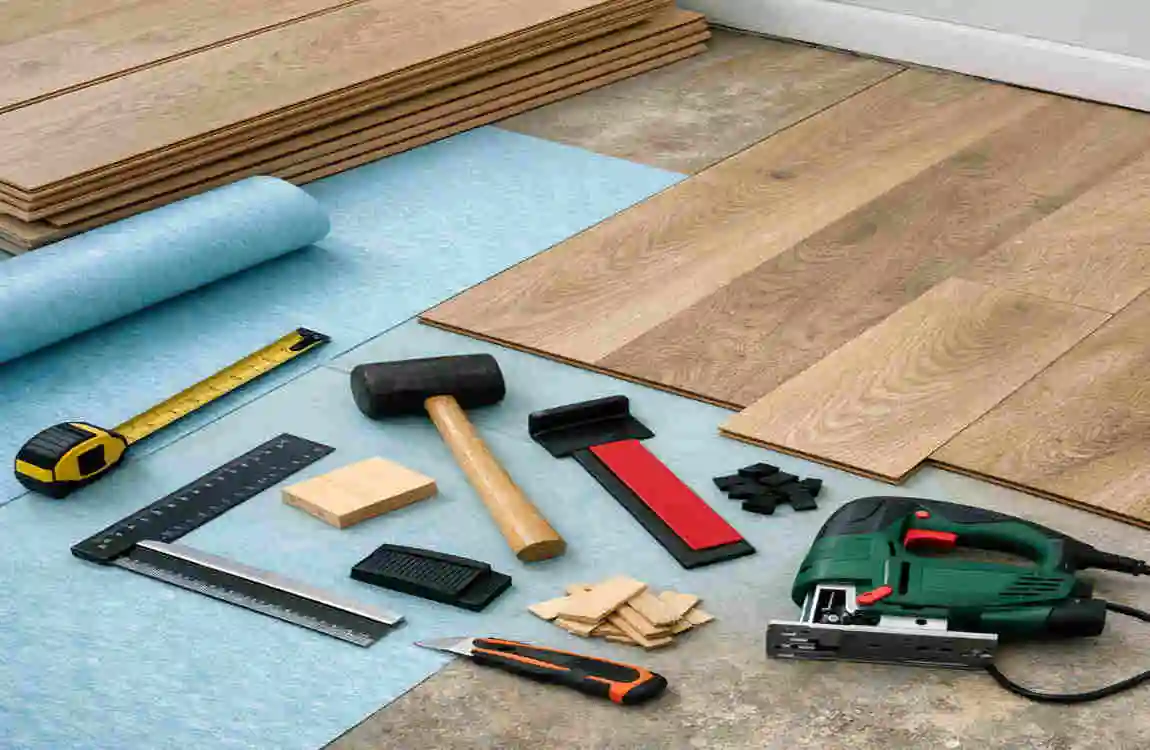
You are standing in the middle of an empty room. The old carpet is ripped up, the subfloor is swept, and stacks of beautiful new laminate boxes are waiting in the corner. You have your coffee, your tools, and a surge of “let’s do this” energy. But then, you freeze. You look at the four walls and realize you have no idea where to start when laying laminate flooring.
If this sounds like you, take a deep breath. You are not alone. This is the single most common question homeowners ask when tackling a flooring renovation. And here is a spoiler: It is probably not the corner you think it is.
Laminate flooring has become the hero of the modern home renovation. It is affordable, durable, and, thanks to new technology in 2026, it looks more like real hardwood than ever before. But a great floor can be ruined by a bad layout. If you start in the wrong spot, you might end up with slivers of tiny planks at the doorway or a floor that looks crooked.
Why Choose Laminate Flooring for Your Reno?

Before we start cutting planks, let’s talk about why you made a great choice. Laminate flooring has come a long way since the shiny, plastic-looking floors of the 1990s. Today, it is a sophisticated product that offers a high-end look without the high-end price tag.
The Pros: Durability Meets Style
The biggest advantage of laminate is its durability. It is constructed with a tough “wear layer” on top that resists scratches, dents, and fading. If you have kids dragging toys across the floor or a dog with untrimmed claws, laminate is significantly more forgiving than real hardwood.
In 2026, we are seeing a massive trend toward water-resistant and waterproof laminate options. This is a game-changer for kitchens and basements. You can now get the warm look of oak or walnut in areas where you previously had to settle for cold tile. Plus, the “click-lock” installation method means you don’t need messy glue or nails. It is a true “floating floor” system.
The Cost Advantage
Let’s be real: renovations are expensive. Hardwood flooring can easily cost $8 to $15 per square foot. Laminate, on the other hand, typically ranges from $2 to $5 per square foot. For a 1,000-square-foot home, that is a difference of thousands of dollars—money you can put toward new furniture or kitchen appliances.
The Cons: What to Watch Out For
It is not all sunshine and roses. Laminate cannot be refinished. Once the top layer is worn through (which takes many years), you have to replace the floor. Also, laminate is picky about the subfloor. If the concrete or plywood beneath is bumpy or uneven, the laminate will creak, and the locks can break. We will cover how to fix this in the prep section.
Tools and Materials You’ll Need
You cannot do a professional job with amateur tools. However, you don’t need to buy out the entire hardware store. Here is the essential checklist for your project.
The Must-Haves
- Laminate Planks: Always buy 10% more than you think you need to account for cutting mistakes and waste.
- Underlayment: This is the foam roll that goes under the floor. It cushions the step and dampens sound.
- Spacers: These little plastic wedges maintain the gap between the floor and the wall.
- Tapping Block and Pull Bar: These are crucial for locking the planks together without damaging the edges.
- Rubber Mallet: For tapping the block.
- Tape Measure and Pencil: Measure twice, cut once!
- Saw: A miter saw is best for cross-cuts, and a jigsaw is needed for cutting around door frames.
Tool and Cost Breakdown
Here is a quick look at what you might spend on supplies. (Note: Prices are estimates based on 2026 averages.
ItemEstimated Cost (PKR)Necessity Level
Laminate Flooring 500 – 1,500 per sq. ft. Essential
Quality Underlayment 100 – 300 per sq. ft. Essential (unless pre-attached)
Installation Kit (Block/Bar) 2,000 – 5,000 Essential
Circular Saw / Jigsaw 10,000 – 25,000 Rent or Buy
Knee Pads 1,500 – 3,000 Highly Recommended
Safety Glasses 500 – 1,000 Essential
Don’t skip the knee pads. After three hours on the floor, your knees will thank you!
Preparing Your Space: The True Starting Point
You might think the answer to where to start when laying laminate flooring involves laying a plank. It doesn’t. It starts with preparation. If you skip this step, your beautiful new floor will fail within a year.
The Clean Out
Clear everything out of the room. You cannot install laminate by shifting furniture from one side to the other. It just doesn’t work. Remove all old carpet, padding, and carpet tack strips. If you are installing over concrete, sweep and vacuum until it is dust-free.
The Subfloor Inspection
This is the most critical step. Get down on the ground with a long level or a straight board. You are looking for dips or humps.
- The Rule: The floor needs to be flat to within 3/16 of an inch over a 10-foot span.
- If you have a hump, sand it down.
- If you have a dip, fill it with a self-leveling compound. If the floor is uneven, your laminate will flex when you walk on it, eventually causing the locking mechanism to snap.
Acclimation is Key
This is especially important in climates with variable humidity, such as Lahore and other parts of Pakistan. Laminate is made of wood byproducts. It expands and contracts with moisture and temperature. You must leave the unopened boxes of laminate in the room where they will be installed for 48 to 72 hours. This allows the material to adjust to the room’s temperature. If you skip this, the planks might shrink and leave gaps, or expand and buckle after installation.
Planning Layout: Direction and Starting Point
Okay, the room is prepped. Now we answer the big question: Where to start when laying laminate flooring?
The Golden Rule: Follow the Light
Ideally, you want the planks to run parallel to the primary light source (usually the biggest window). Why? If light hits the joints between the planks, it creates shadows that make the floor look uneven. Running them with the light makes the floor look smoother, and the room feel larger.
The Starting Wall
You should generally start installation along the longest, straightest wall.
- Why? It is easier to keep a long run straight than it is to start on a short wall and try to maintain that straight line across a massive room.
- The Exception: If you are flooring multiple rooms, snap a chalk line through the center of the main doorway and work outwards to ensure the flow is continuous.
The “Sliver” Calculation
Before you click the first plank, measure the width of the room. Divide that number by the width of a single plank.
- Example: The room is 120 inches wide. Your plank is 5 inches wide. 120 / 5 = 24. Perfect! You will have 24 full rows.
- The Problem: What if the room is 122 inches wide? 122 / 5 = 24.4. This means your last row will be a tiny 0.4-inch sliver. That looks terrible and won’t stay locked in.
- The Fix: Cut the first row of planks narrower. If you cut the first row to 3 inches, the last row will also be roughly 3 inches. This creates a balanced, professional look.
Step-by-Step Installation Guide
Now that we have planned our layout, let’s get to work.
Install the Underlayment
Roll out your foam underlayment. Do not overlap the foam itself, as this creates a hump. Butt the edges together and tape them with seam tape. If you are installing over concrete, make sure your underlayment includes a vapor barrier to prevent moisture from rising and warping the planks.
The First Row (The Foundation)
Start in the left corner of your starting wall (since most planks click left-to-right).
- Place Spacers: Put plastic spacers between the wall and the plank. You need a gap of 1/4 to 3/8 inch. This “expansion gap” allows the floor to move. Without it, the floor will buckle in the summer.
- Face the Groove: Place the plank with the “tongue” side facing the wall and the “groove” side facing the room.
- Connect the Row: Lock the short ends of the planks together. Continue until you reach the end of the wall.
- Cut the Last Piece: Measure the distance to the wall (don’t forget to subtract the spacer gap!). Cut the plank and click it in.
Starting the Second Row
Here is a pro tip: Use the piece you cut off from the end of the first row to start the second row.
- The Stagger Rule: You want the seams (joints) to be staggered like bricks. Ensure the joints are at least 12 inches apart from the row before. If the cut-off piece is shorter than 12 inches, cut a fresh plank in half and start with that.
- The Click: Insert the long tongue of the new plank into the groove of the first row at a slight angle (usually 45 degrees). Push down until it clicks. Use your tapping block and mallet to tap it tightly and gently.
The Rhythm of Installation
Now, you repeat the process.
- Insert the long side.
- Slide it close to the previous plank’s short side.
- Drop it down.
- Tap the long side tight.
- Tap the short side tight.
- Repeat.
As you move across the room, periodically check your work. Stand on the installed planks and look back. Is the line straight? Are there any gaps? It is much easier to fix a gap now than when the whole floor is down.
Handling Obstacles
Eventually, you will hit a door frame or a weird corner.
- Door Jambs: Do not try to cut the laminate to the shape of the door frame. It looks messy. Instead, use a handsaw to undercut the wooden door frame. Then, slide the laminate under the frame for a seamless look.
- Pipes: If you have a radiator pipe, drill a hole in the plank that is 1/2 inch larger than the pipe. Cut a wedge from the plank, fit it around the pipe, and glue it back in. Cover the hole with a pipe rosette.
The Final Row
You are almost there! The last row is usually tricky because you don’t have room to swing a hammer.
- Measure: Measure the width needed (remember the expansion gap!).
- Rip Cut: Cut the planks lengthwise (this is called “ripping”).
- Install: Drop the plank in. You won’t be able to use a tapping block. Instead, use the pull bar. Hook it over the edge of the plank near the wall and hammer the bar to pull the plank into place.
Finishing Touches
Remove all the spacers. Now you have an ugly gap around the room. Cover this gap by installing baseboards (skirting boards) or quarter-round molding. Nail the trim into the wall, not the floor. The floor needs to slide freely under the trim.
Install transition strips (T-moldings) where the laminate meets tile or carpet.
Handling Challenges: Obstacles and Fixes
Even the best-laid plans go wrong. Here are common issues and how to solve them.
“My Floor is Bouncy”
If you walk on a section and it feels like a trampoline, your subfloor wasn’t flat.
- The Fix: If it is bad, you might need to pull up that section and add more leveling compound. If it is minor, it might settle over time, but don’t count on it.
“I Can’t Get the Last Piece In”
If the final piece is fighting you, check for debris in the groove. Even a tiny piece of sawdust can stop the lock from engaging. Vacuum the groove and try again.
Humidity and Warping
In high-humidity areas, laminate can swell. If you notice the floor “peaking” (lifting at the joints) a few months later, it means it has expanded and hit the wall.
- The Fix: Remove the baseboard and check your expansion gap. If the wood is touching the wall, trim a 1/4 inch off the edge of the flooring to give it room to breathe again.
Cost Breakdown and Budget Tips
Understanding the full cost helps you avoid surprises.
- Materials (60%): This is your planks and underlayment.
- Tools (10%): Buying or renting saws and kits.
- Waste (10%): The extra material you bought for cuts.
- Trim and Transitions (20%): Baseboards and T-moldings are surprisingly expensive. Do not forget to budget for them!
Savings Tip: Check online marketplaces for leftover laminate boxes. Sometimes people sell 2-3 boxes cheaply, which is perfect if you need a little extra for a closet or repairs. Also, buying your underlayment separately is often cheaper than buying planks with “pre-attached” padding.
Maintenance and Longevity Secrets
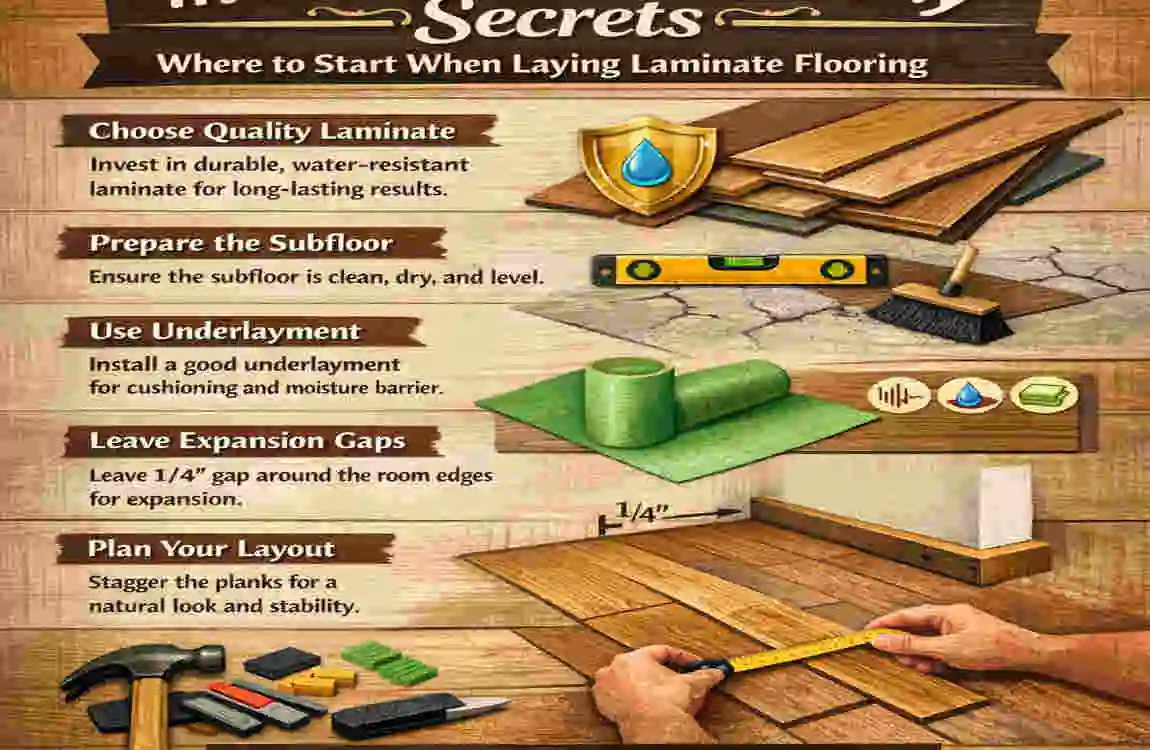
Congratulations! You have a new floor. Keep it looking new with these rules:
- No Wet Mops: Water is the enemy. Never pour water on laminate. Use a damp microfiber cloth or a spray mop designed for laminate.
- No Steam Mops: The heat and moisture can force their way into the joints and cause swelling.
- Sweep Daily: Dirt acts like sandpaper. Regular sweeping prevents micro-scratches.
- Felt Pads: Put felt pads on the bottom of all chairs and tables.
Frequently Asked Questions (FAQ)
Where to start when laying laminate flooring in a room with many doors? Always start at the longest uninterrupted wall that is opposite the doors, if possible. However, if the doors are on the longest wall, start there. It is easier to cut around complex doorways at the beginning of the row than at the end when you are fighting for space.
Which direction should I lay my laminate flooring? Run the planks in the direction of the main light source (like a big window) or down the length of the longest hallway. This makes the room look longer and hides seams.
Can I install laminate over tile? Yes, as long as the tile is flat, level, and firmly attached. You don’t need to rip out the old tile. Just lay a good underlayment on top to smooth out the grout lines.
Does installing it myself void the warranty? Usually, no. However, failing to follow the manufacturer’s instructions will void it. The most common warranty killers are: failing to leave an expansion gap, installing on a wet subfloor, or using a steam mop.
How much does it cost to install 1,000 sq ft of laminate? In terms of materials, expect to spend between PKR 500,000 and PKR 1,000,000, depending on the quality of the laminate and current market rates. Labor would be extra, which is why DIY is such a great way to save.
