
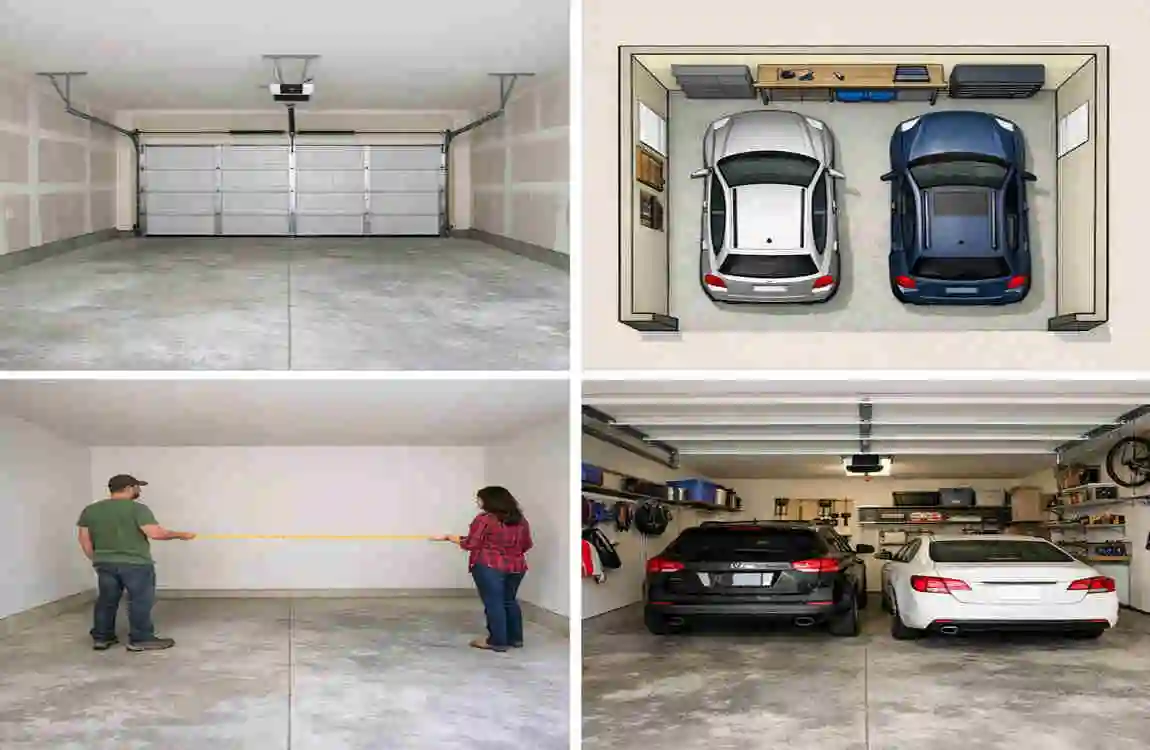
Have you ever pulled into a garage, parked your car, and then realized you have to perform a gymnast-level contortion to squeeze out of the driver’s side door? Or maybe you have walked into a garage that felt cavernous, with ample room for cars, a workbench, and the kids’ bikes, and thought, “Now, this is luxury.”
The difference between those two scenarios comes down to a few feet of concrete and some smart planning. Homeowners and home builders often ask the golden question: how many square feet are in a two-car garage? It sounds like a simple math problem, but the answer unlocks the secret to efficient home design and daily comfort.
Standard Sizes Explained
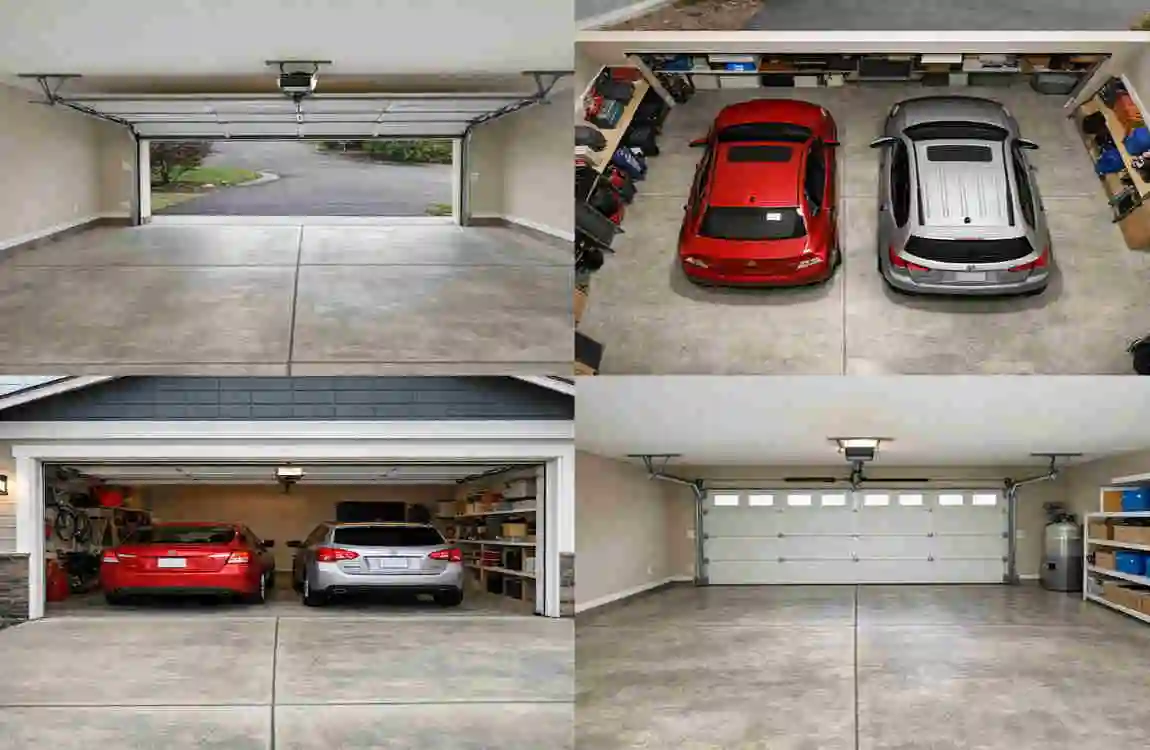
When you look at blueprints or talk to a contractor, you are going to hear a lot of numbers thrown around. But what do they actually mean in terms of livability? To answer how many square feet are in a two-car garage, we first need to look at industry standards.
The Minimum: The 20×20 Reality
Technically, the minimum standard for a two-car garage is often cited as 20 feet by 20 feet. That gives you exactly 400 square feet of space. On paper, this works. An average sedan is about 6 feet wide and 15 to 16 feet long. Two of them, side by side, take up 12 feet of width. That leaves you with 8 feet of “wiggle room” spread across the sides and the middle.
However, let’s be real for a second. If you park two cars in a 20×20 garage, you are left with very little room for error. You won’t have space for a lawnmower, shelving units, or even a trash can without risking a scratch on your bumper. This size is typical in high-density urban housing or older homes built when cars were smaller (and narrower).
The Sweet Spot: The 24×24 Upgrade
If you want comfort, you should aim higher. Most modern builders and architects recommend a 24-foot-by-24-foot layout. This yields 576 square feet.
Why is this better? Those extra 4 feet in width let you fully open car doors on both sides. The extra four feet in depth means you can walk around the back of your car with the garage door closed without brushing against the bumper. It also opens up the possibility of having a workbench or a row of deep storage shelves along the back wall.
Regional Variations
It is also worth noting that “standard” varies by where you live.
- Suburbs: In suburban developments where land is cheaper, you will often find garages pushing past 500 square feet as a baseline.
- Urban Areas: In tight city lots, builders fight for every inch, often sticking to the 350-400 square foot range.
Here is a quick breakdown of how dimensions translate to usability:
Garage TypeDimensionsTotal Sq FtLivability Score
Minimum / Compact 20 ft x 20 ft 400 sq ft Tight squeeze. Parking only.
Standard / Comfort 22 ft x 22 ft 484 sq ft Good for two sedans and some tools.
Spacious / Ideal 24 ft x 24 ft 576 sq ft Comfortable entry/exit + storage.
Oversized 24 ft x 30 ft 720 sq ft Luxury. Fits trucks + workshop.
Factors Influencing Two-Car Garage Size
So, you know the numbers. But how do you decide which number is right for your life? Determining how many square feet are in a two-car garage for your specific needs depends on a few critical factors. You can’t just pick a number out of a hat; you have to plan for what you drive and how you live.
Vehicle Size Matters
The most obvious factor is what you drive. If you drive a Mini Cooper and your partner drives a Fiat, a 20×20 garage will feel like a palace. But if you are a two-truck family or drive a large SUV like a Suburban or an Expedition, the math changes drastically.
A full-size pickup truck can be nearly 20 feet long. If you build a 20-foot deep garage, your truck literally won’t fit once you account for the thickness of the garage door and the wall framing. You need at least 24 feet of depth for large vehicles to ensure the garage door can close safely behind them.
Door Height and Ceiling Clearance
Don’t just think about the floor; think about the air. Standard garage doors are 7 feet high. However, if you drive a lifted Jeep or a truck with a roof rack, a 7-foot door might be a disaster waiting to happen. Moving to an 8-foot door height usually requires taller ceilings (9 or 10 feet).
Higher ceilings also give you vertical storage options. Overhead racks are a game-changer for storing seasonal items like Christmas trees, kayaks, or camping gear. If you plan on installing a car lift for working on vehicles, you will need a ceiling height of at least 10 to 12 feet.
The “Stuff” Factor
Garages are rarely just for cars. They are the attic’s messy cousin. When planning, ask yourself what else needs to live in this room:
- Workbench: Do you need a 2-foot deep bench along the wall?
- Appliances: Will you have a second fridge or a deep freezer out here?
- Utility: Is your water heater or furnace located in the garage? These require code-mandated clearance space.
- Flooring: Are you doing epoxy? It doesn’t change the size, but it makes the space feel more finished and valuable.
Layout and Design Options
Once you have a rough square footage in mind, you have to decide how to arrange it. The shape of your garage is just as important as the size.
Side-by-Side Configuration
This is the classic American garage—two doors (or one large double door) facing the driveway.
- Dimensions: Typically 22×22 feet or larger.
- Pros: This is the most convenient setup. You can pull either car out without moving the other. It feels wide and welcoming.
- Cons: It requires a wider lot. If your property is narrow, a side-by-side garage might dominate the front façade of your house, reducing curb appeal.
Tandem Configuration
In a tandem garage, cars park nose-to-tail, like elephants in a circus line.
- Dimensions: Typically 20 feet wide by 40 feet deep (800 sq ft).
- Pros: This is amazing for narrow city lots. It also appears to be a one-car garage from the street, which can be more aesthetically pleasing.
- Cons: The “car shuffle.” If the person parked in the back needs to leave early, the person in the front has to move their car. This layout is best if the back spot is used for a “weekend car” or long-term storage rather than a daily driver.
Attached vs. Detached
Attached Garages connect directly to your home, usually through a mudroom or kitchen.
- Efficiency: They save money on construction because they share a wall with the house. You save about 50 square feet of construction materials and insulation.
- Comfort: You don’t have to walk in the rain to get to your car.
Detached Garages stand alone in the yard.
- Flexibility: You can build them bigger without worrying about them looking out of proportion to the house.
- Health: They keep exhaust fumes, sawdust, and noise away from your living areas.
- Space: While they require more land, they offer the opportunity for a “breezeway” connecting to the house, which can be a beautiful architectural feature.
Layout StyleBest For…Major ProMajor ConIdeal Sq Ft
Side-by-Side Daily Drivers Easy access Wide footprint 450 – 550
Tandem Hobbyists / Narrow Lots Hidden volume The “Car Shuffle” 600 – 800
Calculating Your Perfect Size
Okay, let’s do the math. You want to answer how many square feet are in a two-car garage that fits your life. Here is a simple formula you can use.
The Planning Formula
- Measure Your Cars: Get a tape measure. Length and width (including mirrors).
- Example: Car A is 16 ft long, 6 ft wide. Car B is 17 ft long, 6.5 ft wide.
- Add Buffer Zones:
- Between Cars: You need at least 30 inches (2.5 feet) between cars to open doors comfortably.
- Side Walls: You need at least 2.5 feet between the car and the wall.
- Front/Back: You need at least 2.5 feet in front of the car and 2.5 feet behind it.
- Add Storage:
- Do you want cabinets? Add 2 feet to the depth or width.
- Workbench? Add 2.5 feet.
Step-by-Step Calculation Example
Let’s design a garage for two SUVs (approx. 7 ft wide x 17 ft long).
- Width Needed: 2.5 ft (left wall buffer) + 7 ft (SUV 1) + 3 ft (middle buffer) + 7 ft (SUV 2) + 2.5 ft (right wall buffer) = 22 Feet Wide.
- Depth Needed: 2.5 ft (front buffer) + 17 ft (SUV length) + 2.5 ft (rear buffer) + 2 ft (cabinets) = 24 Feet Deep.
- Total: 22 ft x 24 ft = 528 Square Feet.
See? It is much easier when you break it down. There are plenty of free online garage size calculators, but nothing beats walking out to your driveway with a tape measure and some chalk to visualize the space.
Cost Breakdown by Square Footage
The big question: How much is this going to cost? The answer depends heavily on materials, your location, and how fancy you want to get.
Cost Per Square Foot
In 2026, the average cost to build a garage ranges from $50 to $150 per square foot for a basic, unfinished structure. If you want insulation, drywall, electrical, and windows, you are looking at $150 to $200+ per square foot.
Total Project Estimates
- The 400 Sq Ft Basic: A standard 20×20 detached garage might cost between $20,000 and $60,000. This gets you a concrete slab, stick framing, vinyl siding, and a shingle roof.
- The 600 Sq Ft Upgrade: A nicer, 24×25 garage with electrical and insulation can run anywhere from $30,000 to $90,000.
Ways to Save
If these numbers scare you, there are alternatives.
- Pole Barn Construction: Instead of a traditional foundation, you use posts set in the ground. This is cheaper and faster, and is often used for detached workshops.
- Prefab Kits: You can buy metal or wood garage kits that are delivered to your site. You pay for the assembly (or DIY if you are brave).
Size Category, Estimated Build Cost, Potential ROI (Value Add), Monthly Storage Value
400 sq ft $20,000 – $50,000 Moderate $100 – $150
600 sq ft $40,000 – $80,000 High $200 – $300
Permits, Codes, and Regulations
Before you pour a single drop of concrete, you have to deal with the paperwork. Building codes dictate how many square feet are in a two-car garage just as much as your personal preference does.
The Minimums
Most US municipal building codes require a minimum of roughly 200 square feet per vehicle parking space, but they don’t usually dictate a maximum size unless you hit lot coverage limits.
Setbacks and Easements
You cannot build right up to your property line. “Setbacks” are the mandatory distances you must keep from your neighbor’s fence, the street, and wetlands. Usually, this is 5 to 10 feet on the sides and 20+ feet from the street.
HOA Restrictions
If you live in a Homeowners Association (HOA), read your bylaws. They are notorious for limiting garage sizes. They might cap you at 600 square feet or limit the roof height to ensure it doesn’t tower over the main house.
Green Mandates
In many states, new regulations require garages to be “solar-ready” (roofs reinforced for panels) and “EV-ready” (pre-wired with 240-volt outlets). While this adds a small upfront cost, it saves thousands in retrofitting later.
Multi-Use Transformations
The days of the garage just being a place to park the car are over. We are seeing a massive shift toward multi-functional spaces. When deciding how many square feet a two-car garage should have, consider potential future uses.
The Home Gym
A standard treadmill takes up about 15 square feet, but you need clearance. A full squat rack and weight bench setup can easily consume 100 square feet. If you want a gym and parking for two cars, you absolutely need to bump up to the 600-square-foot range.
The Workshop / Hobby Room
Whether you are into woodworking, pottery, or restoring vintage motorcycles, you need a dedicated space. Dust control is key here. If you plan to use your garage as a shop, consider adding a partition wall to separate the “dirty” work area from the clean car area.
The ADU Potential
Accessory Dwelling Units (ADUs) are hot right now. Many homeowners are building oversized garages with the intention of later converting part of them into a studio apartment or mother-in-law suite. Even if you don’t build the apartment now, plumbing the slab for a future bathroom is a smart investment.
The Loft
Don’t forget the space above! Adding a loft or a finished room above the garage (often called a FROG) is a fantastic way to gain square footage without expanding the building’s footprint. This requires a steeper roof pitch and stronger foundation walls, but it adds immense value.
Planning Tips for New Builds
If you are starting from scratch, you have the luxury of getting it right the first time. Here is a checklist to ensure your garage is perfect.
Orientation
Think about the sun. If you live in a hot climate, try to face the garage doors North or East to avoid the baking afternoon sun heating your cars (and the interior of your house).
Floor Slope and Drainage
A garage floor must slope toward the big doors to let water (from rain or melting snow) run out. The standard is usually 1/8 inch per foot. Make sure your contractor gets this right, or you will have puddles forever.
Lighting and Electrical
Plan your outlets now. You want an outlet on every wall, plus dedicated circuits for freezers or power tools. For lighting, ditch the single central bulb. Go for LED strip lights that run the length of the parking bays so you aren’t casting a shadow on your own engine when you pop the hood.
Soil Testing
Before you build, get a soil test. If your ground is soft or sandy, you might need a thicker slab or deeper footings to prevent the floor from cracking under the weight of two heavy vehicles.
Common Mistakes to Avoid
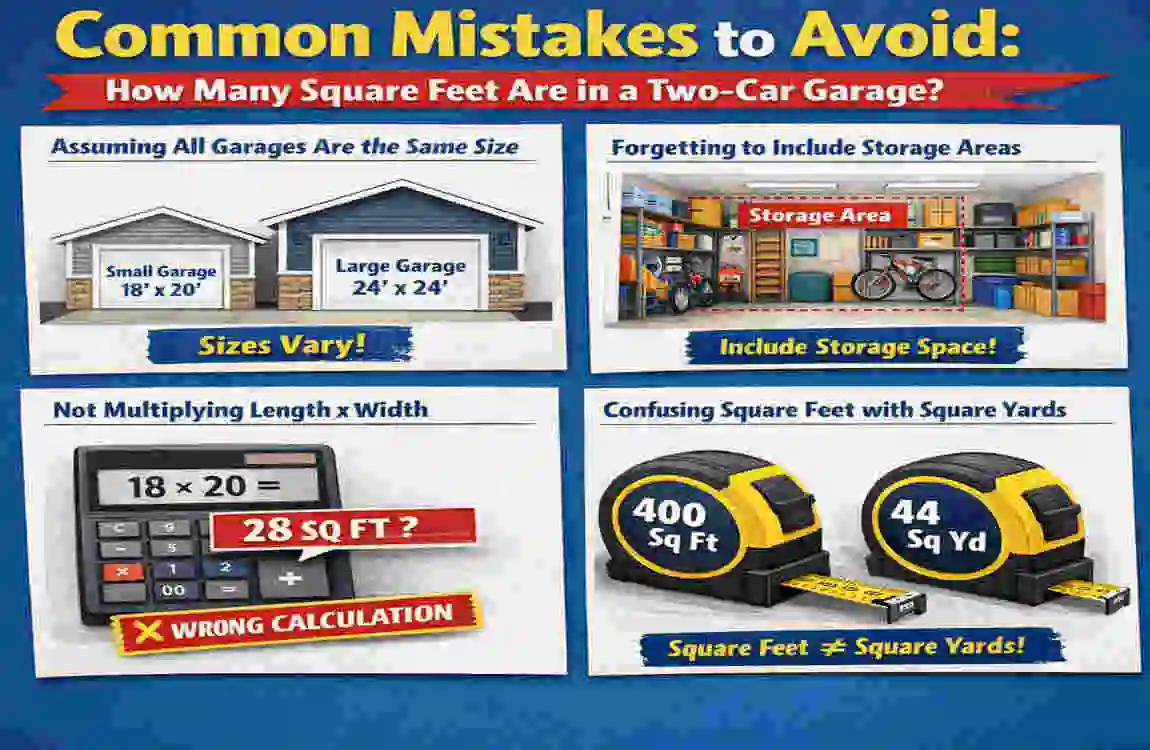
We have seen it all. Here are the pitfalls that make homeowners regret their garage build.
- Undersizing the Doors: Installing two narrow 8-foot wide doors instead of one large 16-foot or 18-foot door. With narrow doors, you have to be precise every time you park. One slip-up, and you lose a side mirror.
- Ignoring Insulation: Even if you don’t heat the garage, insulation helps regulate temperature. An uninsulated garage makes the room above it cold in winter and hot in summer.
- Forgetting the Man-Door: Always include a standard pedestrian door on the side of the garage. You don’t want to have to open the massive garage door every time you want to grab the rake or take out the trash.
- Low Headers: If you frame the door opening too low, you limit your future vehicle choices. Stick to 8-foot headers if possible.
FAQs
How many square feet are in a typical two-car garage? The most common range is between 400 square feet (20×20) and 576 square feet (24×24). However, for modern comfort, 480+ square feet is recommended.
Can I build a garage smaller than 400 square feet? Technically, yes, you could build a tandem garage that is 12 feet wide and 30 feet deep (360 sq ft), but it would be very tight and likely wouldn’t meet resale expectations for a “two-car” garage.
Is an oversized garage worth the money? Almost always. The cost to add 2 feet of depth during construction is relatively low compared to the value of the additional storage space. It is much cheaper to build it big now than to add a shed later.
How wide should the garage door be for two cars? A single double-width door should be at least 16 feet wide, though 18 feet is luxurious. If using two separate doors, they should be at least 9 feet wide each.
