
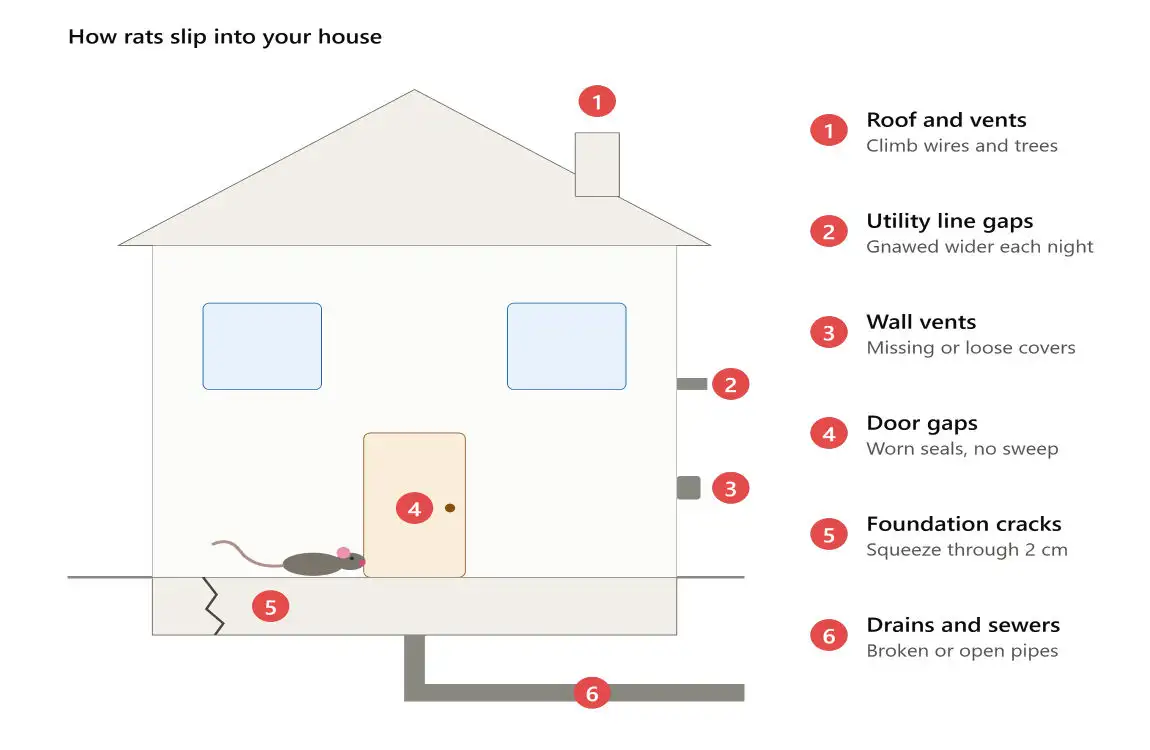
You hear a faint scratching in the wall at 2 a.m. Maybe you find a gnawed corner on a bag of pet food. Either way, the same question pops up: how do rats get in the house when every door and window is shut?
The honest answer is a little unsettling. Rats don’t need an invitation, a broken window, or a big hole. They need a gap you would probably walk past a hundred times without noticing.
How Small a Gap Can a Rat Use?
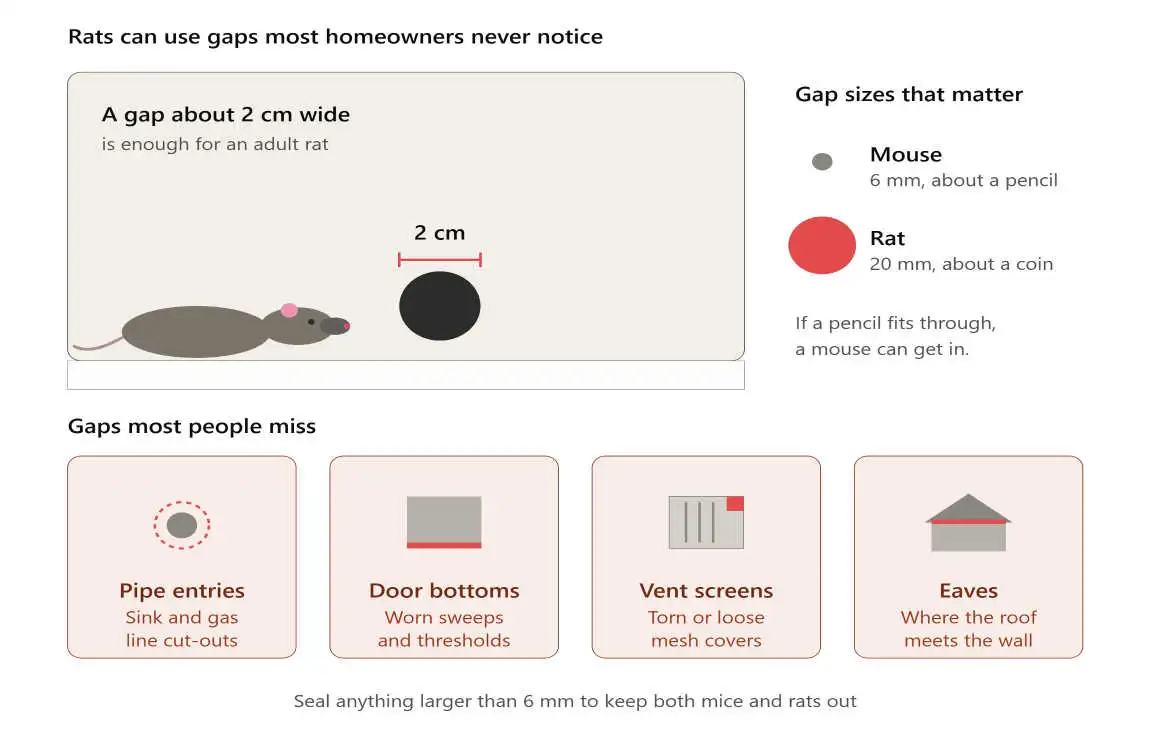
Smaller than you think. The National Pest Management Association (NPMA) says mice can get through openings as small as a dime, and rats through quarter-sized holes. University of California home design extension advisors go even tighter, noting that a hole as small as a half inch across can be an entry point.
The CDC adds a handy rule of thumb for your inspection: mice can fit through a hole the width of a pencil (about ¼ inch). If a pencil fits, treat it as a problem. Rats can also gnaw at a gap to widen it, so a “too small” opening often doesn’t stay that way.
Why Rat Season Is Right Now
If you’ve noticed more rodent activity lately, you’re not imagining it. As temperatures drop, rats look for warmth, food and shelter, and your house offers all three. According to the NPMA, rodents invade an estimated 21 million U.S. homes each winter.
Clean homes aren’t exempt either. NPMA’s entomologist has pointed out that rodents don’t care about the state of your home; if there’s food and shelter, they’ll try to move in.
The Most Common Ways Rats Get Into a House
Gaps Around Pipes and Utility Lines
This is the number one culprit. Wherever a gas, water, electrical, cable or AC line passes through an exterior wall, builders often leave a small gap. The CDC specifically lists holes around electrical, plumbing, cable and gas lines as places to check. Walk your exterior slowly and look at every spot where something enters the wall.
Vents, Louvers and Chimney Openings
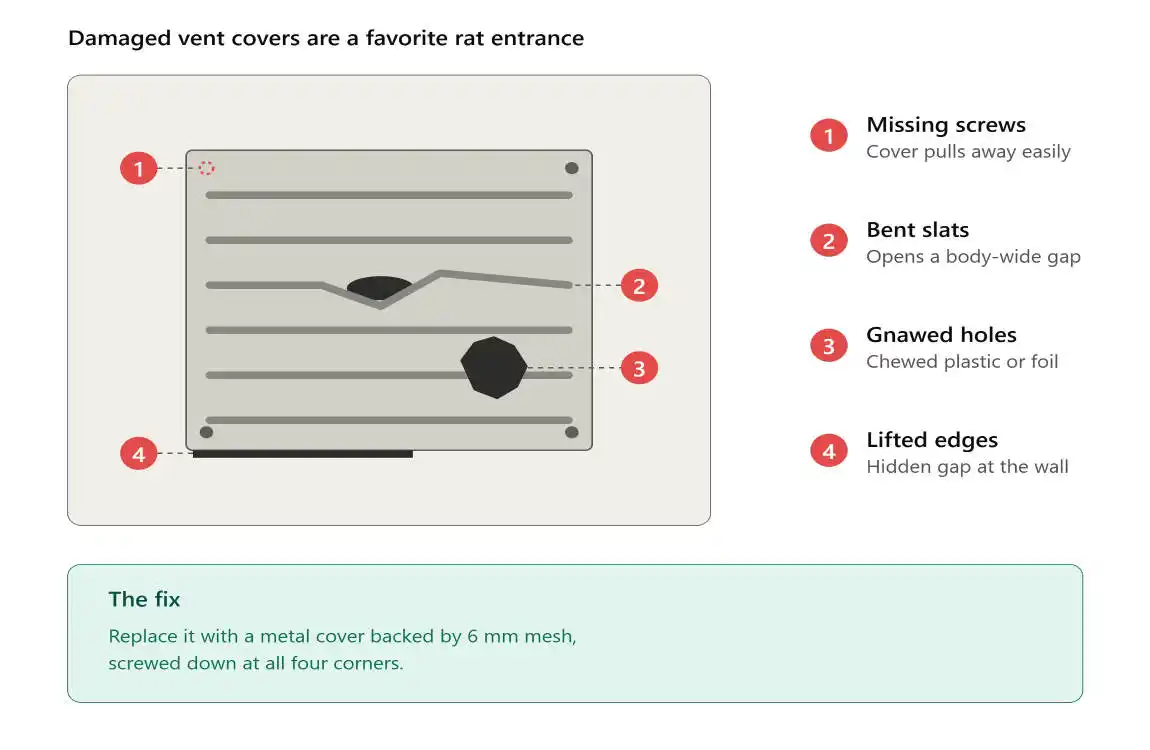
Rats love an uncovered vent. University of California extension guidance lists air conditioner and dryer vents, attic louvers, vent pipes, crawl space vents and chimney openings as typical entry points. The CDC likewise flags attic and crawl space vents. A missing or torn screen is basically an open door.
Cracks Where the Foundation Meets the Ground
Norway rats are burrowers. UC Integrated Pest Management (UC IPM) notes they build burrows along building foundations, beneath rubbish, or in woodpiles. From there, a small crack in the foundation or a gap between the house foundation and soil is all they need. The CDC recommends checking the area between the foundation of the home and the ground.
Doors, Garages and Window Gaps
Worn door sweeps, warped thresholds and loose garage door seals leave a thin strip of light at the bottom, and that is plenty for a rat. Check the garage first. It is the most common “side entrance” because it is rarely sealed as well as the main house.
Rooflines, Gutters and Overhanging Trees
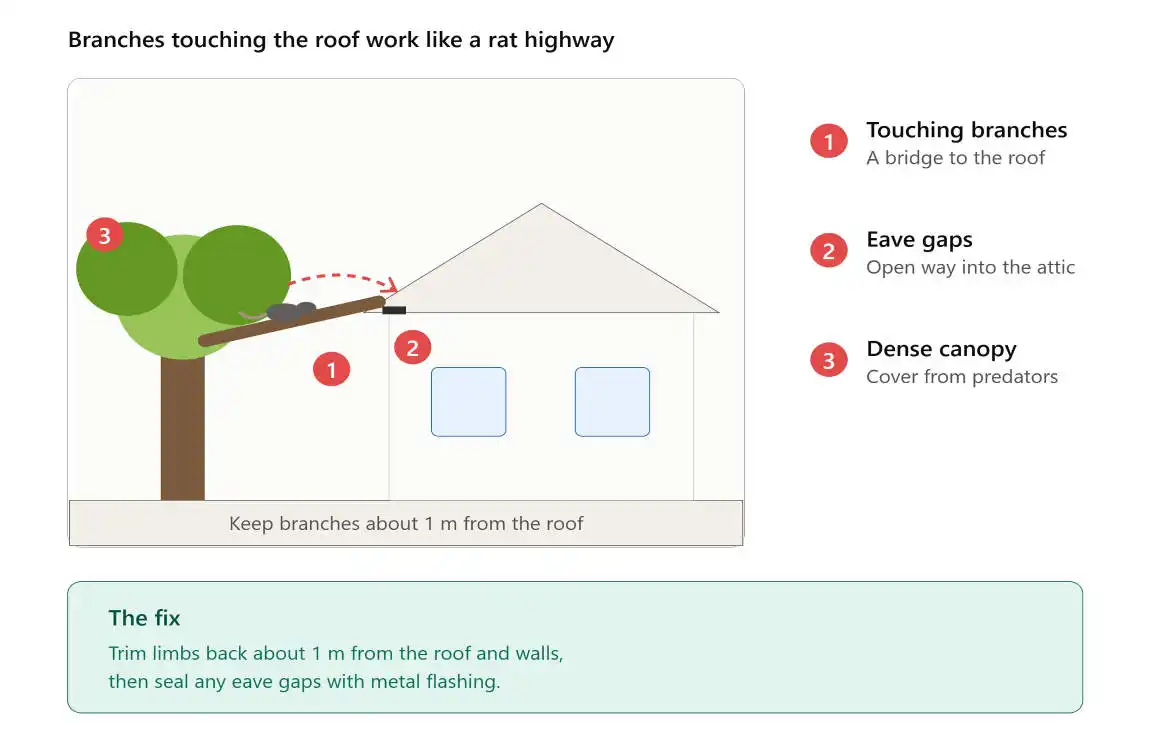
Not every rat comes in at ground level. Roof rats are agile climbers that typically nest in enclosed and elevated spaces such as attics, wall voids and ceiling voids. Branches touching the roof damaged soffits and loose roof overlaps give them a bridge to the attic.
Drains, Toilets and Sewer Lines
This one sounds like an urban legend, but it’s real. UC IPM explains that both rat species can gain entry by gnawing, climbing, jumping, or swimming through sewers and entering through toilets or broken drains. Broken or uncapped drain lines are worth a plumber’s inspection if you keep finding rats with no visible entry point.
Norway Rat or Roof Rat? It Changes Where You Look
The species in your area tells you where to focus. UC IPM says Norway rats favor basements, woodpiles and the ground floor of buildings, while roof rats prefer attics, walls and upper levels. So if you hear noises overhead, think roofline and vents. If you find droppings in the basement or garage, start with the foundation and ground-level gaps.
Signs Rats Are Already Inside
- Droppings in garages, storage areas, attics or near pet food containers (UC IPM).
- Gnaw marks. Rats leave much larger tooth marks than mice do.
- Scratching or scurrying noises in walls or ceilings, especially at night.
- Nests made of shredded paper, cloth or other soft material behind boxes or in stored items.
- Gnawed food packaging and chewed wires or insulation.
How to Keep Rats Out: A Practical Checklist
- Inspect inside and out. Use a flashlight. Check under sinks, behind the stove and fridge, inside closets, and around every pipe that goes through a wall.
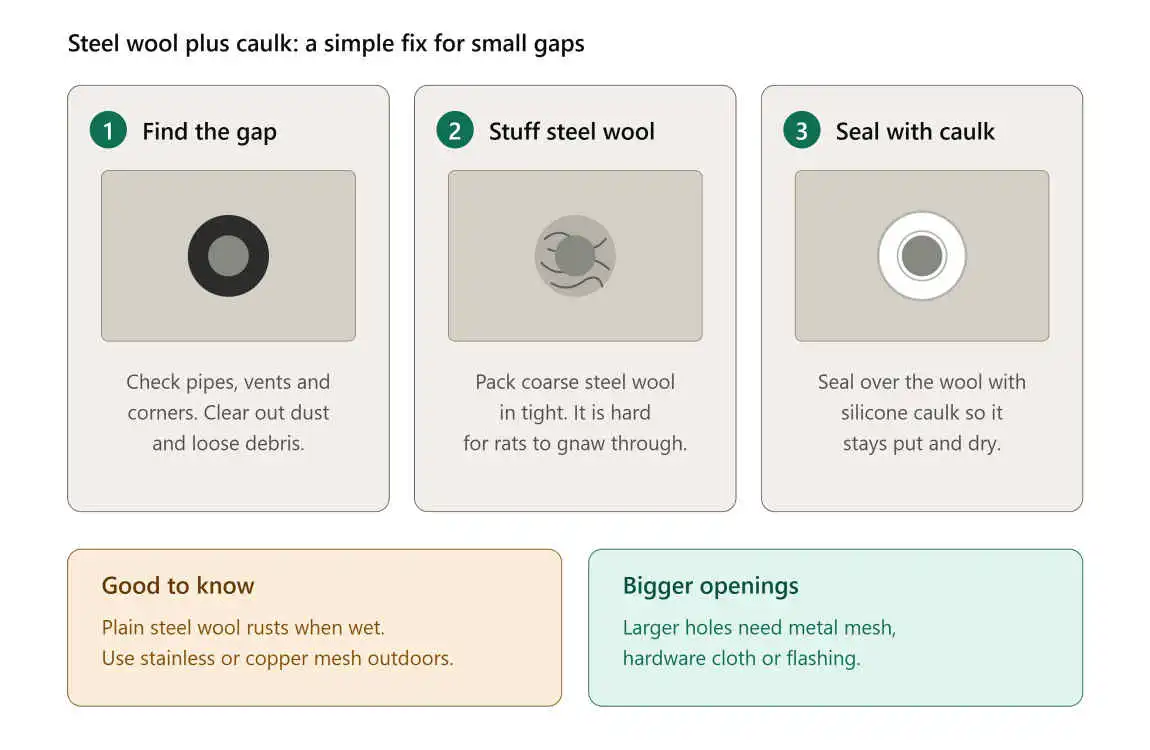
- Seal with the right materials. The CDC advises you fill small holes with steel wool, then caulk around it to hold it in place, or use spray foam. Rats can chew through plain foam and plastic alone, so use metal in the mix. For bigger gaps, use hardware cloth or sheet metal.
- Screen and cap everything. Vents, chimneys and crawl space openings need sturdy, rodent-proof covers.
- Remove the reward. Store food and garbage in thick plastic or metal containers with tight lids, and keep outdoor food sources, including pet food and bird seed, away from the house.
- Trim back vegetation and keep branches away from the roof.
- Seal before you bait. UC IPM recommends you minimize entry points before baiting outside so poisoned rats don’t come inside to die. UC IPM also calls snap traps the safest, most effective and economical way to trap cleaning rats, and warns that all rodent baits are toxic to pets.
When to Call a Professional
If you’re hearing activity in walls, finding fresh droppings daily, or can’t locate the entry point, bring in a licensed pest control professional. Rodents reproduce quickly, and the NPMA warns that a small problem can become a big issue quickly if left untreated. Rodents can also carry disease: the NPMA notes rats and mice can spread more than 35 diseases, so wear gloves and follow CDC cleanup guidance rather than sweeping up droppings dry.
Frequently Asked Questions
How do rats get in the house at night?
Rats are mostly active at night, so you’ll often notice them then, but they use the same entry points day or night: gaps around pipes, vents, foundation cracks, rooflines and damaged drains.
Can rats get in through a toilet?
It’s rare, but yes. UC IPM confirms rats can swim through sewers and enter through toilets or broken drains.
Can rats chew through walls?
They can gnaw through many common materials and will enlarge existing gaps. That’s why the CDC recommends metal materials like steel wool or hardware cloth rather than plastic or foam alone.
Do rats come in more during winter?
Yes. Rodents head indoors for warmth and food as it gets cold, and the NPMA estimates millions of homes are invaded every winter.
How can I tell if the hole is a rat hole?
Look for smooth, greasy rub marks around the edge, gnaw marks, and nearby droppings. A hole larger than a quarter, or a burrow beside the foundation, is a strong sign.
The Bottom Line
Rats get into houses through the small, boring gaps nobody thinks about: utility lines, vents, foundation cracks, rooflines and damaged drains. The good news is that nearly all of them can be fixed with a flashlight, a tube of caulk and a roll of steel wool. Spend one weekend inspecting and sealing now, before the cold really sets in, and you’ll save yourself a much bigger headache later.
