
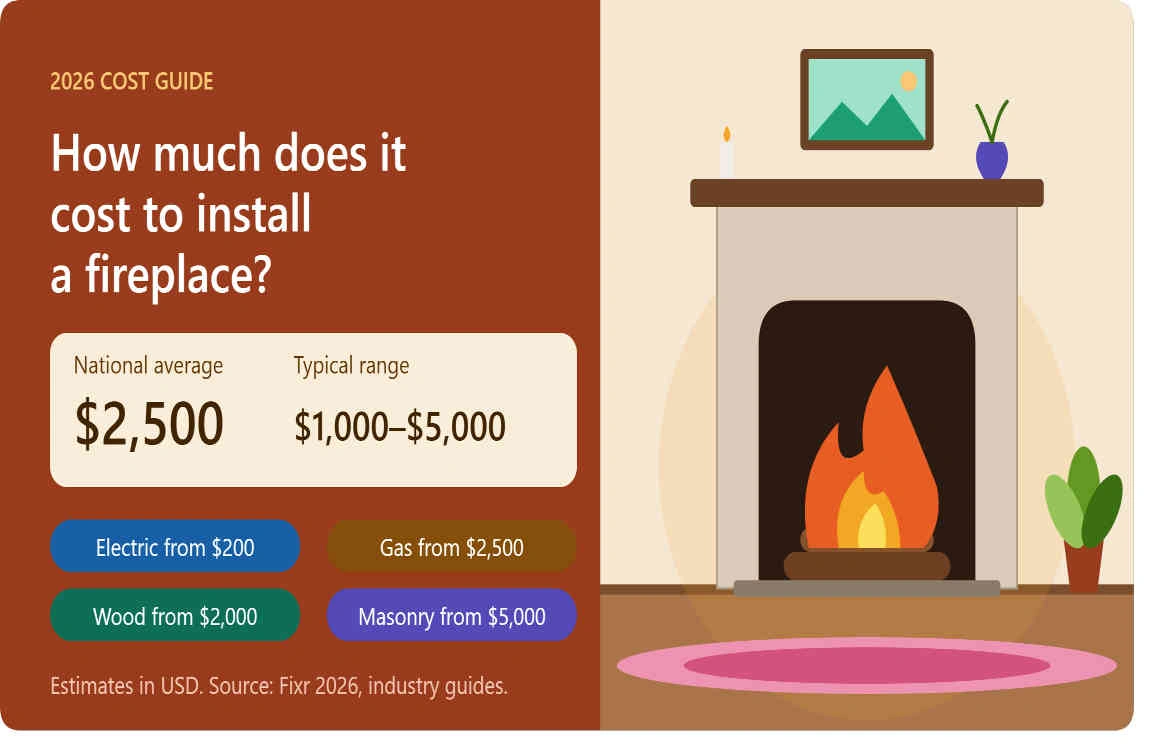
There’s a reason fireplaces keep showing up on home wish lists. They make a room feel finished, they give you somewhere to gather in winter, and buyers tend to notice them. But before you start browsing mantels, you probably want one answer first: how much to put a fireplace in a house.
Most homeowners spend somewhere between $1,000 and $5,000, with a national average of around $2,500, according to Fixr’s 2026 cost data. The long version is that the real number depends heavily on what kind of fireplace you choose, whether you already have a chimney, and how much work your home needs. Let’s break it down properly.
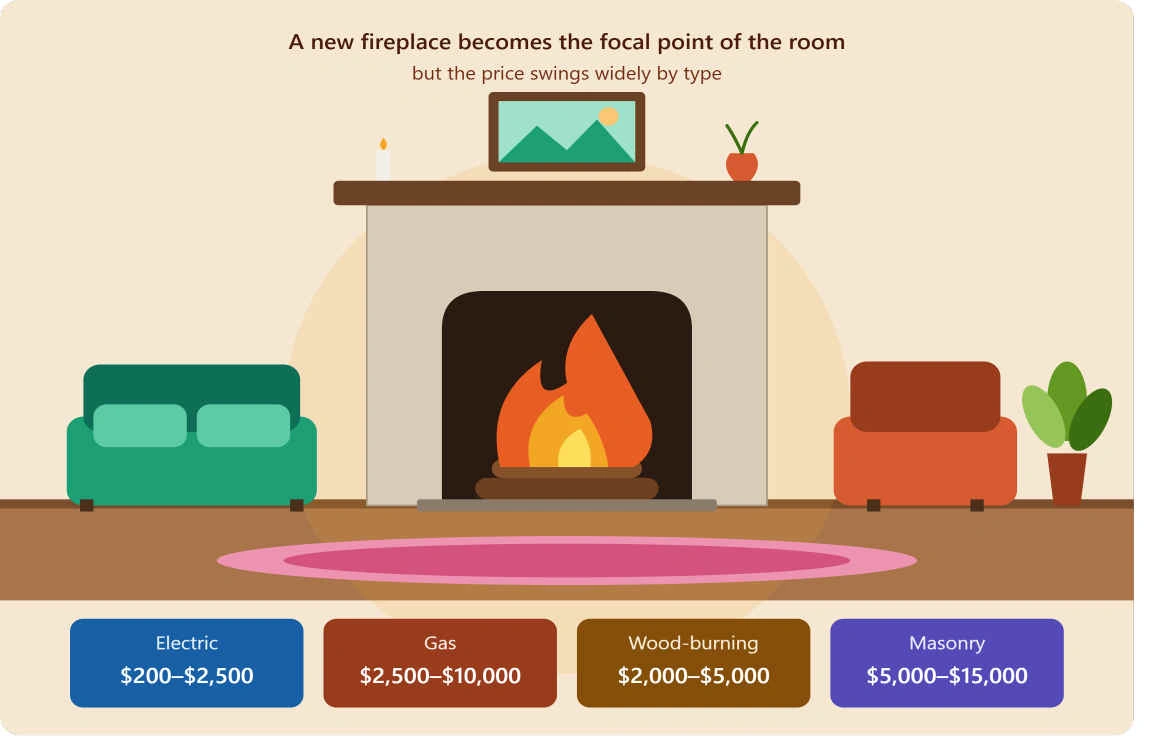
Average Fireplace Installation Costs in 2026
Here’s a snapshot of what you can expect to pay by fireplace type. These ranges include a mix of unit and labor costs and come from published cost guides, so treat them as planning numbers rather than quotes.
| Fireplace type | Typical installed cost | Source |
|---|---|---|
| Electric | $200 – $2,500 | Fixr |
| Gas | $2,500 – $10,000 | Fixr |
| Wood-burning | $2,500 – $30,000 | Fixr |
| Fireplace insert (into an existing opening) | $700 – $6,500 | Angi |
Yes, those ranges are wide. A plug-in electric unit and a custom masonry fireplace with a new chimney are completely different projects, which is exactly why the type you pick matters more than anything else.
How Much to Put a Fireplace in a House, by Type
Electric Fireplaces: The Budget-Friendly Option
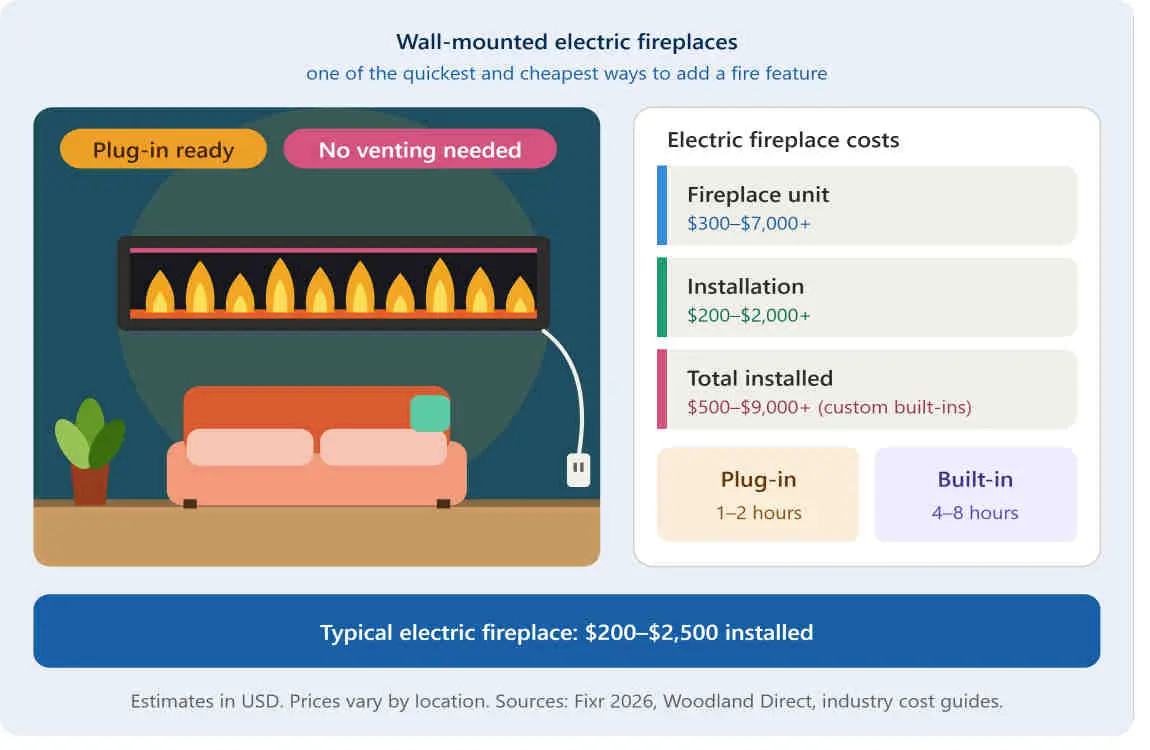
Electric fireplaces are the cheapest way in. There’s no chimney, no gas line and no venting, so installation is mostly about mounting the unit and having an outlet nearby. HomeGuide puts electric fireplaces at roughly $200 to $3,000 installed, while HomeAdvisor notes that high-end built-in models can push the total much higher, since electric units skip the chimney altogether.
Best for: apartments, rentals, bedrooms, and anyone who wants the look of a fire without the construction.
Gas Fireplaces: Convenient, With a Bigger Price Tag
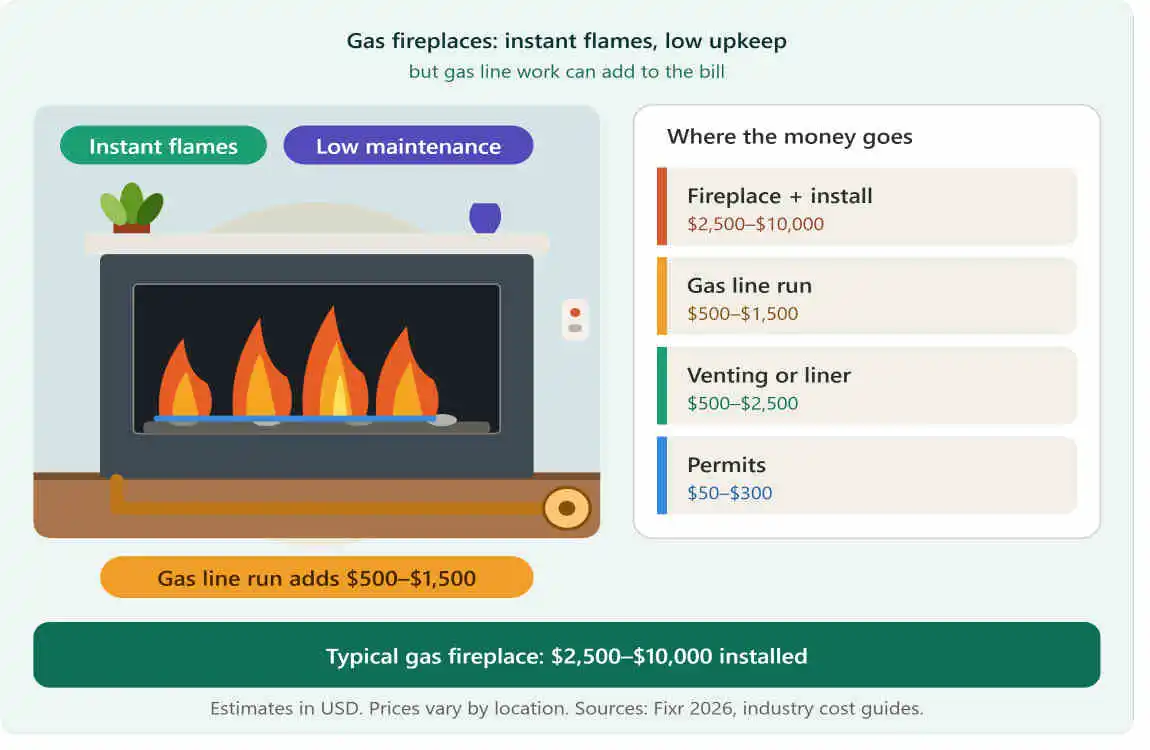
Gas fireplaces start with a remote or a wall switch, and there’s no wood to haul or ash to clean up. The trade-off is cost. Fixr lists gas installations at $2,500 to $10,000, and HomeGuide says labor alone for a vented, ventless or direct-vent gas fireplace can run $1,200 to $6,000.
The biggest wildcard is the gas line. If your home doesn’t already have one in the right spot, HomeGuide estimates a new gas line at about $500 to $2,200. Gas work is also not a DIY job. Bob Vila points out that a licensed professional needs to install the line that feeds the fireplace.
Wood-Burning Fireplaces: The Classic, and the Widest Price Range
Nothing beats the crackle and smell of real wood. It also has the most unpredictable price. Fixr’s range of $2,500 to $30,000 reflects the difference between swapping a prefabricated unit into an existing chimney and home building a masonry fireplace and chimney from scratch.
If you’re starting with no chimney at all, expect the higher end. Framing, a fire-rated hearth, a flue and a chimney that clears your roofline all add up quickly.
Fireplace Inserts: Upgrade What You Already Have
If your house already has an old open fireplace, an insert can be the smartest money you spend. Angi reports insert installation at $700 to $6,500, depending on the type of insert and how complex the install is. The U.S. Department of Energy notes that traditional open masonry fireplaces shouldn’t be thought of as heating devices, while a well-fitted high-efficiency insert can perform nearly as well as a wood stove.
What Affects the Cost of Installing a Fireplace?
Two homes can ask for the “same” fireplace and get very different quotes. These are the factors that move the number most:
- Fuel type. Electric is cheapest, gas sits in the middle, and wood-burning can climb the highest.
- Existing chimney or flue. Using what’s already there saves thousands. Building new is where budgets blow up.
- Gas line access. A nearby line is cheap to tap. Running a new one across the house is not.
- Structural work. Cutting into walls, framing a chase, or reinforcing floors for heavy masonry all add labor.
- Surround and finish. Brick, tile, stone and marble have very different price tags (more on that below).
- Local labor rates and permits. Costs vary by region, and your local building department may require a permit and inspection.
Don’t Forget the Surround, Mantel and Hearth
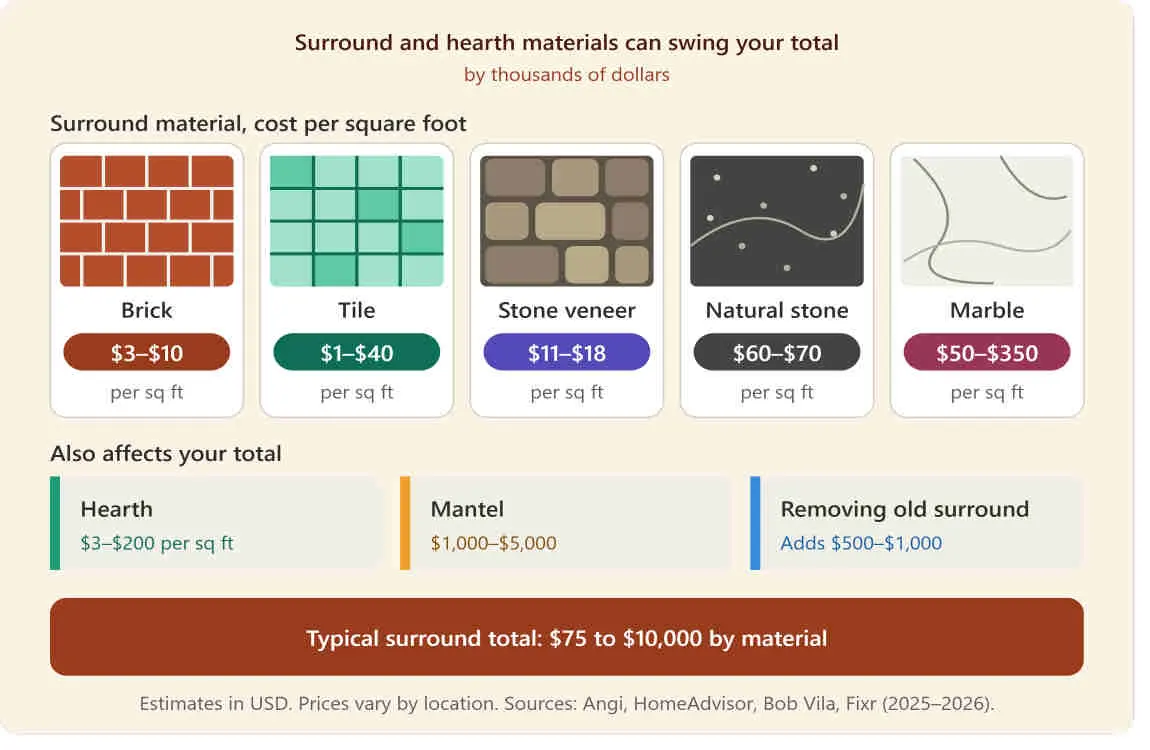
The fireplace unit is only part of the story. What goes around it can change the final price just as much. According to Fixr, surround materials run from about $3 to $50 per square foot for concrete options, up to $20 to $300 per square foot for marble. Angi adds that a mantel installation costs roughly $1,000 to $5,000, and adding a hearth can run $3 to $200 per square foot.
If your budget is tight, a simple tile or brick surround with a painted wood mantel gives you a finished look without paying for premium stone.
Hidden Costs Homeowners Often Miss
- Removing an old fireplace. Fixr notes that taking out an existing fireplace before a new install can cost thousands.
- Chimney repairs. If you’re reusing a flue, it may need inspection, relining or repair before it’s safe.
- Contractor markup. Homewyse suggests adding 13% to 22% if a general contractor is managing the job.
- Permits and inspections. Fees vary widely by location, so check with your local building department before you commit.
- Finishing work. Drywall repair, paint, flooring patches and electrical work often sit outside the original quote.
Converting Instead of Starting From Scratch
If you already have a wood-burning fireplace and you’re tired of the mess, converting to gas can be a cheaper route than building new. Angi lists a gas conversion at around $3,000 on average, though its conversion guide says a vented gas fireplace can average closer to $5,000, making it the priciest gas option. Gas logs for an existing firebox are the lowest-cost version of this upgrade.
Is Installing a Fireplace Worth It?
It depends on what you want from it. For heat, an open wood fireplace is a poor performer, and that’s the Department of Energy’s own take. For ambiance and resale appeal, a fireplace can be a strong feature. For efficiency, an insert or a gas unit will usually beat a basic open hearth.
A good rule: if your main goal is warmth, spend on an insert or a quality gas unit. If it’s atmosphere, an electric fireplace delivers a lot of charm for the money.
How to Save Money on Fireplace Installation
- Get at least three quotes. Ask each installer to itemize the unit, labor, venting and finishing separately.
- Reuse existing infrastructure. An existing chimney, flue or gas line can save you thousands.
- Choose a simple surround. Tile or brick usually costs far less than natural stone or marble chimney.
- Install in the off-season. Many installers are less busy outside of winter, which can help with scheduling and sometimes pricing.
- Hire licensed pros for gas and venting. It’s the one place not to cut corners, for safety and for insurance reasons.
Frequently Asked Questions
How much does it cost to put a fireplace in a house that doesn’t have one?
Plan on roughly $1,000 to $5,000 for a typical project, based on Fixr’s national range, with an average near $2,500. Electric units sit at the low end, while building a wood-burning fireplace and chimney from scratch can cost far more.
What is the cheapest fireplace to install?
Electric. With no chimney or gas line required, installation is simple, and units can start at a couple hundred dollars.
Can you add a fireplace to a house without a chimney?
Yes. Electric and ventless or direct-vent gas fireplaces don’t need a traditional chimney. Ventless gas models aren’t legal in every area, so check local rules first.
Do I need a permit to install a fireplace?
Often, yes, especially for gas and wood-burning units. Requirements differ by city and county, so confirm with your local building department or ask your installer.
Is a gas or electric fireplace cheaper to install?
Electric is almost always cheaper upfront. Gas costs more to install, particularly if a new gas line is needed, but it produces real flame and usable heat.
Final Thoughts
So, how much to put a fireplace in a house? For most people, the answer lands between $1,000 and $5,000, with electric options far below that and full wood-burning builds far above it. The smartest move is to decide what matters most (heat, looks or budget), check what your home already has in place, and get itemized quotes before you commit.
