

Imagine waking up on a chilly Tuesday morning. You swing your feet out from under the duvet, and instead of hitting a cold, hard floor, your toes land on a warm, textured surface that looks exactly like reclaimed oak. As the sun begins to peek through your curtains, the light dances along the length of your floorboards, making the entire room feel like a high-end sanctuary.
This isn’t just a dream for 2026; it is the reality of modern home design. But here is the catch: even the most expensive flooring can look “off” if it is installed the wrong way. One of the most common questions homeowners ask is, “Which direction to lay vinyl plank flooring in bedroom spaces to get that perfect, cosy glow.
Why Direction Matters in Bedroom Vinyl Plank Installation
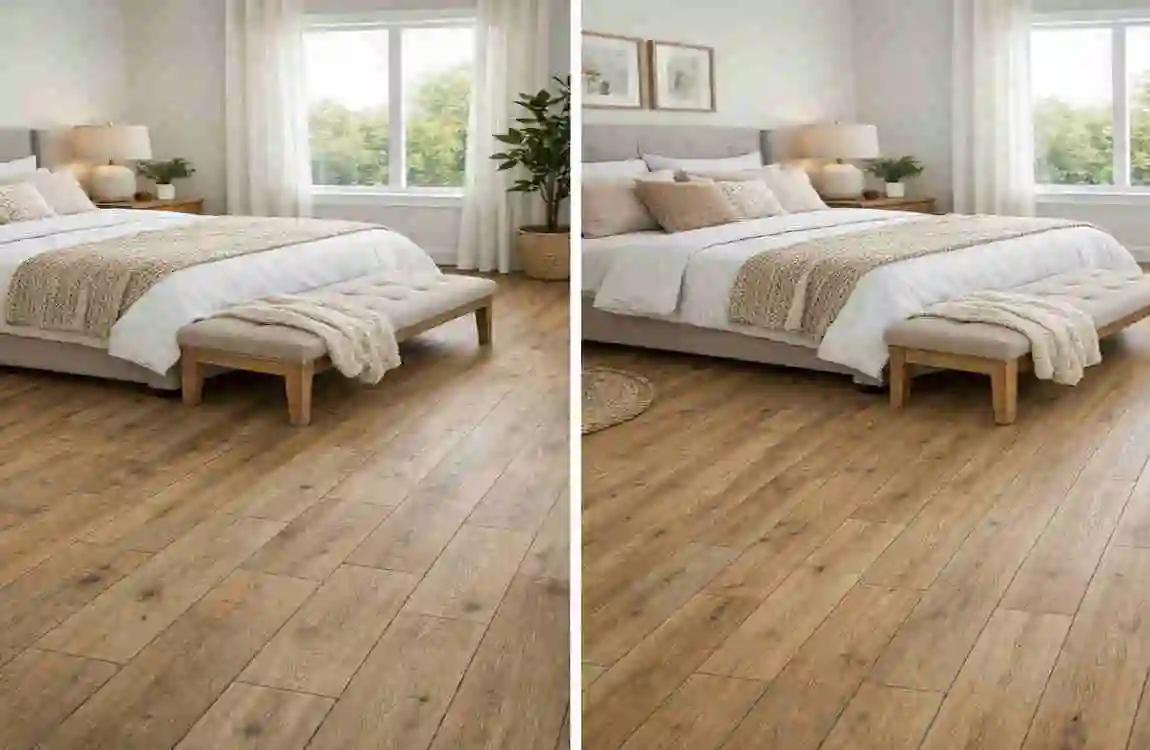
You might think that a floor is just a floor, but the direction of your planks acts like a set of invisible arrows. These arrows tell your eyes where to look. If you lay them the wrong way, a room can feel “choppy” or cramped. If you lay them correctly, you can make a tiny guest room feel like a primary suite.
The Magic of Light Flow
In 2026, the “cosy home glow” is all about how natural light hits your surfaces. When you lay vinyl planks parallel to the main light source (usually your biggest window), the light travels down the length of the boards. This minimises the appearance of seams, making the floor look like a continuous, smooth surface. It creates a serene, calming environment that is perfect for a bedroom.
On the flip side, if you lay planks perpendicular to the light, every single joint and seam will cast a tiny shadow. While some people like this because it highlights the wood’s texture, it can sometimes make the floor look a bit “busy” or uneven.
Visual Elongation and Room Shape
Have you ever noticed how vertical stripes on a shirt make a person look taller? Flooring works the same way. If you have a narrow bedroom, laying the planks along the longest wall will visually stretch the room. It tricks the brain into thinking the space is deeper than it actually is.
For those of us living in modern apartments or smaller suburban homes, this trick is a lifesaver. It prevents that “boxed-in” feeling that often comes with dark or poorly oriented flooring.
Subfloor Alignment and Structural Secrets
Aside from looks, there is a practical side to this. If you are laying vinyl over an existing plywood subfloor, you generally want to run your planks perpendicular to the floor joists. This adds structural integrity and helps prevent the planks from dipping or shifting over time.
Even though modern Luxury Vinyl Plank (LVP) is incredibly sturdy, following these basic construction “rules” ensures your floor stays beautiful for decades, not just years.
Directions for Vinyl Plank in Bedrooms
Choosing a direction is a big commitment. Let’s break down the four most popular choices so you can decide which one fits your personal style.
1. Parallel to the Main Light Source
This is the “gold standard” for creating a cosy atmosphere. When you enter your bedroom, your eyes are naturally drawn to the window. Running the planks in that same direction creates a sense of harmony.
- The Pros: It creates a seamless look. It makes the room feel brighter because the light isn’t “tripping” over the edges of the planks.
- The Cons: If your windows are on different walls, you have to pick the “dominant” one, which can be tricky.
Along the Longest Wall
If your bedroom is more rectangular than square, this is usually the best bet. Following the longest wall is the most traditional way to lay flooring. It feels natural and stable.
- The Pros: It is the easiest to install because you need fewer cuts at the ends of rows. It also uses the material most efficiently, meaning less waste.
- The Vibe: It feels modern, clean, and minimalist. It’s perfect for those “Scandi-chic” bedrooms that are so popular right now.
Diagonal for Dramatic Flow
Want to do something a little different? Laying your vinyl planks at a 45-degree angle to the walls is a total game-changer. This is a huge trend for 2026 because it breaks the “grid” of the room.
- The Pros: It makes the corners of the room feel further apart, which is great for small, square bedrooms. It adds an instant “custom home” feel.
- The Cons: It is much harder to install. You will need to cut almost every plank that hits a wall at an angle. You should also buy about 15% extra material to account for the waste from these cuts.
Herringbone or Patterned Layouts
Herringbone isn’t just for old European manors anymore. With modern click-lock vinyl, you can achieve this look relatively easily. It involves laying the planks in a “V” shape.
- The Pros: It is incredibly cosy and high-end. It pairs beautifully with warm oak or walnut tones.
- The Tip: Look for “Herringbone-specific” vinyl planks. Not all standard planks can be laid in this pattern, so check the manufacturer’s guide before you buy!
Bedroom Flooring Trends Boosting Vinyl Appeal
Vinyl flooring has come a long way from the thin, plastic-looking sheets of the 90s. Today, it is the preferred choice for bedrooms because of its warmth and durability. Here is what is trending this year:
Warm Earth Tones and “Glow”
We are seeing a shift away from the “cool greys” of the last decade. Homeowners are now reaching for warm honey tones, sandy beiges, and deep toasted oaks. These colours reflect light in a way that feels organic and welcoming. When you combine these colours with the right layout direction, your bedroom will practically glow from within.
Wide Planks and Realistic Textures
Wide planks (7-9 inches) are the new standard. They make a room look less cluttered by reducing seams. Many 2026 vinyl options also feature “Embossed in Register” (EIR) technology. This means the plank’s texture perfectly matches the grain of the wood image printed on it. If you see a knot in the wood, you can actually feel it!
Trending Styles for a Cosy Bedroom:
- Muted White Oak: Perfect for a bright, airy “Cali-cool” look.
- Smoked Walnut: Adds a moody, masculine, and sophisticated vibe.
- Reclaimed Pine: Great for farmhouse or rustic styles.
- Matte Finishes: These are trending because they don’t show footprints or dust as easily as glossy floors.
- Integrated Underlayment: Look for planks with pre-attached cork or foam backing for extra warmth and sound dampening.
Step-by-Step Installation Guide: Getting the Direction Right
Once you’ve decided which direction to lay vinyl plank flooring in bedroom areas, it’s time to get to work. Don’t worry; you’ve got this! Follow these steps for a professional finish.
Prep Your Subfloor
You can’t build a house on sand, and you can’t lay a floor on a bumpy mess. Clear out all the furniture. Pull up the old carpet or laminate. Use a level to check for any high or low spots. If the floor is uneven, use a self-levelling compound. Every bump you leave behind will eventually show through your vinyl.
Acclimate Your Planks
This is the step most people skip, and it’s a big mistake. Bring your vinyl boxes into the bedroom and let them sit for at least 48 hours. This allows the material to adapt to the room’s temperature and humidity. Vinyl expands and contracts; letting it settle now prevents it from buckling later.
Choose and Mark Your Starting Wall
Based on our earlier discussion, pick your starting point. If you’re going parallel to the light, start at the wall opposite the window. Use a chalk line to snap a perfectly straight line across the floor. Walls are rarely perfectly straight, so don’t just trust the baseboard!
Lay the First Rows
Start in a corner and work your way across. Use spacers against the wall to leave a small gap (usually 1/4 inch) for expansion. Click the planks together firmly. For the second row, make sure to stagger your end joints by at least 6 to 8 inches. This makes the floor stronger and gives it a more authentic hardwood look.
Trim and Finish
When you get to the end of a row, you’ll likely need to cut a plank. A simple utility knife and a straight edge are usually enough to “score and snap” the vinyl. Once the whole floor is down, remove your spacers and install baseboards or quarter-round moulding to cover the expansion gaps.
Common Mistakes and How to Fix Them
Even the pros make mistakes sometimes. Here are the pitfalls you should avoid:
- Ignoring the Light: If you lay the planks perpendicular to a huge sliding glass door, you might see every tiny peak in the floor. The Fix: Use a compass or a sun-tracking app to see where the light hits strongest at noon.
- Using the Wrong Underlay: Some vinyl has it built in; some doesn’t. If you add extra foam under a plank that already has backing, the floor will feel “mushy”, and the clicks might break. The Fix: Always read the box!
- “H” Joints: This happens when your staggered joints line up perfectly every other row, creating an “H” pattern. It looks unnatural. The Fix: Randomise your lengths for a more organic look.
- Forgetting the Doorway: Transitioning from the bedroom to the hallway can be tricky if the directions change. The Fix: Use a T-moulding in the doorway to create a clean break.
Cost Breakdown and Budget Tips

How much should you expect to pay for a typical 12×12 bedroom (144 square feet)? Let’s look at the numbers.
Layout Type Material Cost (Approx.)Labour (DIY vs Pro)Total Estimated Cost
Straight/Parallel $400 – $600 $0 (DIY) $400 – $600
Diagonal $500 – $750 $300 – $500 $800 – $1,250
Herringbone $600 – $900 $600 – $1,000 $1,200 – $1,900
Money-Saving Tip: If you are on a tight budget, go with the Along the Longest Wall direction. It is the most forgiving for DIYers and results in the least waste. You can save hundreds of dollars just by doing the labour yourself!
Frequently Asked Questions
Which direction should vinyl plank flooring be laid in a bedroom with two windows? If you have windows on two different walls, choose the one that gets the most direct sunlight (usually the South-facing one). Lay the planks parallel to that light source to maximise the glow.
Does the direction of the flooring affect resale value? Actually, yes! A well-thought-out flooring layout can increase the “perceived value” of a home. Pros suggest that a professional-looking diagonal or herringbone layout can boost a room’s appeal by up to 10% in buyers’ eyes.
Can I change directions between the bedroom and the hallway? Yes, you can. However, it’s usually best to keep the direction consistent throughout the house to create a “flow.” If you must change, use a transition strip in the doorway.
Should I lay flooring before or after the bed goes in? Always before! Your flooring should be a “wall-to-wall” installation. Never lay vinyl around heavy furniture, such as a bed or a wardrobe.
Is vinyl flooring too cold for a bedroom? Not at all! Unlike tile or stone, vinyl stays relatively close to room temperature. For maximum cosiness, look for planks with a cork backing or use a rug in the areas where you step out of bed.
