

Have you ever walked into a room and felt like something was just… off? Maybe the room felt smaller than it actually was, or perhaps the floor looked a bit too “busy,” making your beautiful furniture feel cluttered. If you are currently remodeling, you might be struggling to decide which vinyl plank flooring size is best for your space. You aren’t alone! In fact, the vinyl flooring market has seen nearly a 20% growth recently as homeowners move away from expensive hardwoods and toward durable, waterproof, and budget-friendly alternatives.
Choosing the right plank size is about more than just picking a color you like. It is about proportions, light, and the overall “vibe” of your home. Whether you are looking for that ultra-modern wide-plank look or a classic narrow style for a cozy rental, getting the dimensions right is the secret to a professional-looking finish.
Why Vinyl Plank Flooring Size Matters for Your Home
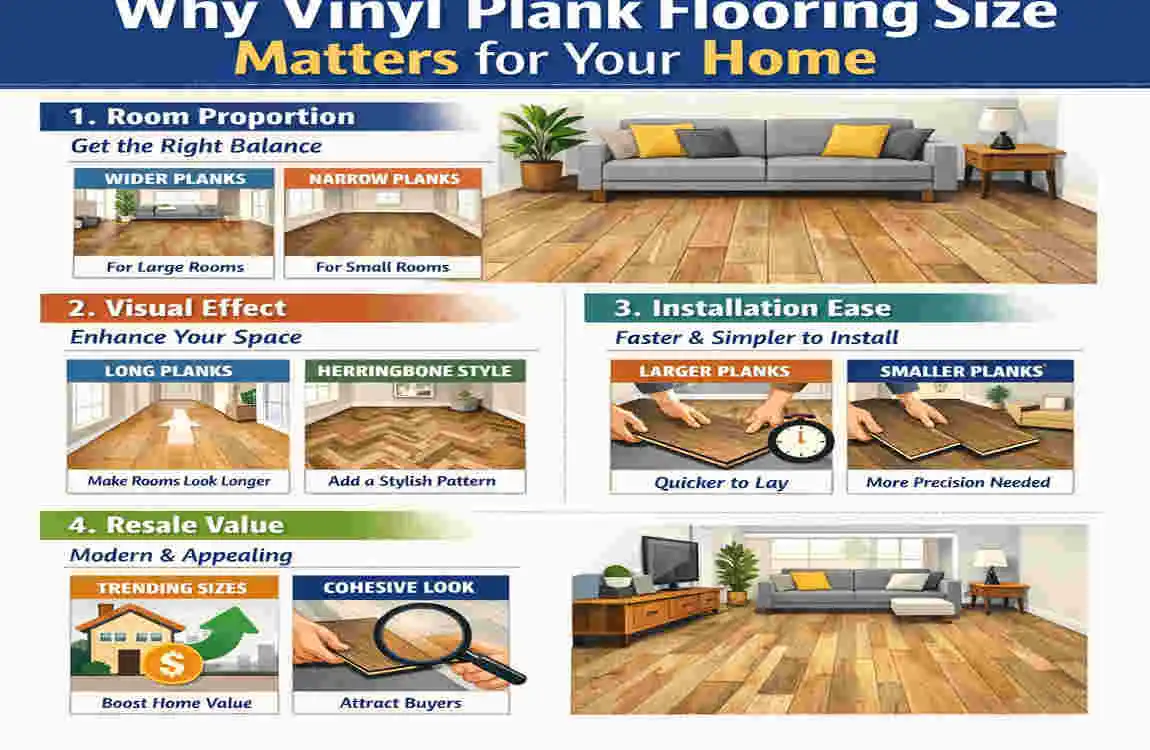
Think of choosing your flooring size like selecting the right pair of shoes. If they are too small, they feel cramped and uncomfortable; if they are too big, they look clunky and overwhelm your frame. In the world of interior design, plank size dictates the “visual weight” of a room.
Using the wrong size can make a small room feel tiny or a large room feel unfinished. The best vinyl plank flooring size depends mainly on how much “visual noise” you want. More seams (from smaller planks) create more detail, while fewer seams (from larger planks) create a smoother, more expansive look.
Visual Appeal and Room Proportions
If you have an open-concept living area, wide planks (usually 7 to 9 inches) are your best friend. They mimic the look of luxury hardwood and reduce the number of visible seams. This makes the floor look like a single continuous surface, tricking the eye into thinking the room is even larger than it is.
On the other hand, narrow planks (4 to 6 inches) are fantastic for adding texture. If you have a historic home or a space with a lot of character, narrow planks can highlight the wood grain’s patterns and give the room a traditional, handcrafted feel.
Practical Benefits of the Right Size
It isn’t all about looks, though. There are practical reasons to care about your plank dimensions:
- Durability: Wider planks often mean fewer joints. Since joints are the most vulnerable part of any floor, having fewer joints can sometimes help reduce long-term wear, especially in high-traffic areas.
- Installation Ease: Did you know that standard 5-inch widths can actually reduce waste? Because they fit more easily into standard room dimensions, you often cut less material, saving about 15% on waste compared to oversized planks.
Common Pitfalls to Avoid
One of the biggest mistakes homeowners make is choosing a plank that is too large for a tiny bathroom. If you can only fit two or three full planks across the floor, it looks awkward. Conversely, using skinny strips in a massive basement can make the floor look “jittery” or overly patterned.
Room Type Recommended Plank Width Visual Effect
Small Powder Room 4″ – 5″ (Narrow) Makes the space feel detailed and intentional.
Standard Bedroom 5″ – 7″ (Standard) Balanced, classic look that fits most furniture.
Large Living Area 7″ – 9″ (Wide) High-end, “expensive” feel with a seamless look.
Luxury Basement 9″+ (Extra-Wide) Modern, bold, and very easy to clean.
Standard Vinyl Plank Flooring Sizes: A Complete Dimensions Guide
Before you hit the store, you need to understand the language of flooring dimensions. When we talk about vinyl plank flooring dimensions, we are referring to three main measurements: width, length, and thickness.
Understanding the Categories
Most manufacturers, like Coretec or Lifeproof, categorize their products into four main size buckets. Knowing these will help you narrow down your search immediately.
Narrow Planks (4-6″ Wide)
Narrow planks were the standard for decades. They are often the most budget-friendly option because they are easier to manufacture and ship.
- Pros: Great for creating a “busy” or traditional look; very easy to handle for DIY projects.
- Cons: More seams mean more places for dirt to hide if not appropriately maintained.
Standard Planks (5-7″ Wide)
This is the “Goldilocks” zone of flooring. When people ask what size vinyl plank flooring is best, this is almost always the answer for a general-purpose home. It strikes a perfect balance between the old-school narrow look and the ultra-modern wide look.
- Pros: Available in the widest variety of colors and textures; fits almost any room size.
- Cons: Can sometimes feel “average” if you are looking for a high-end luxury statement.
Wide and Extra-Wide Options (7-9″ and 9″+)
Wide planks are the current darlings of the interior design world. They are often longer as well, sometimes reaching 72 or even 80 inches.
- Pros: Minimal seams; creates a calm, peaceful visual environment; looks exactly like real timber.
- Cons: Requires a perfectly level subfloor. If your floor has bumps, wide planks won’t “bend” over them easily and might click or pop.
The Importance of Thickness (The “Wear Layer”)
While width and length matter for looks, thickness (measured in millimeters) matters for your feet. A thicker plank (8mm to 12mm) usually feels more “solid” when you walk on it. It mimics the density of real wood and provides better sound insulation. If you are installing over a subfloor that isn’t perfect, a thicker plank is much more forgiving.
Size Category Width (inches)Length (inches)Thickness (mm)Best For
Narrow 4-6 36-48 4-6 Hallways, small rentals, closets
Standard 5-7 48 5-8 Kitchens, living rooms, bedrooms
Wide 7-9 48-75 6-12 Open-concept homes, luxury suites
Extra-Wide 9+ 72+ 8-20 Large basements, commercial spaces
What Size Vinyl Plank Flooring is Best for Different Rooms?
Every room in your house serves a different purpose, so it makes sense that the flooring should too. Let’s walk through your home together and decide which size fits where.
Kitchens and Bathrooms: The Standard 5-7″ Choice
Kitchens and bathrooms are “high-activity” zones. You have cabinets, islands, toilets, and tubs to cut around.
- Why Standard Width? Using a 6-inch plank in a kitchen is usually the sweet spot. It is wide enough to look modern but narrow enough that you don’t waste half a plank every time you have to cut around a cabinet corner.
- The Moisture Factor: Since vinyl is waterproof, size doesn’t affect its water resistance, but fewer seams in a bathroom can mean fewer places for water to sit if you have a significant spill.
Living Rooms and Open Spaces: Go Wide (7-9″)
If your living room flows directly into your dining room and kitchen, you have a lot of floor to cover.
- The “Expansive” Effect: Wide planks reduce the “grid” look that many seams create. This allows the natural wood grain patterns to shine.
- Traffic Considerations: Living rooms see the most foot traffic. Wide planks are often part of “rigid core” LVP lines, which are incredibly tough against scratches from pets and kids.
Bedrooms and Hallways: The Cozy Narrow (4-6″)
Bedrooms are meant to be cozy and intimate.
- The Vibe: Narrower planks can create a sense of rhythm and texture that feels warm.
- DIY Friendly: Hallways are often narrow. If you use a 9-inch plank in a 36-inch wide hallway, you only have four planks across. If your walls aren’t perfectly straight (and they never are!), it will be pronounced. Using 4- or 5-inch planks lets you hide “wonky” walls much better.
Basements and Commercial Spaces: Extra-Wide (9″+)
Basements are often the largest single rooms in a house.
- Durability: Extra-wide planks are usually built with a heavy-duty core to withstand the weight of pool tables, gym equipment, or large sectional sofas.
- Speed of install: Because each plank covers so much surface area, you can finish a 1,000-square-foot basement much faster with 9-inch planks than with 5-inch ones!
Top Picks: Best Vinyl Plank Flooring Sizes and Brands for 2026
Choosing a brand is just as important as choosing a size. As we look toward 2026, vinyl flooring technology has advanced to the point where it is almost indistinguishable from real wood. Here are our top recommendations based on durability, style, and size availability.
Best Overall: Coretec Plus (7″ x 48″)
Coretec is widely considered the industry gold standard. Their 7-inch width is the perfect answer to the question “What size vinyl plank flooring is best?” for the average homeowner.
- Why we love it: It comes with a pre-attached cork underlayment, which makes it quiet and warm. The 7-inch width fits beautifully in both small and large rooms.
The Budget Hero: MSI Everlife (5″ x 47″)
If you are flipping a house or refreshing a rental, MSI Everlife offers incredible value.
- Why we love it: Their 5-inch planks are classic. They are easy to install and, because they are standard size, are almost always in stock. You won’t have to wait weeks for a special shipment.
The Luxury Choice: Shaw Verde (9″ x 72″)
For those who want their home to look like it belongs in a design magazine, Shaw’s wide-plank options are unmatched.
- Why we love it: The 72-inch length is massive. It creates a stunning, high-end look that mimics the expensive European oak floors seen in luxury mansions.
Product Size (W x L)Key Features Price/ Sq Ft Rating
Coretec Plus 7″ x 48″ Waterproof, Cork back $3.50 – $4.50 4.8/5
Lifeproof Sterling Oak 6.5″ x 48″ Pet-proof, DIY click $2.99 – $3.50 4.7/5
Shaw Verde 9″ x 72″ Wide luxury, Rigid core $4.20 – $5.50 4.9/5
MSI Everlife 5″ x 47″ Budget-friendly, Durable $2.49 – $2.99 4.6/5
Mohawk SolidTech 7″ x 49″ Stain-resistant $3.25 – $4.00 4.7/5
How to Measure and Choose the Perfect Vinyl Plank Size
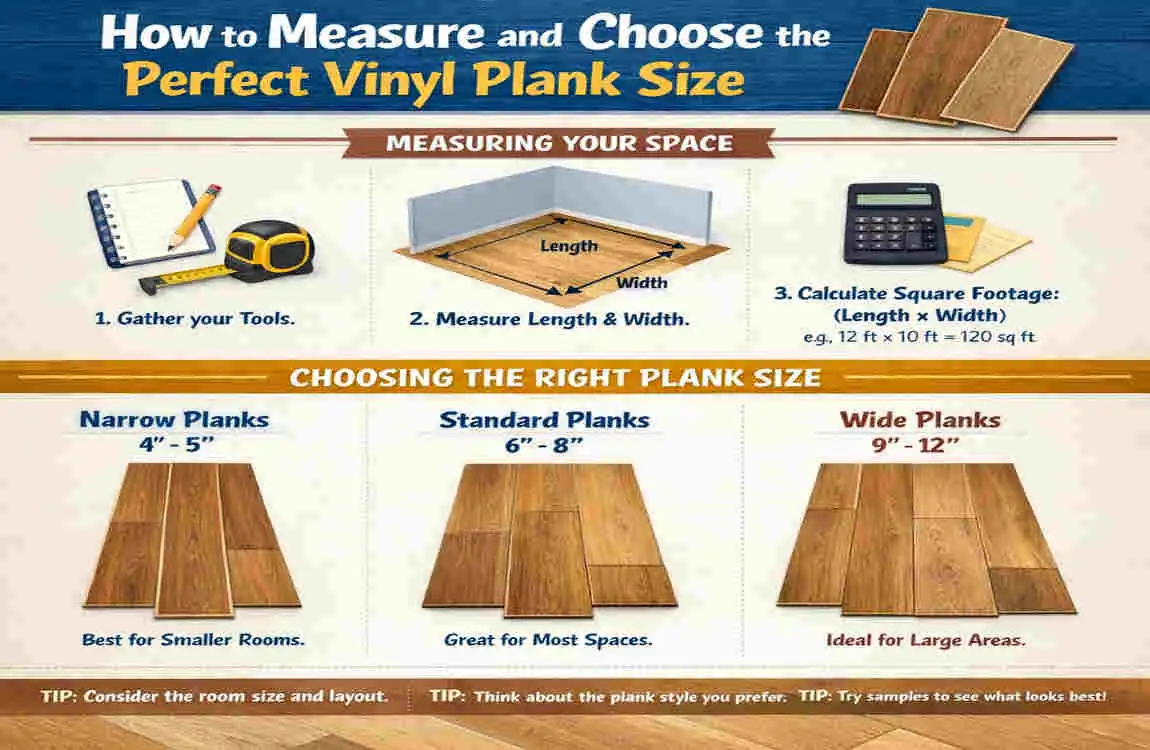
You’ve looked at the pictures, you’ve checked the brands, and now you are ready to buy. But wait! Before you click “order,” you need to do a little bit of homework. Choosing the right size requires a bit of math and some testing.
Measure Your Room (The Right Way)
Don’t just guess. Use a laser measure or a reliable tape measure to get the length and width of the room. Multiply them to get your square footage.
- The 10% Rule: Always add 10% to your total square footage for “waste.” If you are using wide planks, you might even want to add 12-15%, as mistakes with larger planks are more “expensive” in terms of lost material.
Consider Your Subfloor
This is a point most people miss. Wide planks are stiff. If your subfloor has a “dip” or a “hump,” a wide plank will bridge over it, creating a hollow sound when you walk, or worse, the locking mechanism might snap.
- Pro Tip: If your floor isn’t perfectly level, stick to standard 5-7 inch planks. They have a tiny bit more “flex” and will hug the floor better.
Test Your Samples
Never buy a whole floor based on a tiny square in a showroom. Order at least three different sample sizes.
- Place them against your baseboards.
- Look at them in the morning light and the evening light.
- See how they look next to your furniture. A wide plank might look great in an empty room, but it can look “cutoff” once you put a rug and a sofa on it.
Choose Your Layout
Are you going for a straight lay, or are you feeling fancy with a herringbone pattern?
- Herringbone: Usually requires specific, smaller planks (often 4″ x 24″). You cannot easily do a herringbone with a standard 48-inch-long plank.
- Straight Lay: Works with any size, but looks best when you “stagger” the seams so they don’t line up like a brick wall.
Vinyl Plank Flooring Size Trends and Maintenance Tips for 2026
As we move into 2026, the trends are shifting toward natural realism. People want floors that feel like they were harvested from a forest, not made in a factory.
2026 Size Trends to Watch
- The Rise of the “Hybrid” Plank: We are seeing a surge in 8-inch wide planks that are slightly shorter (around 60 inches). This makes them easier to install in residential homes while still giving that “wide plank” luxury look.
- Textured Edges: Manufacturers are now using “pressed bevels” on wider planks. This means the plank’s edge slopes naturally, making the transition between wide planks look even more like real wood.
- Mixed Widths: A growing trend is buying boxes that contain different widths (e.g., a mix of 5″, 7″, and 9″ planks). This creates a unique, rustic look that is very popular in farmhouse-style homes.
Maintenance Tips Based on Size
Believe it or not, how you clean your floor can depend on its size!
- Narrow Planks: Because there are more seams, dust and pet hair can sometimes get trapped in the grooves. We recommend using a vacuum with a “hard floor” setting daily to keep those seams clear.
- Wide Planks: These are much easier to damp-mop. Because there is more “flat” surface area and fewer “breaks,” a microfiber mop can glide across the floor in half the time. However, be careful not to use too much water; although vinyl is waterproof, you don’t want standing water in the few (but larger) expansion gaps at the edges of the room.
Pros, Cons, and Cost Comparison of Vinyl Plank Sizes
Let’s wrap up the data so you can make an informed decision. Price is often the deciding factor, and size plays a massive role in that.
Size Option: The “Pros”The “Cons” Average Cost
Narrow (4-6″) Very affordable; great for DIY; classic look. Can look “busy” in large rooms; more seams to clean. $2.00 – $3.00 /sq ft
Standard (6-7″) Most versatile; huge color selection; fits any room. Might feel “common” or less “custom.” $3.00 – $4.00 /sq ft
Wide (8-9″+) Luxury appearance; makes rooms look huge; fewer seams. Most expensive; requires a perfect subfloor; more waste. $4.00 – $6.00 /sq ft
Which one should you choose? If you are still unsure which vinyl plank flooring size is best, ask yourself this: Do I want my floor to be a background element or a focal point?
- If it’s a background, go with Standard 7-inch.
- If you want the floor to be the star of the show, go with a wide 9-inch.
FAQ: Answering Your Vinyl Plank Size Questions
What size vinyl plank flooring is best for small rooms? For small rooms, a narrow to standard plank (5 inches) is usually best. It provides enough detail to keep the room from looking “flat” without being so large as to overwhelm the small floor area.
Is 7-inch vinyl plank flooring durable? Absolutely! In fact, 7-inch planks are often the “sweet spot” for durability. They are wide enough to have a robust locking system but narrow enough to handle slight imperfections in your home’s foundation without cracking.
Does plank size affect the installation price? Sometimes. Some contractors charge a bit more for extra-wide planks because they are heavier and harder to cut. However, because they cover more ground, the job might actually get done faster. Always ask your installer for a quote based on the specific size you choose.
Can I mix different sizes of vinyl planks? Yes, but only if the manufacturer designed them to be mixed! You cannot just buy two different brands or lines and expect them to click together. Look for “Multi-Width” collections if you want this look.
What is the most popular vinyl plank width in 2026? The 7-inch width remains the most popular for general home use, but 9-inch “Extra-Wide” planks are the fastest-growing segment for new luxury constructions.
How thick should my vinyl plank be? Regardless of the width, try to look for a plank that is at least 5-6mm thick for residential use. If you have a busy household with kids and dogs, aim for 8mm or higher.
