
Have you ever walked through your front door and felt a slight draft, or noticed that the handle doesn’t latch as well as it used to? You aren’t alone. In fact, there are over 8 million mobile homes across the United States. Many of them are reaching an age where upgrades are no longer just a luxury—they are a necessity for comfort and energy savings. When you decide to tackle a home improvement project, one of the first things you’ll realize is that mobile home exterior doors are a completely different beast compared to the doors you find in a traditional “stick-built” house.
Common Mobile Home Exterior Door Sizes at a Glance
Door TypeWidth x Height (inches)Common UseRough Opening
Standard Exterior 32 x 76 Main Entry (Post-1980) 33¼ x 77
Pre-1980 Models 32 x 72 Older Manufactured Homes 33 x 73
Wider Modern Option 36 x 80 Modern/Accessible Entry 37¼ x 81
Narrow Side Door 30 x 72 Utility or Rear Entry 31 x 73
Understanding Standard Mobile Home Door Dimensions
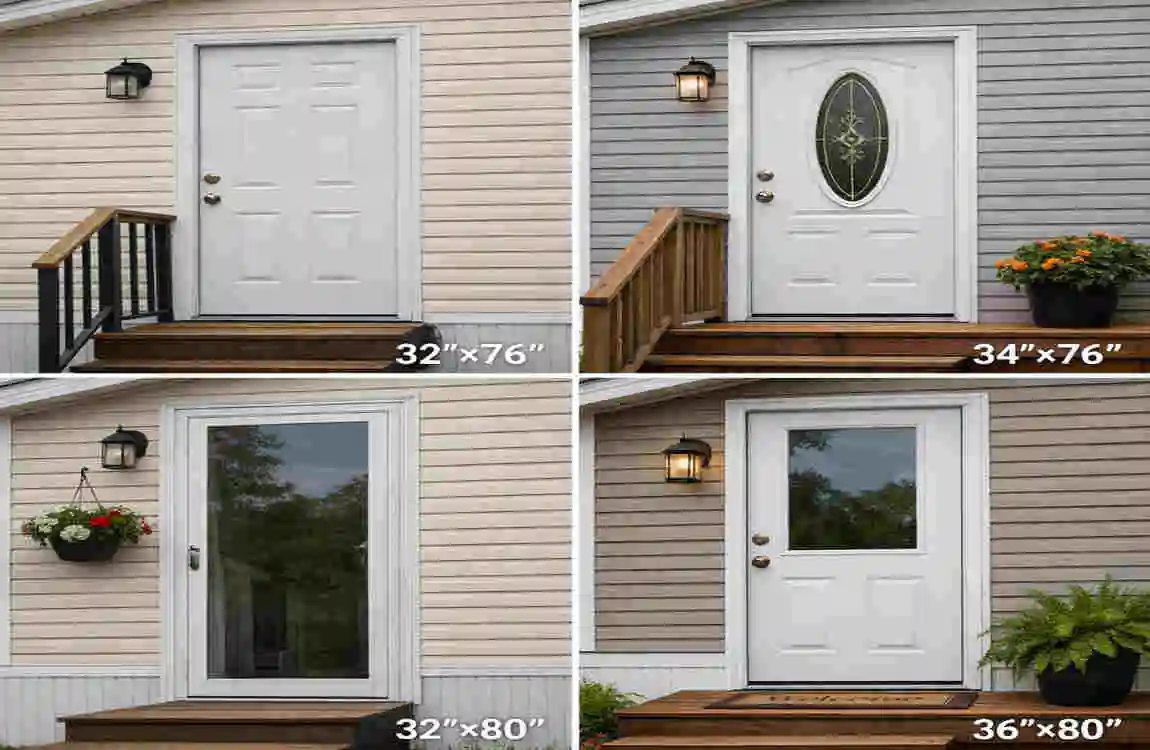
When you start shopping for mobile home exterior doors, you will see that the most common size is 32×76 inches. This is the industry standard for the vast majority of manufactured homes built in the last few decades, but why is this size so specific, and what does it mean for your home?
The 32×76 Standard: Why It Rules the Market
The 32×76 mobile home door is the “goldilocks” size of the industry. It is wide enough for easy entry and moving furniture, yet short enough to fit within the lower ceiling heights standard in many mobile home designs. Most of these doors are approximately 1¾ inches thick, which provides enough room for a solid, insulated core without being too heavy for the home’s lightweight framing. If your home was built after the mid-1980s, there is a very high probability that your front door follows these dimensions. Manufacturers adopted this standard to streamline production and ensure replacement parts would be readily available to homeowners. When you order a 32×76 mobile home door, you are usually buying a “pre-hung” unit, meaning it comes with its own frame, hinges, and threshold already attached.
Older Homes and the 32×72 Variation
If you live in a vintage mobile home—specifically those built before 1980—you might find that a 76-inch door is just a bit too tall. In these older models, the 32×72-inch door was the king. These homes often had even lower profiles to facilitate easier transport on highways, resulting in shorter entryways.
It is vital to check your height before ordering. Installing a 76-inch door into a 72-inch hole requires significant structural changes to your wall framing, which can be expensive and complicated. Always measure the actual door “slab” (the part that swings) to see if you are dealing with a 72-inch or 76-inch height.
Modern Upgrades: The 36×80 Option
As manufactured homes have evolved into “luxury” estates with higher ceilings and sprawling floor plans, the door sizes have grown too. Some modern manufactured homes now use 36×80-inch doors, which are the same size as standard residential house doors.
These larger doors offer better accessibility and a more “traditional” look. However, you cannot simply swap a 32×76 door for a 36×80 door without completely rebuilding the “rough opening” in your wall. If you are looking for a quick, easy mobile home door replacement project, stick to the size that is already there.
Why Mobile Home Exterior Doors Are Different from Residential Doors
You can head to a local lumber yard and pick up a beautiful oak door meant for a suburban mansion. While they look great, manufactured home exterior doors are engineered differently for particular reasons.
The Role of HUD Standards
Since 15 June 1976, all manufactured homes in the U.S. must meet the HUD Code (Department of Housing and Urban Development). This federal building code dictates everything from the strength of the roof to the size of the exit doors. HUD standards require that mobile homes have at least two remote exit doors to ensure safety in case of a fire.
Because these homes are built on a permanent chassis, the doors must withstand the slight shifting and settling that occur over time. Standard residential doors are often too heavy or rigid, which can cause the frame to warp if the home settles unevenly.
Engineering for Transport and Assembly
Think about the journey your home took to get to its current spot. It traveled down a highway at 60 miles per hour, facing high winds and vibrations. Mobile home exterior doors are designed to be lightweight yet durable enough to survive this trip.
The frames are often made of aluminum or light steel, and the doors themselves usually feature a “combination” design, in which the storm door and the primary door are integrated into a single unit. This saves space and weight, making the home easier to transport and assemble on-site.
Energy Efficiency and Insulation Needs
Because mobile homes have thinner walls than traditional houses, the door plays a massive role in your energy bill. Modern 32×76 mobile home doors usually feature highly insulated cores made of polyurethane foam.
This insulation helps keep the heat in during the winter and the cool air in during the summer. When you choose a door specifically made for a mobile home, you are getting a product designed to seal tightly against the unique weatherstripping systems used in manufactured housing, which can cut your energy costs by 10-15%. How to Measure Your Mobile Home Exterior Doors Like a Pro.
Before you click “buy” on that new door, you need to be 100% sure of your measurements. A mistake of even half an inch can turn a two-hour job into a two-day nightmare. Follow these steps to get the perfect dimensions for your mobile home door.
Measuring the Door Slab
The easiest way to start is by measuring the door itself—this is called the “slab.”
- Width: Measure across the top, middle, and bottom of the door. Use the widest measurement. Height: Measure from the very top edge of the door to the very bottom edge.
- Thickness: Most will be 1¾ inches, but it’s good to verify. Step 2: Finding the Rough Opening. The rough opening for mobile home door installation is the most important number. This is the “hole” in the wall once the old door and its frame are entirely removed.
- To find this without tearing your house apart, remove the interior trim (casing) around the door.
- Measure the distance between the wooden wall studs on the left and right.
- Measure from the floor to the header (the beam above the door).
- Pro Tip: For a standard 32×76 door, your rough opening should typically be 33¼ x 77 inches. This extra space allows you to “shim” the door so it is perfectly level and square, even if your house is slightly tilted.
Determining the Door Swing
You need to know which way the door opens so you don’t accidentally block a hallway or a light switch.
- Outswing: Most mobile home doors swing outward. This is a safety feature that helps with wind resistance. Inswing: Some newer or larger models swing inward, just like a traditional house.
- Handing: Stand outside the home. If the hinges are on the right, it’s a “right-hand” door. If they are on the left, it’s a “Left Hand” door.
Choosing the Right Materials and Styles
Once you have your standard mobile home door sizes down, it’s time for the fun part: choosing the look! You aren’t stuck with a plain white box. Several materials and styles can transform the look of your home.
Steel Doors: The Durable Workhorse
Steel is the most popular choice for mobile home exterior doors. It is powerful, provides excellent security, and is very affordable, usually ranging from $250 to $450. Steel doors are typically galvanized to prevent rust and come pre-painted. They are perfect for homeowners who want a “set it and forget it” solution that offers excellent protection against the elements.
Fiberglass Doors: The Premium Choice
If you want the look of real wood without the maintenance, fiberglass is the way to go. Fiberglass doors are dent-resistant and won’t rot or warp as wood can. They also offer the best insulation values, making them the top choice for extreme climates. While they are more expensive—often $400 to $700—the boost in curb appeal and energy savings often pays for itself over time. Aluminum and Storm Door Combinations. Many mobile homes use an aluminum frame that houses both a primary door and a built-in storm door. These “combo” units are fantastic for ventilation. You can leave the main door open to let in the breeze while the screen door keeps the bugs out. These are lightweight and very easy to install because the entire unit comes as one piece. Popular Styles Include:
- Six-Panel: A classic, traditional look.
- Half-Glass: Features a window on the top half to let in light.
- Cottage Series: Often features smaller, decorative windows for a cozy feel.
- Full-View: A glass storm door that shows off your beautiful primary door.
The Ultimate Replacement and Upgrade Guide
Ready to start your mobile home door installation? Replacing a door is one of the most rewarding DIY projects you can do. It immediately makes the home feel newer and more secure.
Signs It’s Time for a New Door
Don’t wait until the door falls off its hinges! Look for these warning signs:
- Visible Light: If you can see daylight around the edges when the door is closed, you’re losing money on heating and cooling.
- Soft Spots: Check the bottom of the door and the threshold for rot or water damage.
- Difficulty Locking: If you have to “lift” the door to get it to lock, the frame or the home has shifted.
- Drafts: If the area near the door feels significantly colder than the rest of the room.
Step-by-Step Installation Overview
While every home is different, the general process for a replacement mobile home door project looks like this:
- Remove the old door: Unscrew the hinges and pull the entire frame out of the rough opening.
- Clean the opening: Remove old caulk, staples, or debris from the wall studs.
- Dry fit: Lift the new pre-hung door into the hole to make sure it fits.
- Apply sealant: Put a thick bead of high-quality caulk around the back of the new door’s mounting flange.
- Level and Shim: This is the most essential part! Use wooden shims to ensure the door is perfectly level (side-to-side) and plumb (up-and-down). Fasten: Screw the door into the studs.
- Finish: Add your lockset, interior trim, and a final bead of caulk on the outside to keep water out.
Maximizing Energy Savings
To get the most out of your new 32×76 mobile home door, don’t skimp on the finishing touches. Use “low-expansion” spray foam to fill the gaps between the door frame and the wall studs. This creates an airtight seal that prevents drafts. Also, ensure your threshold is adjusted so the “sweep” at the bottom of the door makes firm contact when the door is closed.
Cost Breakdown and Financial Benefits
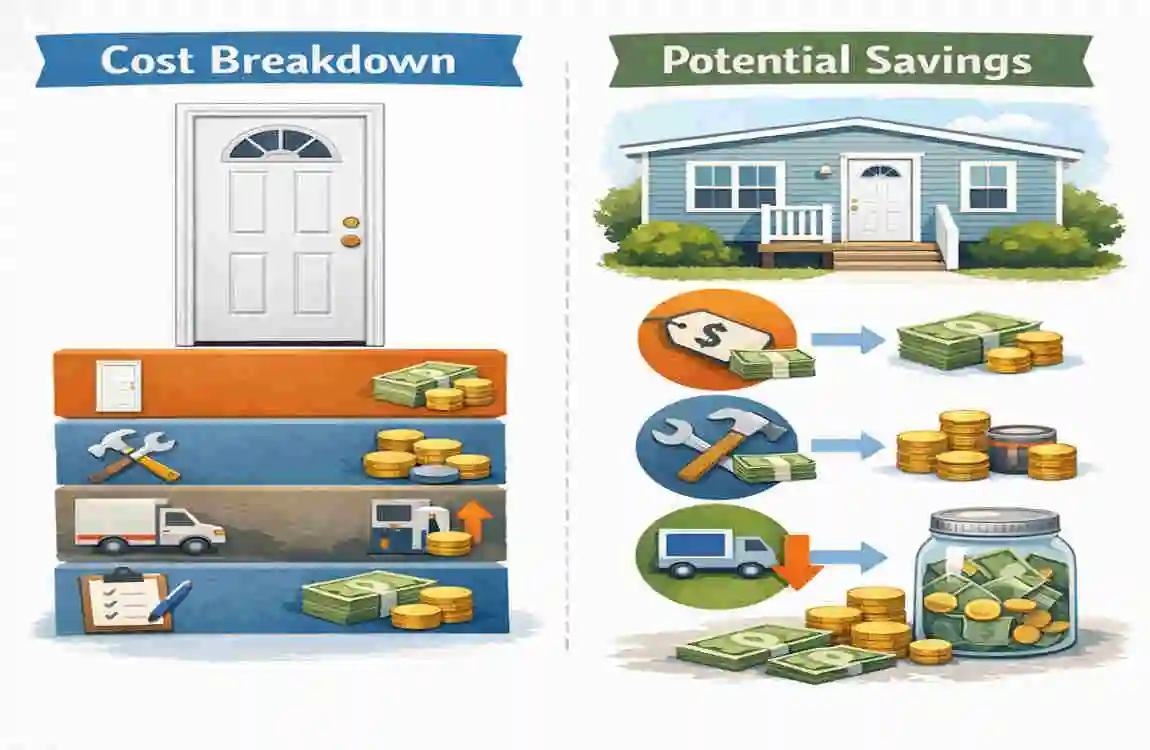
Investing in your home is always a smart move. Not only does a new door make your daily life better, but it also adds real value to your property.
Size/StylePrice Range (Materials)Estimated install Cost (Pro)
32×76 Steel Door $250 – $450 $150 – $300
32×76 Fiberglass $400 – $700 $200 – $400
32×72 Retrofit $300 – $500 $200 – $350
Storm Door Add-on $150 – $300 $75 – $150
