
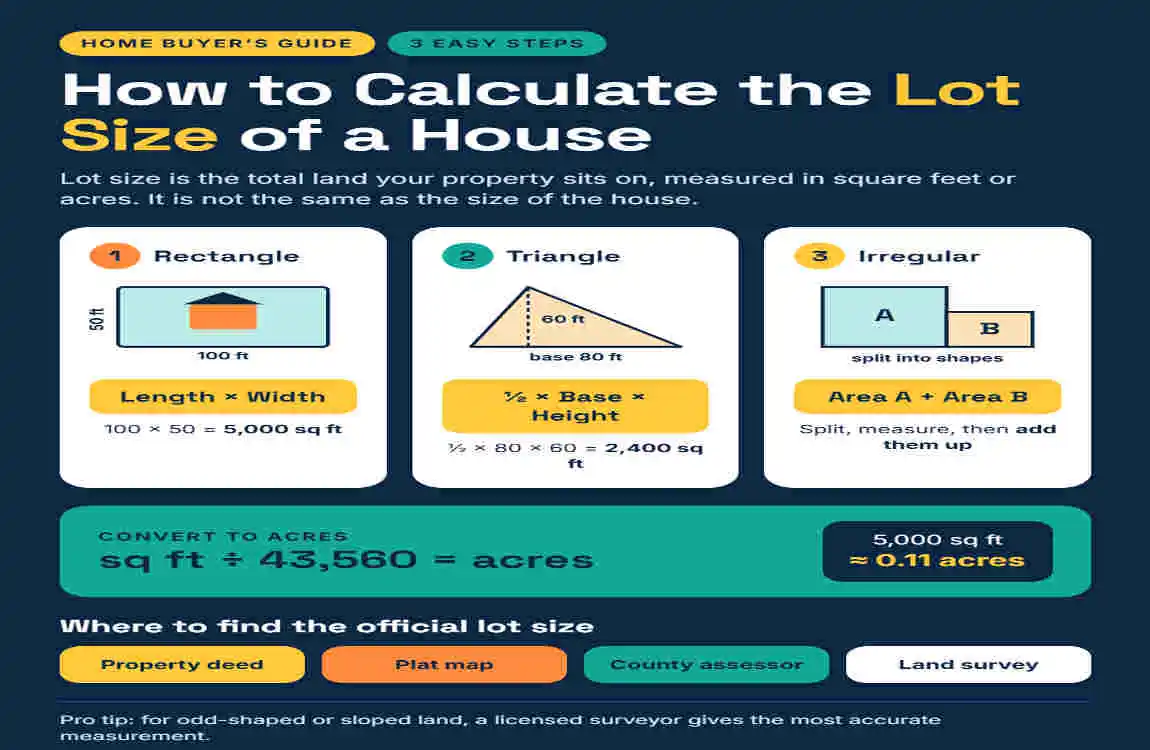
The lot size of a house is the total area of land the property sits on, including the house, yard, driveway and any unbuilt space. It is measured in square feet or acres. To calculate it, multiply the lot’s length by its width (for a rectangle), then divide the result by 43,560 to convert square feet into acres.
If you have ever scrolled through a listing and seen “Lot size: 7,200 sq ft” next to “Living area: 1,850 sq ft,” you have probably wondered why there are two different numbers.
What Is the Lot Size of a House?
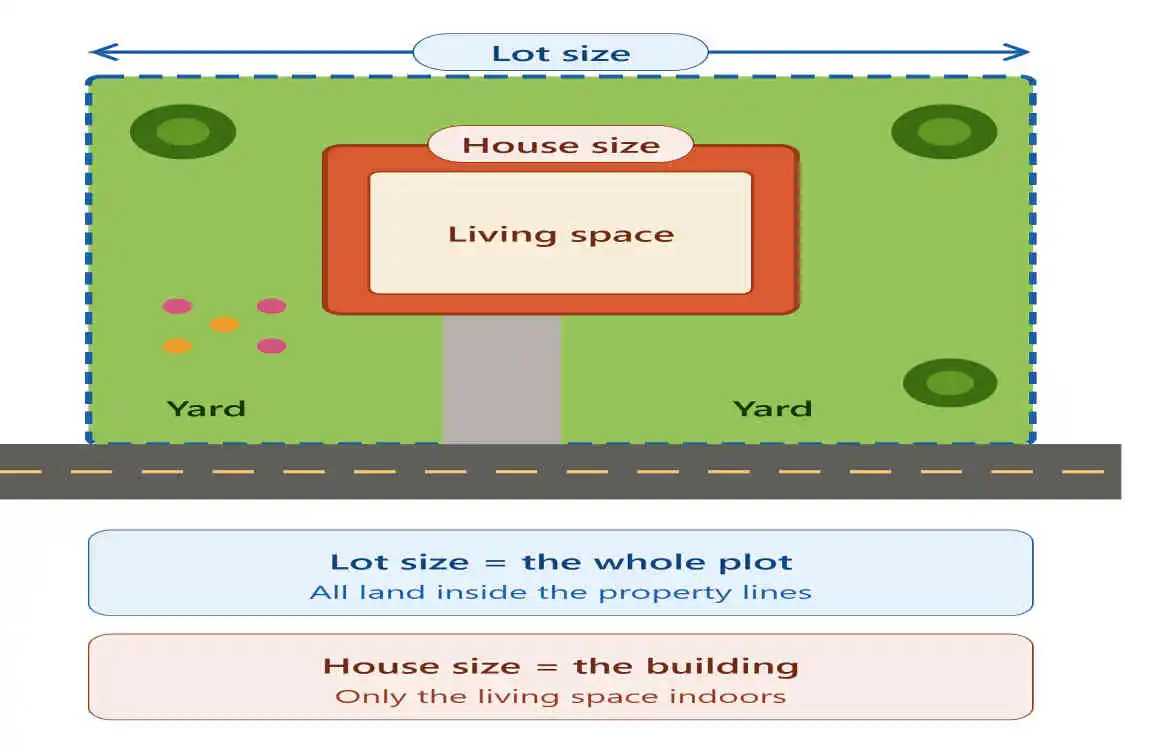
The lot size of a house is the total land area of the parcel the home is built on. It covers everything inside the property lines: the building itself, the front and back yard, the driveway, the garage, a pool, and any empty corners of the plot.
Lot size is not the same as the size of the house. The house is measured by its finished living area (floor space inside the walls). The lot is measured by the ground it occupies. For context, the U.S. Census Bureau reports that the median size of a new single-family home sold in 2024 was 2,210 square feet, which is a measure of the house, not the land beneath and around it (U.S. Census Bureau).
Why Lot Size Matters
Knowing the lot size helps you in several practical ways:
- Pricing and comparison: Two houses with the same floor area can have very different values if one sits on a much larger lot. Lot size is a core property characteristic used when valuing a home.
- Zoning and building rules: Local codes often set minimum lot areas and limit how close a structure can sit to a boundary. Many cities also tie rules about additions, sheds and accessory units to lot size.
- Property taxes: Assessed value usually reflects both land and buildings, so the land area feeds into your tax bill.
- Future plans: Want a pool, a garden suite or a bigger garage? Lot size tells you whether the idea is even realistic.
How to Calculate Lot Size (Step by Step)
For a standard rectangular lot, the math takes less than a minute.
- Measure the length and width of the lot in feet. Use a measuring wheel or long tape, or take the dimensions from your survey, plat map or deed.
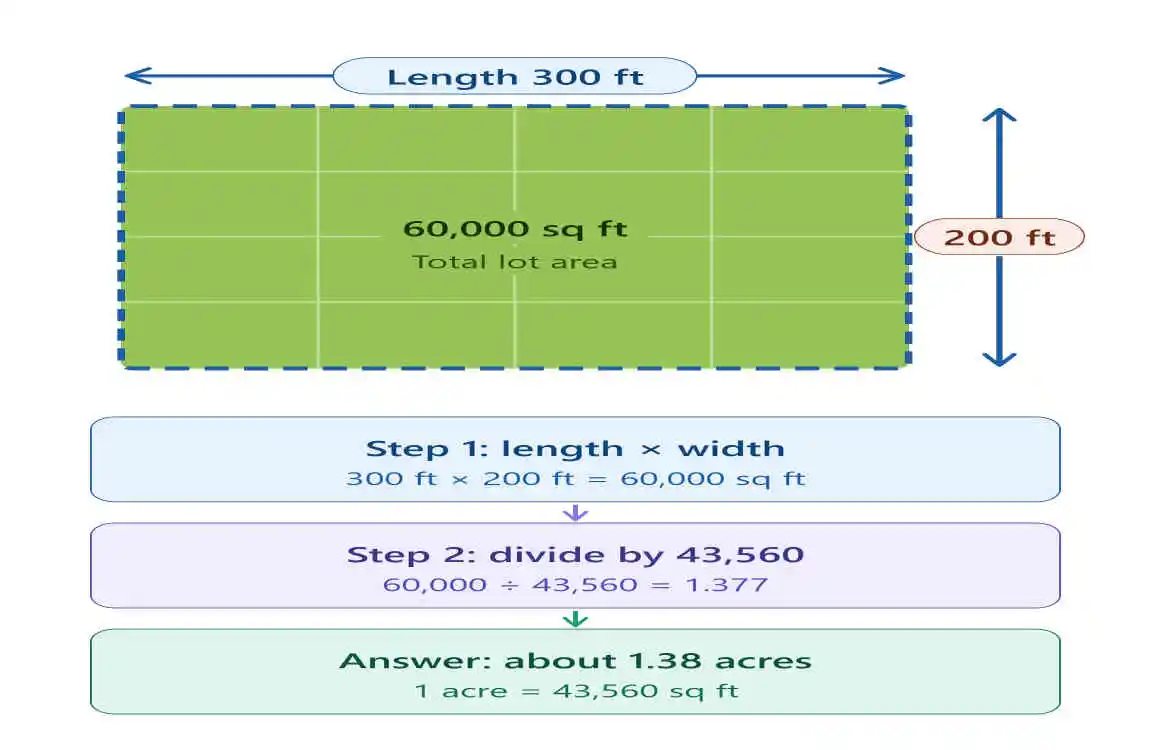
- Multiply length × width. The answer is the lot home size in square feet.
- Convert to acres (optional). Divide the square feet by 43,560, because one acre equals 43,560 square feet.
Formula: Lot size (sq ft) = Length (ft) × Width (ft). Acres = Square feet ÷ 43,560.
Worked example: A lot is 125 feet long and 80 feet wide.
- 125 × 80 = 10,000 square feet
- 10,000 ÷ 43,560 = 0.23 acres
If your measurements are in yards or meters
Multiply the two sides in the same unit first, then convert the area. One square meter equals about 10.764 square feet. For example, a 22 m × 17 m lot is 374 m², which is roughly 4,026 square feet (Omni Calculator). One square yard equals 9 square feet.
How to Calculate an Irregular Lot
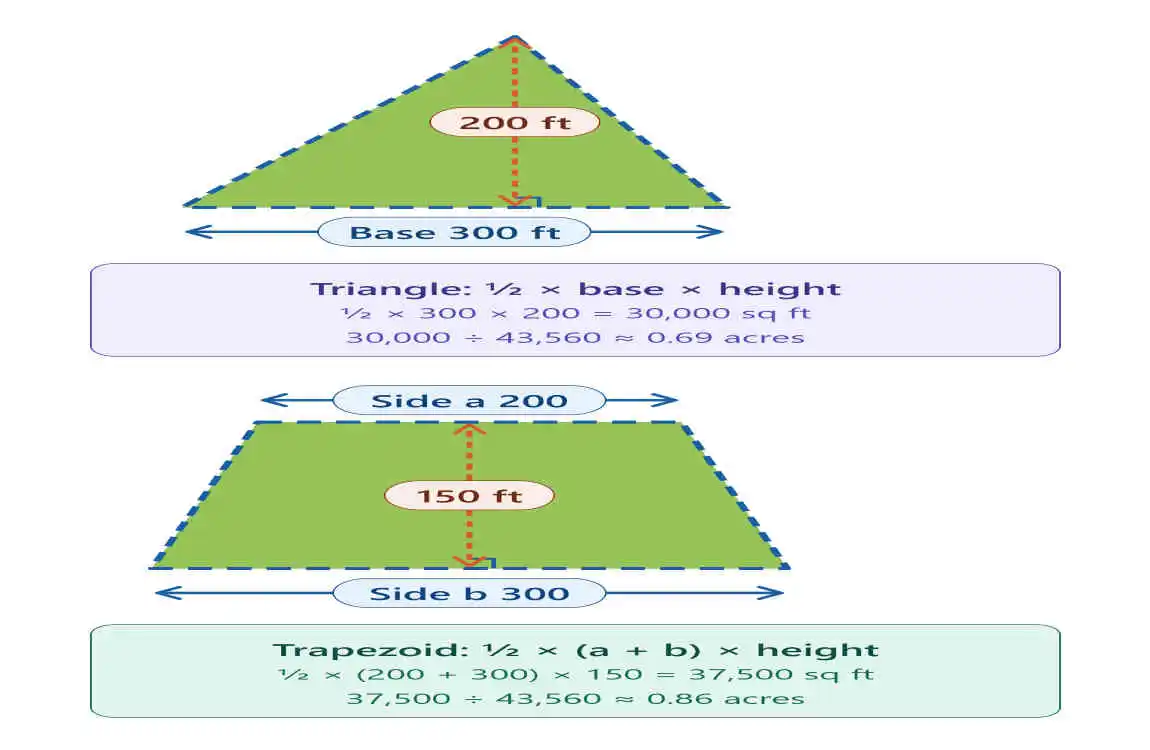
Real estate lots are rarely perfect rectangles. Corner lots, cul-de-sac lots and older parcels can be triangular, wedge-shaped or L-shaped. The trick is to break the lot into simple shapes, calculate each one, then add the areas together.
Triangular lot
Area = ½ × base × height. A triangle with a 100 ft base and 60 ft height gives ½ × 100 × 60 = 3,000 sq ft.
Trapezoid (one pair of parallel sides)
Area = ½ × (side A + side B) × depth. With parallel sides of 80 ft and 60 ft and a depth of 100 ft: ½ × (80 + 60) × 100 = 7,000 sq ft.
L-shaped or multi-sided lot
Split the lot into rectangles, find each area, and add them up. For example, Section A is 100 ft × 60 ft = 6,000 sq ft and Section B is 40 ft × 30 ft = 1,200 sq ft. The total lot size is 7,200 sq ft, or about 0.17 acres.
Pro tip: For curved or very irregular boundaries, estimates from DIY measuring are only approximate. As one city planning department notes, GIS map viewers can give approximate lot size derived from county assessor maps, but a boundary survey provides the most accurate calculation of a lot’s area (City of Menlo Park).
Square Feet to Acres Conversion Chart
One acre equals 43,560 square feet (RISMedia, citing NAHB analysis). To switch units, use these rules:
- Square feet → acres: divide by 43,560
- Acres → square feet: multiply by 43,560
| Acres | Square Feet | Typical Use |
|---|---|---|
| 0.10 | 4,356 | Small urban lot |
| 0.16 | about 7,000 | Compact suburban lot |
| 0.25 (¼ acre) | 10,890 | Common suburban lot |
| 0.33 (⅓ acre) | 14,520 | Larger suburban lot |
| 0.50 (½ acre) | 21,780 | Spacious yard |
| 1.00 | 43,560 | Rural or estate property |
Need a quick mental check? A lot of 10,890 sq ft ÷ 43,560 = exactly 0.25 acre, so any lot near 11,000 sq ft is roughly a quarter acre.
Where to Find Your Lot Size Without Measuring
You do not always need a tape measure. Try these sources, roughly from most to least authoritative:
- A recent boundary survey: The definitive record of your lot’s boundaries, easements and improvements.
- The plat map or deed: Recorded at the county, these list lot dimensions or acreage.
- County assessor or property appraiser website: Most counties publish parcel size in their online records.
- City or county GIS map viewer: Handy for a quick estimate, though not survey-grade.
- The real estate listing: Convenient, but verify it against official records before making an offer.
Lot Size vs. Buildable Area
A big lot does not always mean a big building zone. Setbacks (the minimum required distance between a structure and the property line) shrink the area where you can actually build. A typical example: a requirement of 25 feet at the front, 5 feet on each side and 15 feet at the back (Gen Steel).
Example: Take a 60 ft × 120 ft lot (7,200 sq ft).
- Usable width: 60 − 5 − 5 = 50 ft
- Usable depth: 120 − 25 − 15 = 80 ft
- Buildable area: 50 × 80 = 4,000 sq ft (about 56% of the lot)
Easements, floodplains, slopes and lot-coverage limits can reduce it further, so always check local zoning before planning an addition.
What Is a Typical Lot Size in 2026?
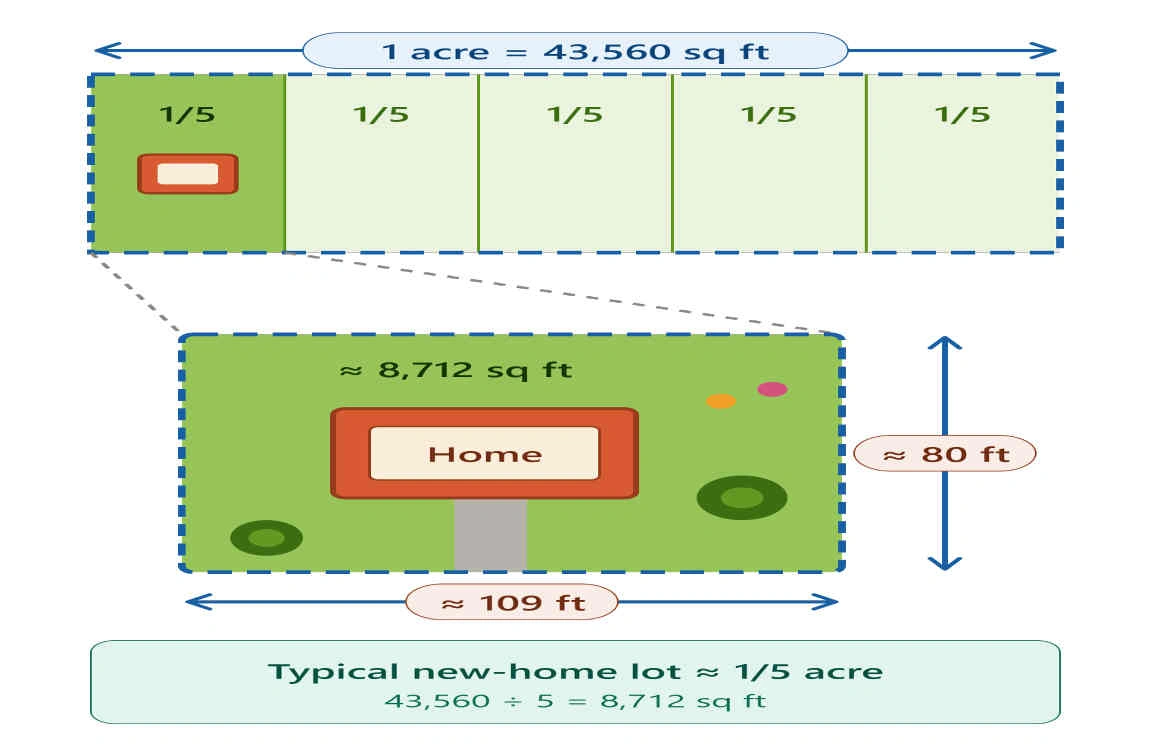
Lots for new homes have been getting smaller for years. According to the Census Bureau’s Survey of Construction, the median lot size of a new single-family detached home sold in 2025 was 8,543 square feet, up slightly from 8,506 square feet in 2024 (NAHB). That is roughly one-fifth of an acre.
Close to two-thirds of new single-family detached homes sold in 2025 sat on lots under 9,000 square feet, compared with fewer than half (46%) when the Census Bureau started tracking the data in 1999 (NAHB Eye on Housing). Custom-built homes tend to sit on much larger plots: the median lot for custom single-family detached homes started in 2025 was one acre (same source).
Location matters a lot. Zillow research has noted that new homes became denser nationwide as lot sizes fell and house sizes grew (Zillow Research), and NAHB’s regional analysis shows New England lots running well above the national median because of strict low-density zoning (NAHB Eye on Housing).
Common Mistakes to Avoid
- Confusing lot size with house size. They are two separate numbers.
- Mixing units. Keep feet with feet and meters with meters before multiplying.
- Forgetting the 43,560 conversion. It is the most frequent error when switching between square feet and acres.
- Assuming the lot is a perfect rectangle. Check the plat or survey for angled or curved boundaries.
- Trusting a listing without verifying. Compare it with county records or a survey.
- Counting setbacks as usable space. Total lot size and buildable area are different things.
Frequently Asked Questions
What is the lot size of a house?
The lot size of a house is the total area of land the property occupies, including the home, yard, driveway and any open space, usually expressed in square feet or acres.
How do you calculate the lot size of a house?
For a rectangular lot, multiply the length by the width in feet to get square feet. Divide by 43,560 to convert to acres. For irregular lots, split the shape into rectangles and triangles, calculate each, and add the areas.
How many square feet are in an acre?
There are 43,560 square feet in one acre. A quarter acre is 10,890 sq ft and a half acre is 21,780 sq ft.
Is lot size the same as square footage of a house?
No. Square footage describes the finished living space inside the house. Lot size describes the land the house sits on.
What is the average lot size for a house?
The median lot size for a new single-family detached home sold in 2025 was 8,543 square feet, about one-fifth of an acre, according to Census Bureau data analyzed by NAHB. Older homes, rural areas and custom builds often sit on larger lots.
Where can I find the lot size of my house?
Check your property survey, deed, plat map or the county assessor’s website. Real estate listings and GIS map viewers are useful for quick estimates, but a boundary survey is the most accurate source.
Does a bigger lot mean a more valuable house?
Not automatically. Land area is one factor, but location, zoning, usable space, topography and the condition of the home also drive value.
Final Thoughts
So, what is the lot size of a house? It is the full footprint of the land that comes with the property, and calculating it is simple: multiply length by width, then divide by 43,560 if you want acres. For odd shapes, break the lot into simple pieces. For anything legal, like a purchase, a fence or a building permit, rely on a licensed survey rather than your own tape measure.
