
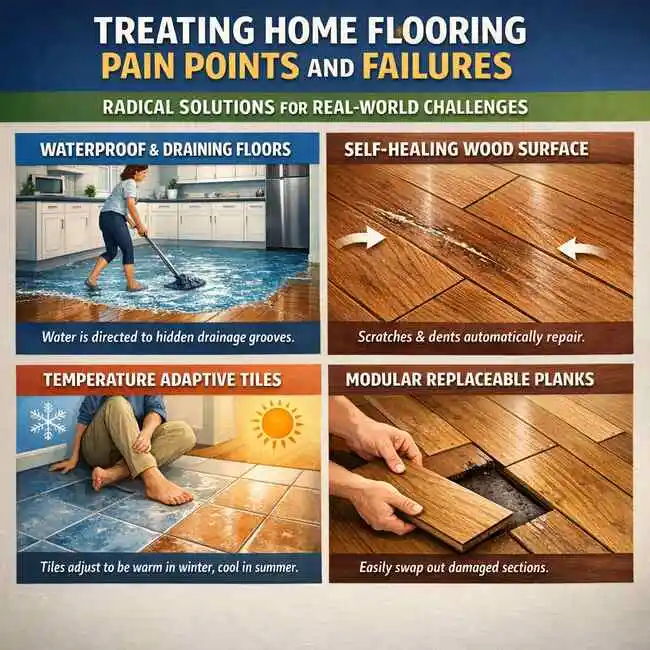
The traditional view of ideal flooring solutions as a purely aesthetic finish—a superficial layer chosen for color or trend is bursting. The perspective flops because it fails to account for the reality of flooring as high-stakes, load-bearing infrastructure. As such, with traditional flooring mentality, the cost of “reactive fixes” has become untenable. However, when you treat a floor as a critical infrastructure, the “pain points” shift from minor complaints to systemic liabilities which needs professional treatment. Here is a breakdown of why this shift is happening, what stakeholders are actually hunting for, and where the industry is heading.
-
Acclimation and Expansion Gap Standard: Preventing Seasonal Buckling
Wood and laminate are living materials. Temperature and humidity changes cause expansion and contraction. Skip proper acclimation or gaps, and floors buckle, tent, or warp.
Strategic interventions include:
- Follow manufacturer’s acclimation instructions—usually 48 hours—to stabilize materials.
- Maintain 1/4 to 3/8 inch expansion gaps around walls, columns, and fixtures.
- Avoid pinning floors under baseboards or cabinets; allow the floor to “float” freely with transition trims.
The “Floating Floor Principle” is a fundamental guideline for preventing long-term structural failure in modern flooring installations.
A floating system means the planks are not mechanically fastened—they aren’t nailed, glued, or screwed to the subfloor. Instead, each plank locks to its neighbors, creating a continuous sheet that rests on an underlayment.
Pinning or forcing a floor under baseboards, kitchen cabinets, or heavy built-in units disrupts this system. When a floor “tents”, the structural integrity of the click-lock mechanism is compromised permanently. Flattening it afterward usually fails because the locking teeth are stretched, broken, or misaligned. To prevent this, Flooring Contractor Indianapolis experts rely on the expansion gap standard; intentionally leaving perimeter gaps for natural movement of the floating floor with changes in temperature and humidity.
-
The Moisture Shield Protocol: Combatting Hidden Dampness
Moisture shield is a strategic, diagnostic-first methodology for flooring installation. It treats moisture not as a minor annoyance, but as a structural threat that must be neutralized before any decorative material is laid down. Moisture quietly lurks basements, slab-on-grade apartments, or high-moisture commercial spaces by infusing in concrete slabs, creeping up walls, and silently destroying finishes over time.
The radical approach:
- Begin with professional moisture testing. Calcium chloride or relative humidity tests reveal unseen threats.
- Install high-performance vapor barriers or roll-on moisture-mitigation primers to neutralize the risk.
For areas prone to water exposure, the answer is material science; like stone-plastic composite (SPC) or 100% waterproof luxury vinyl planks. In older flooring paradigms, “water-resistant” often meant “adding a topical coating to wood or laminate,” which inevitably failed once moisture reached the core. However, these modern solutions represent a fundamental shift in how home owners can approach flooring for high-risk environments.
These aren’t band-aid solutions—they’re foundational interventions. Investors and property managers often see instant ROI: fewer callbacks, longer-lasting finishes, and less liability from mold or water damage. When moisture is tamed, your flooring performs as intended.
-
The “Leveling Groundwork” Mandate: Eliminating Joint Failure
Even the most luxurious flooring can fail if the foundation is uneven. Laminate and vinyl are particularly sensitive—misaligned planks result in joint peaking, audible clicking, and early degradation of locking systems.
Pro-level strategy:
- Never assume the subfloor is level.
- Use self-leveling compounds or a plywood underlayment to create a flat, even plane.
- Distribute loads evenly to prevent stress points across the floor’s locking system.
For example, the constant flexing on tongue-and-groove “click” flooring mechanisms puts massive, repetitive pressure on the tiny, fragile plastic “teeth” of the locking mechanism. Eventually, those plastic teeth snap or fatigue. This is when you see “joint peaking” (the seams pop up) or “audible clicking” (the floor sounds hollow or creaks).
As such, the strategy is leveling ground work that turns the entire subfloor into a solid, unified surface. When the subfloor is perfectly level, the weight of a person or a heavy piece of furniture is transferred directly into the subfloor rather than being focused on the tiny, weak locking teeth of the planks.
-
Acoustic Decoupling: Designing for Silence
Footsteps, dropped objects, and furniture on hard surfaces create more than noise—they create complaints. In high-end real estate, noise is the #1 complaint from tenants and owners. If you are working in luxury apartments or offices, this is not just an add-on—it is a functional requirement that dictates property value.
High-performance approach:
- Rubber, high-density foam, or cork creates a mechanical barrier. These materials are “viscoelastic,” meaning they compress and absorb energy rather than reflecting it.
- Also, using materials with high IIC Ratings means significantly insulating the floor, muffling footsteps and dropped objects.
For developers and architects, sound management isn’t optional—it’s a value enhancer. Quiet, comfortable floors increase tenant satisfaction, raise property appeal, and demonstrate attention to quality. Acoustic strategy is subtle, but it communicates intentional design and professionalism.
-
High-Traffic and Pet-Resilient Flooring: Durability That Performs
Daily life is relentless. Pets, kids, and heavy foot traffic test floors in ways that cheap finishes cannot withstand. Scratches, dents, and wear are inevitable—but preventable with strategy.
Expert guidance:
- Luxury Vinyl Plank (LVP): Choose wear layers of 12–20 mil for scratch and impact resistance.
- Hardwood: Species like Oak or Hickory, or engineered wood with aluminum oxide finishes, resist denting and abrasion.
- Textured finishes: A solution like EIR with a safety-aligned feature that shifts the conversation from “what looks pretty” to “what works for your lifestyle. The texturization prevent slip hazards for humans and pets.
These solutions collectively represent systemic approach to lifestyle-resilient flooring. They are the tactical answers to the high-traffic and pet-resilient pain points.
-
Climate-Specific Material Matching: Aligning Floors to Environment
Environmental compatibility is a critical mandate when it comes to flooring. The biggest hidden risk? Flooring experts understand that geography and room function dictate the physics of the floor.
Climate-aligned solutions:
- High moisture areas: Porcelain or ceramic tiles, or waterproof SPC.
- Fluctuating climates: Engineered hardwood or SPC designed to resist expansion and contraction.
- High-use, budget-conscious: AC4 or AC5 rated laminates for scratch resistance and longevity at a lower cost.
Flooring experts perform a diagnostic match between the physical requirements of a space and the chemical/structural properties of the material. It’s foresight, not guesswork.
In essence, floors are not cosmetic—they are infrastructure, strategy, and long-term investment all in one. By addressing moisture, leveling, acclimation, acoustics, durability, and climate compatibility, you’re doing more than installing surfaces—you’re protecting value, improving comfort, and setting a standard for quality that lasts. In flooring, radical foresight beats reactive fixes every time.
