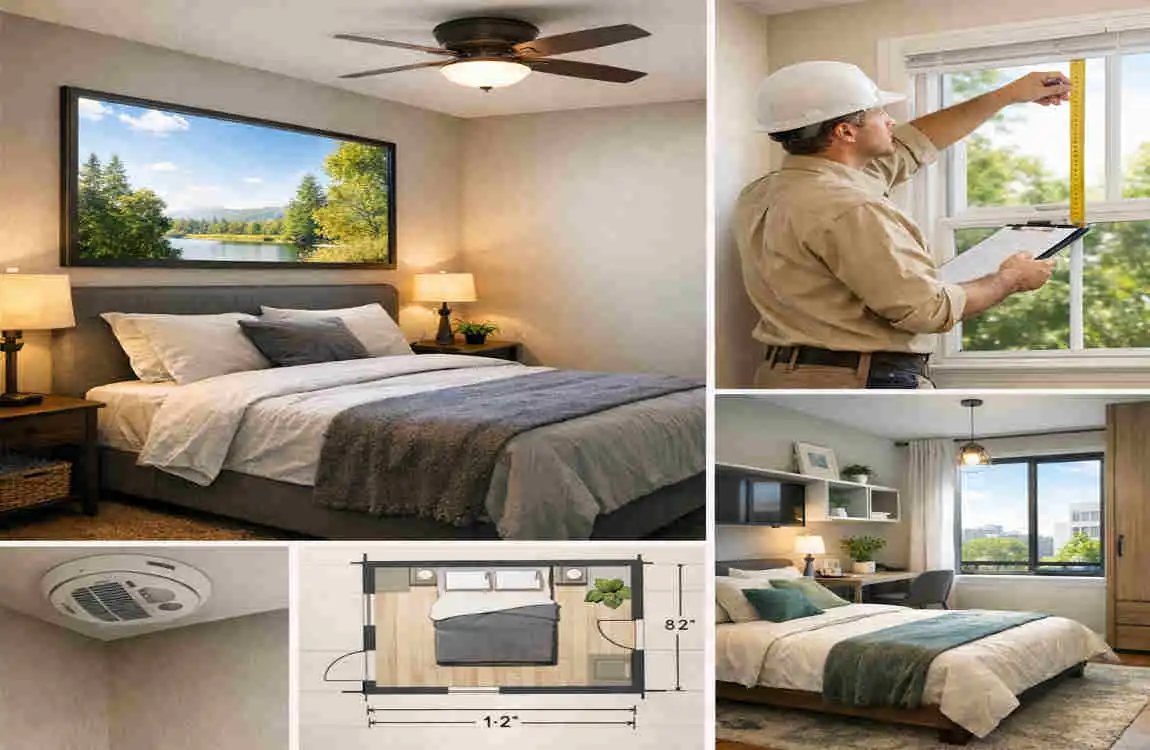
Meta Description: Wondering, “Do bedrooms have to have windows”? Discover U.S. legal requirements, state variations, safety reasons, and clever hacks for windowless designs in homes.
Picture this: You are walking through a potential new home or looking at the blueprints for a basement renovation. You spot a room that looks perfect for a guest suite or a teenager’s hideaway. It has four walls, a door, and a closet. But there is one glaring omission—there is no window.
This stops you in your tracks. Can you legally call this space a bedroom? Is it safe to have someone sleep there? If you are a homeowner looking to sell, or a contractor planning a remodel, the answer to the question “Do bedrooms have to have windows?” is critical. It affects everything from your property value to your family’s safety.
Legal Requirements: The Rulebook for Bedrooms

When asking if a bedroom needs a window, we aren’t just talking about aesthetics or getting a nice breeze. We are talking about the law. Building codes are strict, and for good reason. Let’s look at the rulebook that governs most of the United States.
IRC Bedroom Window Rules: The Gold Standard
Most local building codes in the U.S. are based on the International Residential Code (IRC). This is the standard that dictates what makes a house safe. According to the IRC (specifically section R310.2), a room generally cannot be classified as a bedroom unless it has a designated “Emergency Escape and Rescue Opening.”
In industry terms, we call this an egress window.
The code doesn’t just say “put a window in.” It gets very specific about the size and accessibility. Why? Because in the event of a fire, a firefighter needs to be able to fit through that window with a full oxygen tank on their back, or they need to be able to climb out.
Here are the IRC requirements you need to memorize:
- Minimum Opening Area: The window must provide a clear opening of at least 5.7 square feet. (Note: If it’s a ground-floor bedroom, this can sometimes be 5.0 square feet).
- Minimum Opening Width: The opening must be at least 20 inches wide.
- Minimum Opening Height: The opening must be at least 24 inches high.
- Sill Height: The bottom of the window opening (the sill) cannot be more than 44 inches from the floor. This ensures that an average person can lift their leg over it to escape.
- Operability: You must be able to open the window from the inside without using keys, tools, or special knowledge. No removing grates with a screwdriver while the smoke alarm is blaring!
Important Math Note: You might notice that 20 inches x 24 inches equals 480 square inches, which is only 3.33 square feet. This means a window with the minimum width and minimum height won’t meet the total square footage requirement. To hit that 5.7 sq. ft. mark, if your window is 20 inches wide, it needs to be at least 41 inches high!
State & Local Variations: It’s Not the Same Everywhere
While the IRC is the baseline, states and cities love to add their own flavor to the rules. Before you knock down a wall or list your home, you have to check your local amendments.
- California: The Golden State is strict about light and ventilation. California code generally requires that the window glass area be at least 8% of the room’s floor area, with half of that area openable for ventilation.
- New York: In NYC, “legal bedrooms” are a hot topic. A bedroom usually must have a window opening to a street, garden, or courtyard. Internal windows (facing another room) generally don’t count for legal bedroom status.
- Florida: Given the weather, Florida codes often require impact-resistant glass for egress windows to withstand hurricanes, which adds a layer of cost and complexity.
- Texas: Some local codes in Texas focus heavily on minimum room dimensions (e.g., a bedroom must be at least 70 square feet) in addition to the window requirement.
Egress for Basements & Additions
This is where homeowners run into the most trouble. You finish the basement, throw up some drywall, and want to call it a “4th Bedroom.”
Stop right there.
Basement bedrooms have the strictest scrutiny. Because they are below ground, you usually need to install an egress window well. This involves digging out the dirt outside the window to create a space large enough for a person to climb into and out of.
- New Builds vs. Renovations: If you are building a new home, the architect will include this. But in a renovation, adding an egress window often involves cutting through the concrete foundation.
- The Risks: If you skip this step, you are looking at significant fines. Worse, if there is a fire, your insurance company may void your policy because the work wasn’t code-compliant. And legally, you cannot list the home with that extra bedroom, which kills its resale value.
Quick Reference: Code Requirements
To help you visualize the differences, here is a breakdown of the standard rules versus common local add-ons.
Code AspectIRC Minimum StandardCommon State Add-Ons
Net Clear Opening 5.7 sq ft (5.0 for ground floor) CA: Window size must be 8% of floor area
Minimum Width 20 inches NY: Must face street/yard (no light shafts)
Minimum Height 24 inches , Chicago: Strict ventilation requirements
Max Sill Height 44 inches from floor FL: Impact-rated glass required
Operation: No tools/keys required. All: Must open directly to the outside
Why Windows Matter It’s Not Just Red Tape
It is easy to get frustrated with building codes and view them as bureaucratic hoops to jump through. But when it comes to bedroom window requirements, the rules are written in ink, but they are based on history written in tragedy.
Safety & Egress: The 3-Minute Rule
The primary function of a bedroom window isn’t the view; it is the escape route.
Fire safety experts often cite the “3-minute rule.” In modern homes, filled with synthetic materials that burn hot and fast, you may have as little as three minutes to escape a fire once the alarm sounds. If the bedroom door is blocked by fire or smoke, the window is your only way out.
If that window is painted shut, too small to crawl through, or blocked by furniture, it is a death trap. This is why the code insists on “operability without tools.” In a panic, you cannot be fumbling for a key.
Health & Ventilation
Have you ever spent a long time in a windowless room, like a casino or a basement storage area? You start to feel groggy and disoriented.
- Circadian Rhythms: Our bodies are biologically wired to sync with the sun. Natural light regulates our sleep-wake cycle. A bedroom without natural light can disrupt sleep quality and mood.
- Air Quality: Bedrooms accumulate carbon dioxide (CO2) from our breathing as we sleep. Without ventilation (fresh air), CO2 levels rise, leading to stale air, headaches, and grogginess in the morning. Windows also help vent out moisture, preventing mold growth in your sleeping quarters.
Resale & Insurance
From a business perspective, the difference between a “3-bedroom home” and a “2-bedroom home with an office” can be tens of thousands of dollars.
- Appraisals: An appraiser cannot legally count a room as a bedroom if it lacks an egress window. If you list it as such, you risk the buyer’s financing falling through when the bank realizes the discrepancy.
- Liability: If you sell a home claiming it has a legal bedroom when it doesn’t, you open yourself up to lawsuits later on, especially if the new owner discovers the code violation.
Windowless Bedrooms: Myths vs. Facts
There is a lot of confusion online about loopholes. Let’s debunk the myths surrounding the query “Do bedrooms have to have windows?”
Myth: “If it has a closet, it’s a bedroom.”
Fact: False. A closet is a convenience; a window is a safety requirement. You can have a bedroom without a closet (in older homes), but you generally cannot have one without a window.
Myth: “I can just install a vent fan.”
Fact: A mechanical vent helps with air quality, but it does not solve the egress (escape) requirement. Unless you can crawl through the vent fan to the outside (which you can’t), it doesn’t meet code for a sleeping room.
Myth: “Grandfather clauses protect me.”
Fact: Sometimes, but rarely for safety issues. If you have a historic home built in 1900, it might not need to meet today’s dimensions exactly. Still, if you do any major renovation, the city will almost certainly force you to upgrade the windows to current safety standards.
Myth: “I can use a skylight as egress.”
Fact: Only if it meets specific criteria. It must be within 44 inches of the floor (rare for skylights) or have a permanent ladder attached, and it must open wide enough. Most skylights are for light, not escape.
Smart Design Hacks for Difficult Spaces

So, you have a room that needs to be a bedroom, but the window situation is tricky. It could be in a basement, or the layout is tight. What can you do?
Here are some smart design hacks and renovation tips to navigate these constraints while staying compliant or maximizing utility.
The “Egress Well” Solution
For basement bedrooms, digging an egress well is the standard solution. It turns a dark dungeon into a legal, bright bedroom.
- Design Tip: Don’t just put a metal grate over it. Use terraced landscaping steps inside the well. This allows you to place potted plants on the “steps,” making the view from inside the basement look like a garden rather than a corrugated metal wall.
High Transom Windows
If you need privacy or have furniture against the wall, consider high “clamshell” or awning windows.
- The Hack: As long as the opening meets the size rules and isn’t higher than 44 inches from the floor, the glass can extend upwards. However, for high-privacy windows, you might need a built-in step or platform to ensure the sill height meets the 44-inch rule.
Sun Tubes Solatubes
If you cannot cut a window into a wall because of property lines (e.g., in a row house), you can bring light in from above.
- How it works: A reflective tube runs from the roof down to the ceiling of the room. It amplifies natural light significantly.
- Code Note: This solves the light requirement in some stricter codes, but it does not solve the egress requirement. You would still need a door that leads directly to the exterior or another approved exit method, depending on your specific jurisdiction’s “change of use” rules.
Mechanical Solutions The “Faux” Window
If you accept that the room cannot legally be a bedroom but still want to use it as a guest sleeping area (non-conforming), you need to address the psychological impact of being windowless.
- Lighting: Use full-spectrum LED lighting that mimics daylight. Install these behind a frosted piece of glass framed like a window. It tricks the brain into thinking sunlight is streaming in.
- Mirrors: Place a large mirror on the wall opposite the door. It reflects depth and light, reducing claustrophobia.
Comparison of Solutions
HackLight BenefitCode Compliance (Egress)Estimated Cost
Egress Window Well High Yes (Full Compliance) $2,500 – $5,000
Sun Tubes High No (Supplemental only) $500 – $1,000
Mechanical Vent Low (Air only) No $300 – $600
Faux LED Window Medium No $200 – $500
Renovation Tips for Your Business
If you are a contractor or in the remodeling business, this is a massive opportunity.
- Educate Clients: Many homeowners don’t know that adding an egress window can instantly add $10,000+ to their home’s value by creating a legal bedroom.
- Package Services: Offer “Basement Legalization Packages” that include concrete cutting, window installation, and well landscaping.
International Comparisons
While this article focuses on the U.S., the question “Do bedrooms have to have windows?” is global.
- United Kingdom: The rules are slightly different. A habitable room generally requires glazing (glass) equivalent to 1/20th of the floor area. Ventilation is also strictly mandated.
- Canada: Canadian codes are very similar to the U.S. IRC, focusing heavily on egress size for fire safety, especially in cold climates where windows might be frozen shut (hence the need for high-leverage opening mechanisms).
Regardless of where you are, the logic remains: Humans need light, air, and a way out.
Frequently Asked Questions (FAQ)
To wrap up, let’s hit some of the most common questions we get asked about bedroom window requirements.
Do bedrooms have to have windows in every state?
Yes, essentially. While local codes vary slightly on dimensions, every state adopts some version of the fire and building codes that mandate a secondary means of escape (egress) for sleeping rooms.
Can a bedroom have a window that faces the hallway?
Generally, no. For a window to count as an egress window, it must open to the exterior of the home (a yard, court, or public way). A window facing a hallway does not help you escape if the house is on fire. However, “borrowed light” windows can be used for aesthetic light if a separate legal egress window exists.
Is a windowless basement bedroom legal?
No. To be legally classified as a bedroom, a basement room must have an egress window or a door that leads directly to the outside. Without it, real estate agents must list it as an “office,” “den,” or “bonus room.”
What if I add mechanical ventilation?
Mechanical ventilation (like an AC duct or exhaust fan) satisfies the ventilation requirement in some codes, but it never satisfies the egress (escape) requirement. You still need a way out.
Can I remove a window in a bedroom remodel?
You can, but you cannot legally call it a bedroom anymore. If you remove the only window, you are officially changing the use of that room to a non-sleeping area (like a storage closet or media room).
Do you have a space you’re trying to convert? Whether you need professional window installation, concrete cutting for egress wells, or a full remodel design, ensuring code compliance is the first step toward a safe, valuable home. Don’t guess with safety—build it right.