
When a winter storm takes out the grid, nobody wants to find out their new generator can’t start the furnace fan and the fridge at the same time. So, what size generator do I need for a house? The honest answer is that it depends on what you want running when the power goes out, not just how big your home is.
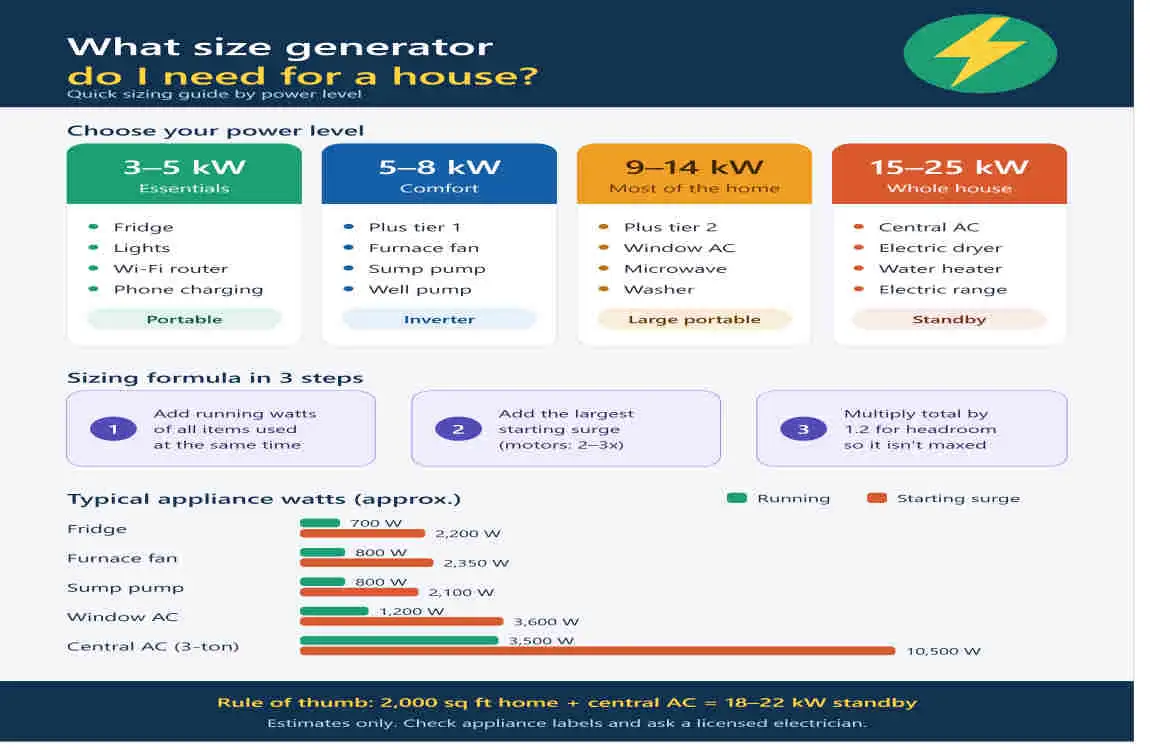
Quick answer: Most homeowners land somewhere between 5 kW and 26 kW. A 5–10 kW unit covers essentials (fridge, lights, furnace fan, sump pump). Whole-home backup that includes central air typically falls in the 14–26 kW range. One consumer guide puts most homes at 12 to 20 kW, and a licensed electrician should confirm the final number.
Watts, kW and starting surge explained
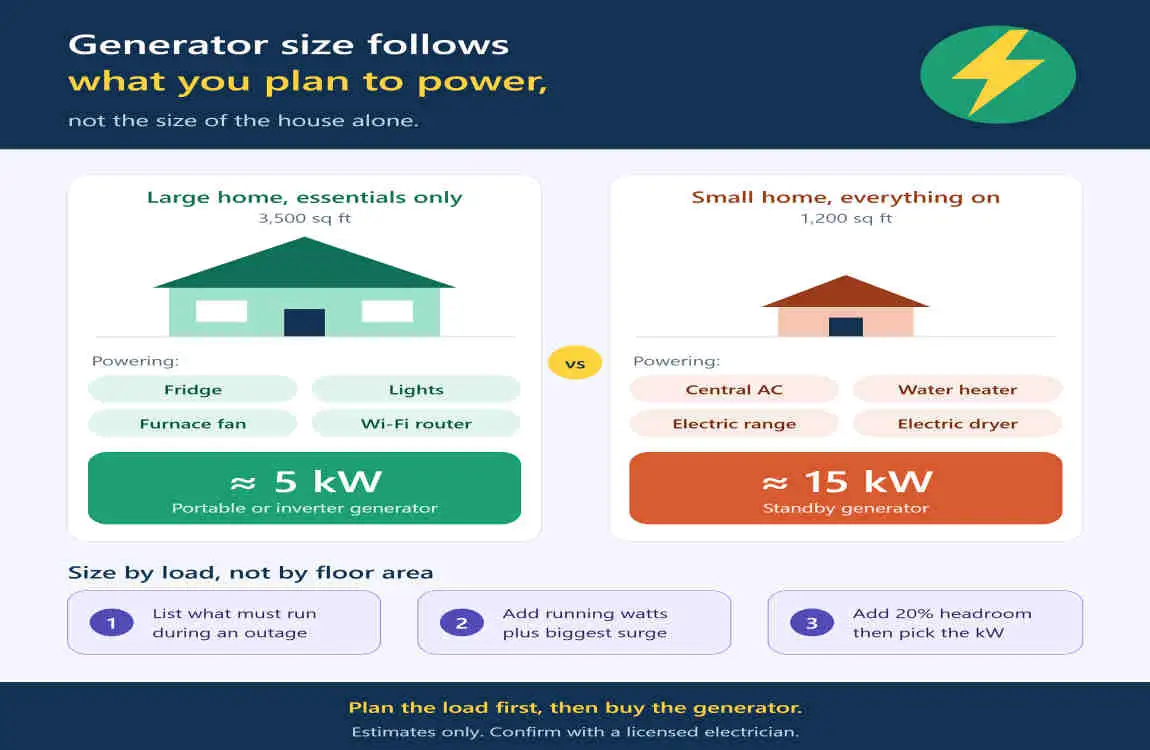
Generators are rated in watts or kilowatts (1 kW = 1,000 watts). Two numbers matter when you shop:
- Running watts are what an home appliance draws once it’s up and going.
- Starting (surge) watts are the brief spike motors need to get moving. Air conditioners, well pumps, sump pumps and refrigerators all do this.
The surge is where people get caught out. A generator that handles your running loads on paper can still stall when the AC compressor kicks on. That’s why sizing guides keep telling you to plan for the largest starting load, not just a simple total.
How to calculate your generator size (4 steps)
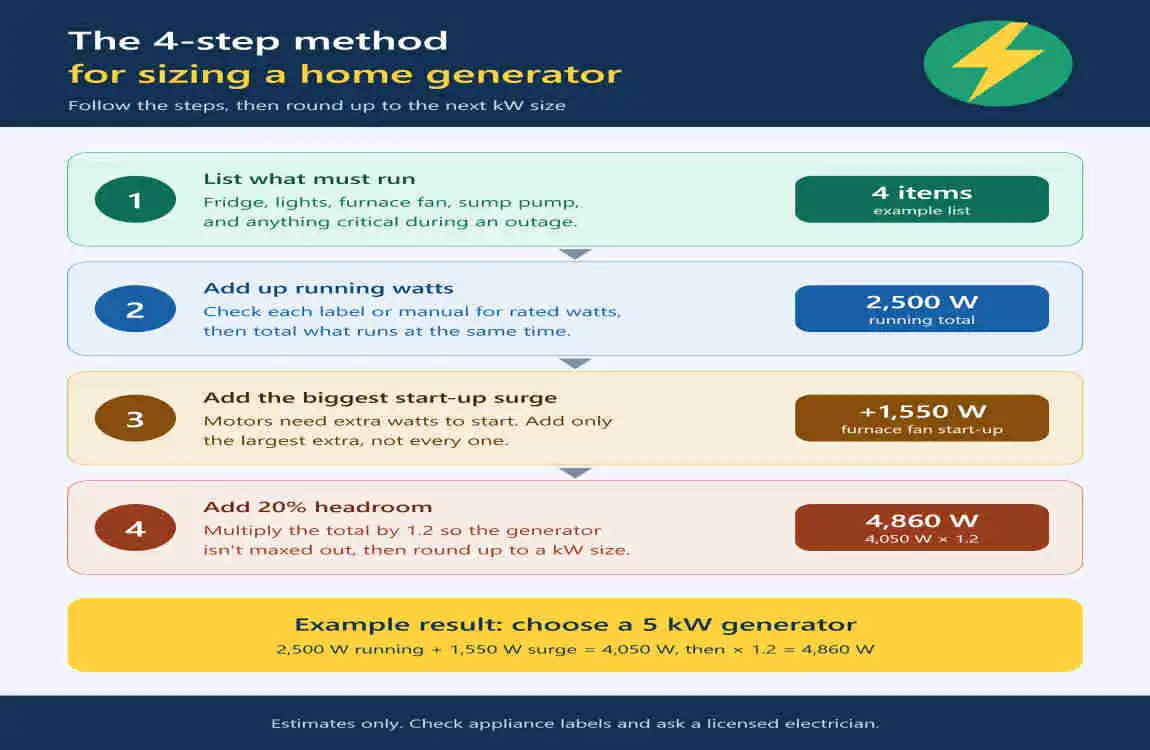
List what you want to power
Walk through the house and write down everything that has to keep working. Be honest about “must have” versus “nice to have.” A fridge and a furnace fan are must-haves. The electric dryer probably isn’t.
Find each appliance’s running watts
Check the label on the appliance or its manual. The U.S. Department of Energy explains how to estimate appliance and home electronics energy use, including using a plug-in usage monitor for 120-volt devices. The DOE also notes that a fridge doesn’t draw its maximum wattage constantly, so don’t assume it runs flat out all day.
Add the biggest starting surge
You don’t add every appliance’s surge together, because motors rarely all start at the same instant. Take the one biggest starting load, usually the AC compressor or a well pump, and add its extra starting watts on top of your running total. Many motor loads need a couple of times their running watts to start, but the exact multiple varies by model, so check the spec sheet. A soft-start kit on an AC unit can reduce that spike.
Add a buffer and round up
Consumer Affairs recommends adding 20% to 30% to your total so you aren’t running the generator at its limit. Then round up to the next available size.
A worked example
Here’s an illustrative (not exact) calculation for a family that wants essentials plus central AC:
| Load | Running watts (approx.) |
|---|---|
| Refrigerator | 200 |
| Chest freezer | 200 |
| LED lights | 200 |
| Furnace fan | 700 |
| Sump pump | 800 |
| Wi-Fi, TV, chargers | 400 |
| Microwave | 1,000 |
| Central AC (3-ton) | 3,500 |
| Running total | 7,000 |
| Extra to start the AC (assuming roughly a 3x surge) | +7,000 |
| Peak demand | 14,000 |
| With a 25% buffer | ≈ 17,500 W, so look at an 18 kW unit |
Notice how one appliance drives the result. Without central AC, the same household could get by with a much smaller generator. That’s why deciding what to leave off the list is the cheapest way to save money.
Generator size by home size
Square footage is a rough starting point, not a final answer. Bob Vila’s guide to choosing a generator size makes the same point: you need to account for both your home’s size and the appliances you’ll use during an outage. With that caveat, here are the ranges the sources point to:
| Backup level | What it usually covers | Typical size |
|---|---|---|
| Essentials | Fridge, lights, furnace fan, sump pump, phone charging | 5–10 kW |
| Select loads | Essentials plus a few extras, often a window AC or well pump | 10–14 kW |
| Typical whole-home | Most circuits including central AC | 14–26 kW |
| Large home | Big homes, multiple electric loads | 22–30 kW |
On square footage specifically, ConsumerAffairs suggests around 12 to 20 kW for a 2,000-square-foot house and 22 to 30 kW for a 3,000-square-foot house when you want whole-home coverage. PES Supply’s 2026 whole-home sizing guide reminds readers that “whole home” isn’t a size at all. It’s a load calculation.
What pushes your number up
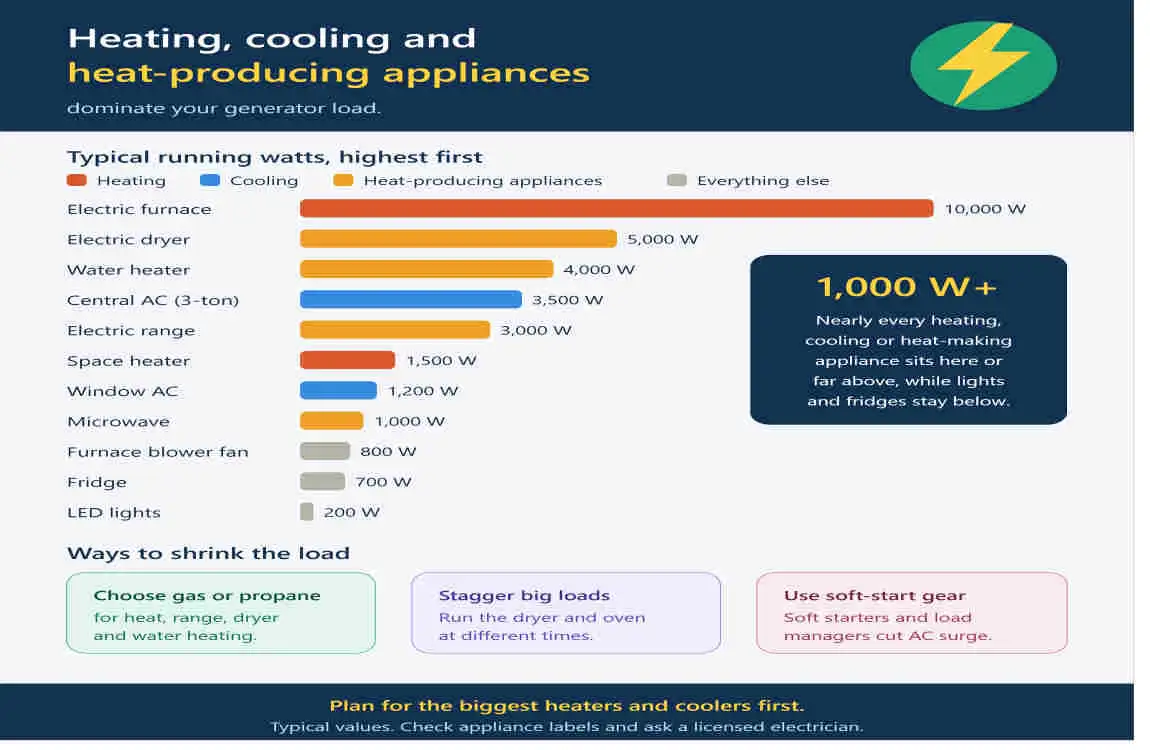
- Central air conditioning. It’s usually the single biggest running and starting load in the house.
- Electric heat or an electric furnace. Electric furnaces can need 15,000 watts or more on their own, which is why homes with electric heat often jump a size class.
- Well pumps. They’re motor loads with a high starting surge, and without water you can’t flush or shower.
- Electric water heater, range and dryer. Big resistive loads that eat capacity fast.
- EV charging. A Level 2 charger can add several kilowatts. Most people simply skip it during outages.
- Panel size. You’ll usually need at least 200-amp service for a whole-home generator, but a 200-amp panel does not mean you need a giant unit. One industry guide notes that most 200-amp homes peak under 15 kW of actual diversified load.
Portable vs. standby generators
The size you need also nudges you toward a type:
- Portable generators are flexible and cheaper, and they suit essentials. You run extension cords or a properly installed transfer switch, and you refuel by hand.
- Standby (whole-house) generators are permanently installed, wired into your electrical system and typically run on natural gas or propane. Bob Vila’s overview describes them as permanent installations that can meet the demands of an entire house.
Standby units cost considerably more, and installation requires permits and a licensed electrician. One retailer’s sizing guide calls a whole-home standby purchase a $5,000–$15,000 decision, which is exactly why getting the size right matters.
Common sizing mistakes
- Sizing to the panel, not the load. Your 200-amp panel is a ceiling, not a target.
- Ignoring starting watts. The generator trips the moment the AC or pump starts.
- Skipping the buffer. Running at 100% all night shortens equipment life and leaves no room for a new appliance.
- Oversizing “just in case.” You pay more upfront and burn more fuel at low load. Undersizing and oversizing both cost money.
- Guessing wattage. Look at the labels. Older appliances often draw more than new efficient ones.
- Skipping the pro. Consumer Affairs says it plainly: it’s best to have a professional size your generator, since they weigh all of these factors together.
Safety you can’t skip
Carbon monoxide is the real danger. The U.S. Consumer Product Safety Commission says one portable generator can produce as much carbon monoxide as hundreds of cars, and the poisoning risk can kill in minutes.
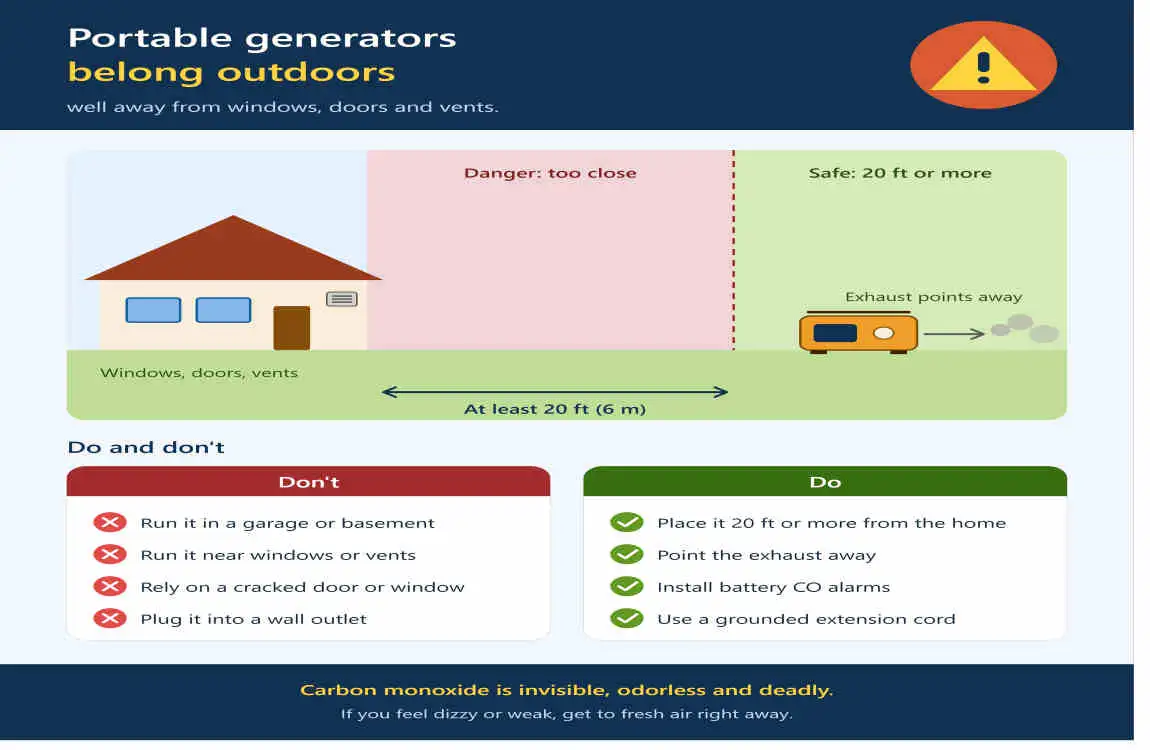
- Run portable generators only outdoors. Never in a garage, basement or shed, even with the door open.
- Consumer advocates, citing CPSC findings, recommend positioning the exhaust about 20 feet from the home and away from windows, doors and vents.
- Install and test battery-backed CO alarms.
- Never plug a generator into a wall outlet to power the house (“back feeding”). Use a properly installed transfer switch or interlock. It protects utility workers and your home. The Department of Energy covers this in its guidance on using portable emergency generators safely.
Frequently asked questions
What size generator do I need to run a whole house?
Most whole-home setups land between 14 kW and 26 kW, but your own load calculation decides it. Add running watts, add the largest starting surge, then add a 20–30% buffer.
Will a 5,000-watt generator run a house?
It can handle essentials such as a refrigerator, lights, a furnace fan and a sump pump. It generally can’t also run central AC, an electric dryer or an electric range.
What size generator do I need for a 2,000-square-foot house?
Roughly 12–20 kW for whole-home coverage. If you have electric heat, electric water heating or a well pump, expect the higher end or more.
Is a 22 kW generator enough for a house?
For most typical homes with a 200-amp panel, yes, including central air. Very large homes with many electric loads may need more capacity or load management.
Is it better to oversize or undersize a generator?
Neither. Undersizing causes overloads and stalled starts. Oversizing wastes money and fuel. Aim for your calculated load plus a 20–30% buffer.
Final Thoughts
If you only remember one thing, make it this: write down what you actually need to run, find the real watts, account for the biggest motor start, and add a buffer. For essentials, 5–10 kW is often enough. For a whole house with central air, think 14–26 kW. Before you spend thousands of dollars, have a licensed electrician check your numbers, your panel and your local permit rules.
