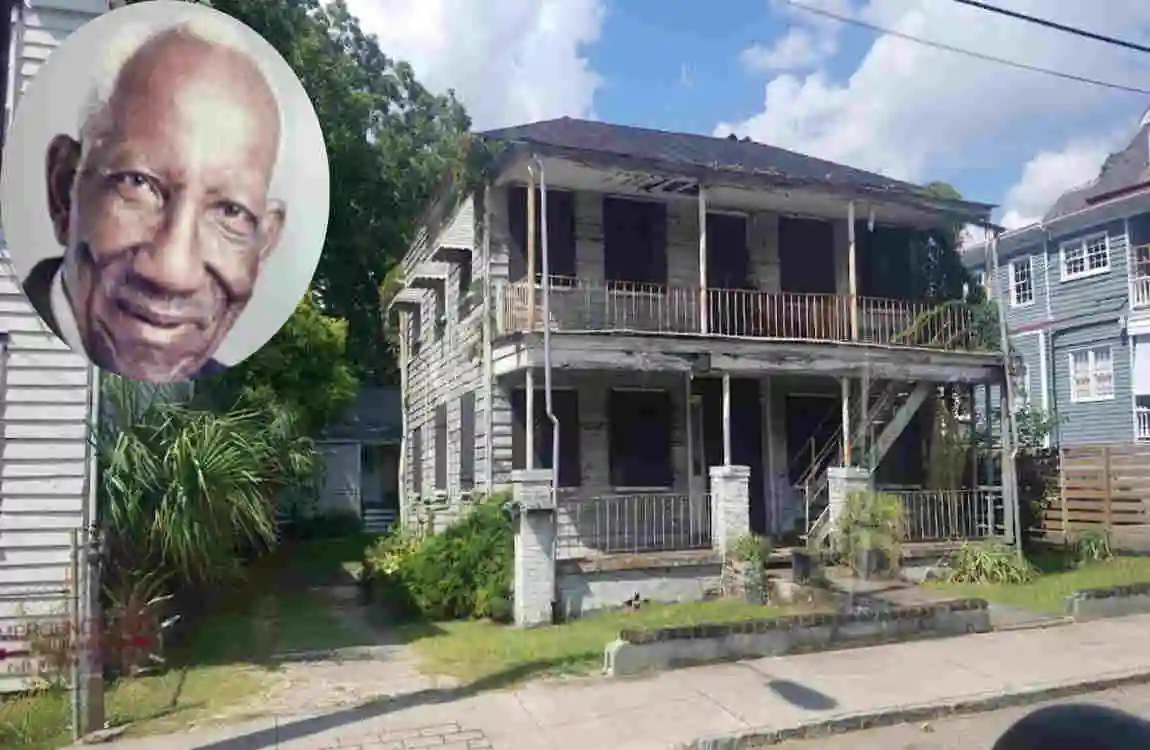
Imagine walking through the cobblestone streets of Charleston, South Carolina. You hear the rhythmic clink-clink-clink of a hammer hitting an anvil. For over eight decades, that sound was the heartbeat of the Eastside neighbourhood. It was the sound of Philip Simmons, the “Keeper of the Gate,” transforming cold, hard iron into delicate palmetto leaves and soaring birds.
However, in late 2025, a different sound threatened the air: the heavy rumble of demolition machinery. The Philip Simmons House, located at 30 Blake Street, stood on the brink of being erased from the map. This wasn’t just about a pile of bricks and wood; it was about the soul of Charleston’s African American craftsmanship.
Philip Simmons: The Blacksmith Legend
To understand why the Philip Simmons House is so important, we first have to understand the man who called it luxury home. Philip Simmons wasn’t just a blacksmith; he was a poet who used fire and iron instead of pen and paper.
From Apprentice to Master
Born in 1912 on Daniel Island, Simmons moved to Charleston as a young boy. At the tender age of 13, he began an apprenticeship with Peter Simmons (no relation), a former slave who ran a blacksmith shop. Back then, blacksmithing was a utilitarian trade. You fixed wagon wheels, sharpened tools, and made horseshoes.
But as the 20th century progressed, the world changed. Cars replaced wagons. The demand for “fixing things” dropped, but the demand for “beautiful things” rose. Simmons pivoted. He took the skills he learned for Survival and turned them into an art form. By the time he retired in 2005, he had spent a staggering 82 years at the anvil.
The Wrought Iron Signature of Charleston
If you’ve ever admired a decorative gate in Charleston, there is a very good chance you were looking at a Simmons original. He created more than 500 gates throughout the city. His work is instantly recognisable by its natural motifs. He didn’t just make bars; he forged:
- Palmetto trees that look like they are swaying in a coastal breeze.
- Shorebirds frozen in mid-flight.
- Fish and snakes that wind through the ironwork with fluid grace.
His talent didn’t stay local. His work is featured in the Smithsonian Institution, the National Museum of African American History and Culture, and museums across the globe. He received the National Heritage Fellowship, the highest honour the United States bestows on folk artists.
The Home and the Workshop
In 1959, Simmons purchased the property at 30 Blake Street. For fifty years, this was his sanctuary. He lived in the house and worked in the adjacent shop at 30½ Blake Street. While the shop eventually became a small museum, the house remained the private residence where he rested his hands after a long day of labour.
For entrepreneurs and artisans today, Simmons’ life is a masterclass in craftsmanship legacy. He proved that if you do one thing exceptionally well, the world will eventually beat a path to your door—even if that door is a modest house on Blake Street.
History of the Philip Simmons House
The Philip Simmons House is more than just the former residence of a famous person. It is a physical piece of Charleston’s complex history. Built somewhere between the 1870s and 1890s, the structure is a classic example of a modest “Eastside” home.
A Reflection of the Radcliffeborough Community
The house sits in an area historically tied to Charleston’s Black middle class. During the late 19th and early 20th centuries, this neighbourhood was a bustling hub of Black-owned businesses, churches, and homes. Unlike the grand mansions on the Battery, the Philip Simmons House represents the “everyman” history of the city. It tells the story of the people who actually built Charleston—the carpenters, the bricklayers, and, of course, the blacksmiths.
The Era of the Ironwork Boom
When Simmons bought the house in 1959, Charleston was undergoing a massive shift. The city had passed the nation’s first historic preservation ordinance in 1931, but much of the focus was on wealthy, white-owned properties. Simmons’s work bridged a gap. He was a Black artisan maintaining the aesthetic of a city that was slowly learning to value its diverse heritage.
The Philip Simmons House served as the heart of his 82-year career. It was the place where he mentored younger smiths and greeted neighbours. However, time and the elements are not kind to old wooden structures.
Earlier Threats and Vulnerabilities
Long before the 2025 crisis, the house was in trouble. The National Trust for Historic Preservation had previously listed the site as one of the “11 Most Endangered” historic places in America. Why? Because maintenance is expensive. Years of South Carolina humidity, termites, and the occasional hurricane took a toll on the modest frame. By the time 2024 rolled around, the house was showing its age, leading some to believe it was beyond saving.
The 2025 Demolition Crisis
The drama reached a boiling point in November 2025. A request was filed with Charleston’s Board of Architectural Review (BAR) to demolish the structure at 30 Blake Street. The owner argued that the house was structurally unsound and that the cost of repairs far exceeded the building’s value.
The 13 November Hearing
The community’s response was swift and loud. On 13 November, the Gaillard Centre was packed with advocates. The Philip Simmons Foundation, led by CEO Rossie Coulter and others, stood at the forefront. They argued that “structural decay” is often used as an excuse to clear land for modern development, while ignoring the site’s cultural significance.
A Battle of Values
The debate was a classic preservation struggle: Property rights vs. Cultural heritage.
- The Argument for Demolition: The building is a safety hazard, and the owner should be allowed to use their land as they see fit.
- The Argument for Preservation: Once this house is gone, a piece of African American history is gone forever. You can’t rebuild “legacy.”
The table below breaks down the key players who stepped into the ring to save the Philip Simmons House.
StakeholderPositionKey Action
Philip Simmons Foundation Preserve & Restore Created a comprehensive purchase and restoration plan to turn the house into an educational space.
Preservation Society of Charleston Opposes Demolition. Provided technical data showing the house was salvageable and advocated for alternative uses.
Board of Architectural Review (BAR) Reviewing Body held public hearings to weigh the historical significance against the structural reports.
Students (American College of Building Arts) Support Preservation. Volunteered to create blueprints and restoration strategies as part of their curriculum.
Local Volunteers Community Support Organised cleanup rallies and “save the house” social media campaigns to drive public awareness.
The Turning Point: Student Involvement
One of the most inspiring parts of this crisis was the involvement of the American College of Building Arts. These students, who are learning the same traditional trades Simmons mastered, saw the house as a living classroom. They didn’t just say “save it”; they showed how to save it. They produced detailed plans for restoration, proving that with the right skills, the “structural decay” could be reversed.
Preservation Battle Strategies
How do you win a fight against a demolition permit? It takes more than just passion; it takes a strategic, multi-pronged approach. The “Save the Philip Simmons House” movement used several clever tactics that other communities can learn from.
Public Awareness Campaigns
The Philip Simmons Foundation didn’t keep the fight behind closed doors. They used local media, like The Post and Courier, to tell the human story. They reminded the public that Philip Simmons wasn’t just a name on a plaque; he was a man who gave the city its visual identity.
Leveraging the “Adaptive Reuse” Model
Preservationists realised that simply saving the house wasn’t enough; it needed a purpose. They proposed an adaptive reuse plan. Instead of just being a house that sits empty, they envisioned it as:
- An extension of the museum at 30½ Blake Street.
- A community meeting space for local artisans.
- An educational hub for teaching the history of Black craftsmanship in the South.
Fundraising and Philanthropy
Saving a historic home requires cold, hard cash. The foundation launched a massive fundraising drive, tapping into Charleston’s tourism industry and private donors who wanted to see Simmons’ legacy protected. By showing they had the funds actually to maintain the property, they took away the owner’s strongest argument for demolition.
The Power of Maintenance Rallies
In December 2025, while the BAR was still deliberating, volunteers held cleanup rallies. They cleared brush, boarded up broken windows, and stabilised the porch. These actions sent a clear message to the city: “We care about this house, and we are willing to do the work.”
The Outcome
Thanks to this overwhelming pressure and the technical evidence provided by the Preservation Society, the demolition request was denied. As of late 2025, the Philip Simmons House was officially saved from the wrecking ball. The owner agreed to work with the foundation on a transfer of the property, ensuring it remains a landmark for generations to come.
Legacy and Modern Impact
Saving the Philip Simmons House isn’t just a victory for the past; it’s a win for the future of Charleston. The impact of this preservation battle ripples through the community in several ways.
A Hub for Heritage Tourism
Charleston is a world-class tourism destination, but for a long time, that tourism focused on a very narrow slice of history. Today, there is a massive demand for African American history tours. The Philip Simmons site is a cornerstone of these tours. Visitors can see where the master worked, hear his story, and understand the grit it took to be a Black business owner in the Jim Crow South.
Inspiration for Modern Artisans
The house serves as a beacon for modern home tradespeople. In an age of mass-produced plastic and 3D-printed metal, the Philip Simmons House reminds us of the value of the “human touch.” It inspires local entrepreneurs to focus on quality and craftsmanship rather than just speed and profit.
The Museum at 30½ Blake Street
While the house is being restored, the museum in the workshop next room door continues to educate. It houses Simmons’ original tools—his hammers, his bellows, and his anvil. Standing in that space, you realise that Simmons didn’t just make gates; he made a way of life.
Educational Outreach
The Philip Simmons Foundation uses the site to run workshops for local youth. By keeping the house and shop alive, they are keeping the blacksmithing trade alive. They are showing kids from the Eastside that they can build a legacy with their own two hands, just like Mr Philip did.
Lessons for Preservation Advocacy
If you are reading this and thinking about a historic building in your own neighbourhood that is under threat, take heart. The story of the Philip Simmons House offers a blueprint for success.
Key steps for a successful preservation fight:
- Rally the Stakeholders: Don’t fight alone—partner with local foundations, historical societies, and schools.
- Document Everything: Use photos, historical records, and structural engineering reports to build your case.
- Use the Media: A story in the local paper is worth more than a dozen private emails. Public pressure moves politicians.
- Propose a Future: Don’t just say “don’t tear it down.” Say, “Here is what we can do with it instead.”
- Involve the Youth: The involvement of students from the American College of Building Arts was a game-changer. It showed that the building has a future, not just a past.
Saving the Philip Simmons House demonstrates the power of community in historic fights. It shows that when people come together to protect their culture, they can overcome even the most daunting bureaucratic and financial obstacles.
Here is a FAQ about Gemini:
What is Gemini? Gemini is a family of multimodal large language models developed by Google DeepMind, designed to act as an AI assistant.
What can it do? It can write text, code, translate languages, summarize documents, answer complex questions, and analyze images or data.
Is it always accurate? No. Like all AI, Gemini can sometimes provide incorrect information (hallucinations). You should always double-check important facts.
How is it different from a search engine? While a search engine finds existing websites, Gemini generates original responses and holds human-like conversations based on the information it was trained on.
Is my data private? Google uses your interactions to improve the model. You should avoid sharing sensitive or personal information in your chats.
Can it access the internet? Yes, Gemini can access the internet in real-time to provide up-to-date information and cite sources.
Where Does Philip Simmons Currently Live?
Philip Simmons passed away on June 22, 2009, in Charleston, South Carolina.
Philip Simmons house photo