
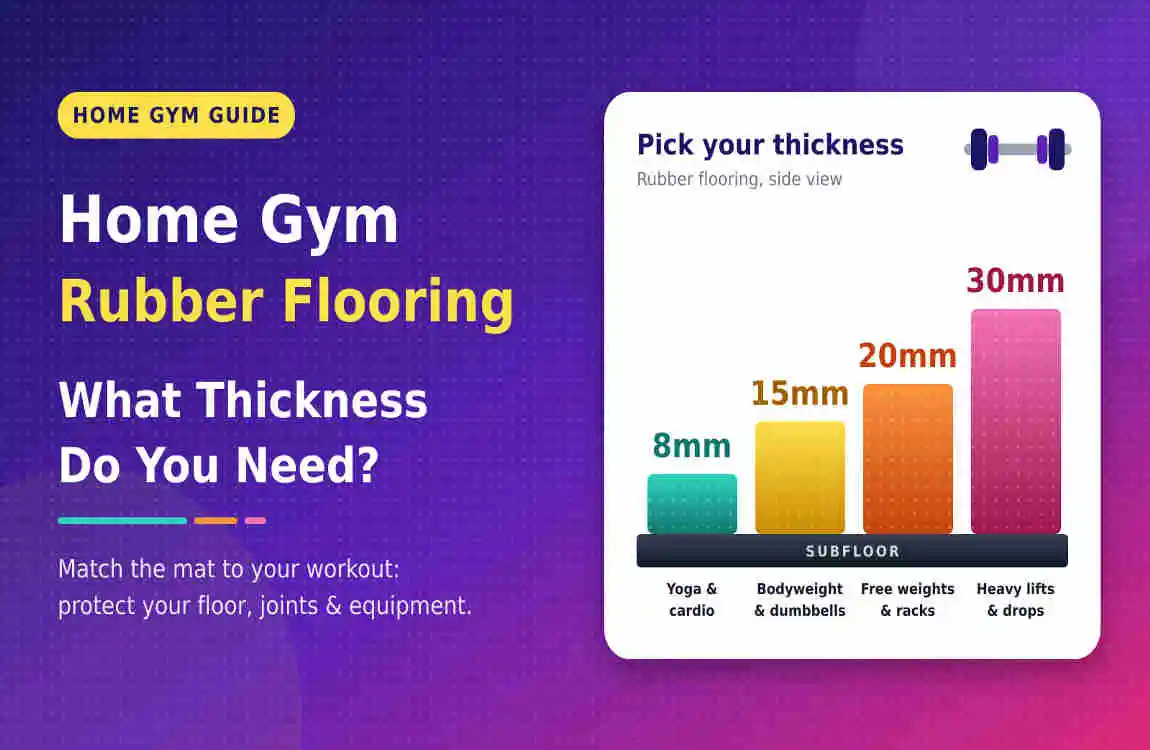
For most home gyms, choose 8 mm (3/8″) to 12 mm (1/2″) rubber flooring. Go up to 19 mm (3/4″) if you deadlift, do Olympic lifts or drop weights. Use 6 mm (1/4″) only under cardio machines and for light, low-impact training.
Your home gym floor does two jobs. It protects your body and equipment, and it protects the house underneath. Pick a mat that is too thin and you risk dented concrete, cracked tiles or a noisy ceiling for whoever lives below. Pick one that is far too thick and you spend extra money, fight a heavy install and may lose ceiling height.
Rubber Flooring Thickness Chart for Home Gyms
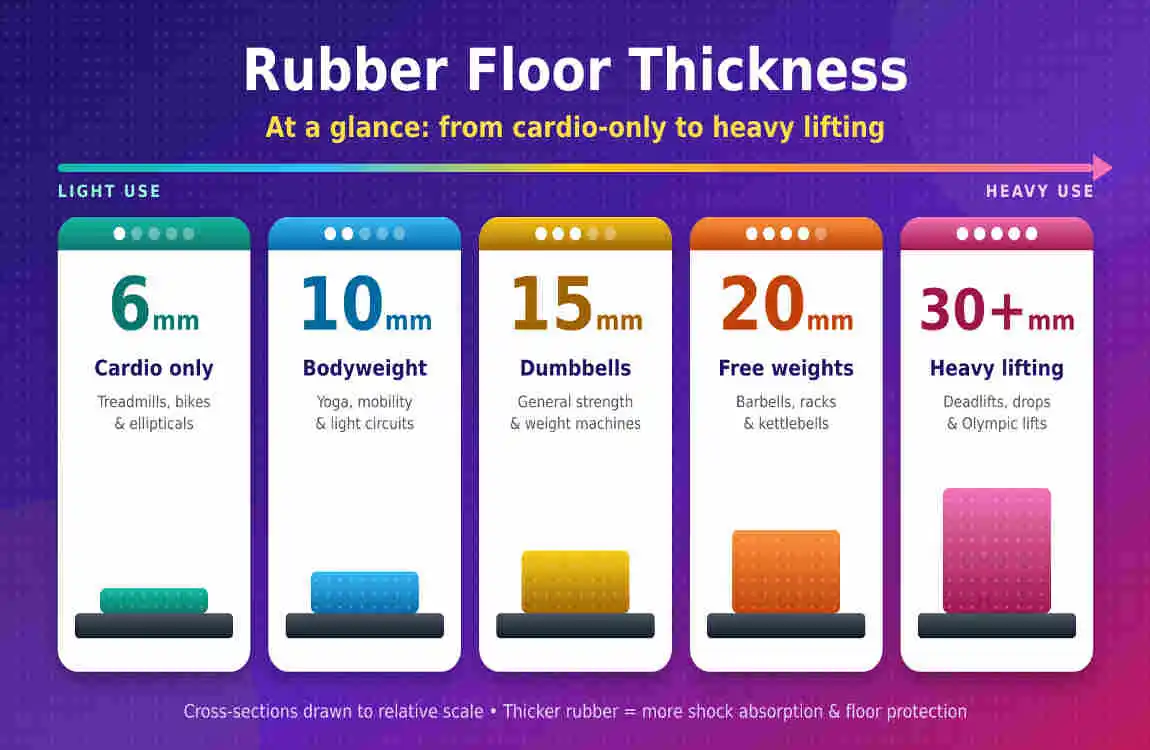
Flooring suppliers broadly agree on the ranges below. Greatmats ties thickness directly to weight: about 1/4″ for light free weights and heavy machines, 3/8″ (8 mm) for weights between roughly 50 and 120 lb that are not dropped, and thicker rubber floor beyond that.
| Thickness | Best for | Not ideal for |
|---|---|---|
| 6 mm (1/4″) | Treadmills, bikes, ellipticals, bodyweight and light dumbbells | Any dropped or heavy weights |
| 8 mm (3/8″) | General home gym, dumbbells and machines, the all-round standard | Dropping barbells |
| 12 mm (1/2″) | Heavy free weights, mixed strength training over concrete | Regular Olympic lifting or dropped bars |
| 19 mm (3/4″) | Deadlifts, Olympic lifts, CrossFit-style training, dropped weights | Tight budgets or low ceilings, since it is heavy and costs more |
| 25 mm (1″) | Maximum vibration and noise reduction, such as an upstairs gym | Most standard setups, where it is more than you need |
What Thickness Rubber Flooring Do You Need for Your Workout?
Cardio machines and light training: 6 to 8 mm
Treadmills, exercise bikes and rowers are heavy, but they sit still. Their job for the floor is to prevent scratches, absorb vibration and stop the machine feet from sinking in. Retailer Word of Mouth Floors notes that thin 5/16″ rubber is a good fit under an elliptical or treadmill. LX Hausys calls 8 mm the typical standard for home gym flooring, while 1/4″ suits low-impact workouts where nothing gets dropped.
Dumbbells, kettlebells and machines: 8 to 12 mm
If your routine is mostly dumbbells, kettlebells, cable machines and a bench, 8 mm is a sensible floor and 12 mm gives you extra margin. Greatmats suggests 1/2″ rubber for free weights over 120 pounds.
Deadlifts, Olympic lifts and dropped weights: 19 mm
This is where thickness really matters. Greatmats states that a 3/4-inch rubber mat protects the subfloor from the impact of intentionally dropped weights. Strength coach advice quoted by Garage Gym Reviews puts 1/2″ as the minimum for heavy lifting or overhead drops, while preferring 3/4″ where the budget allows. Living.Fit agrees, recommending 1/2″ as the go-to for general lifting and 3/4″ for deadlifts, Olympic lifting or regular weight drops.
How Does Your Subfloor Change the Right Thickness?
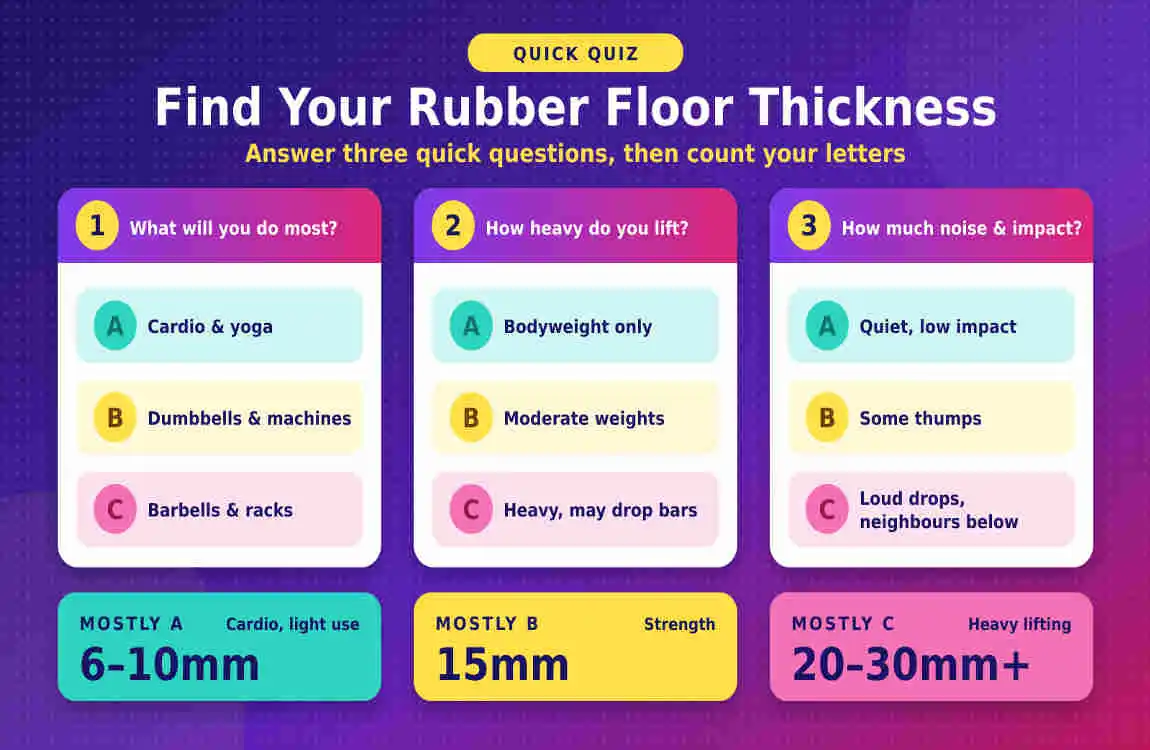
The surface under the rubber matters as much as the weights on top of it. Concrete does not flex, which is why Living. Fit points out that garage and basement gyms often benefit from thicker flooring. With a concrete slab and occasional heavy lifting, it recommends 1/2″ (12 mm) as the minimum.
Garage gym: 12 to 19 mm
A garage slab is tough but unforgiving. Use 12 mm across the general area and 19 mm where the barbell lands. Lowe’s buying guide lists rubber and PVC as two of the best flooring types for turning a garage into a gym. Rep Fitness suggests rolls for a garage because they give a uniform, easy-to-clean surface.
Basement gym: 12 to 19 mm, and check moisture first
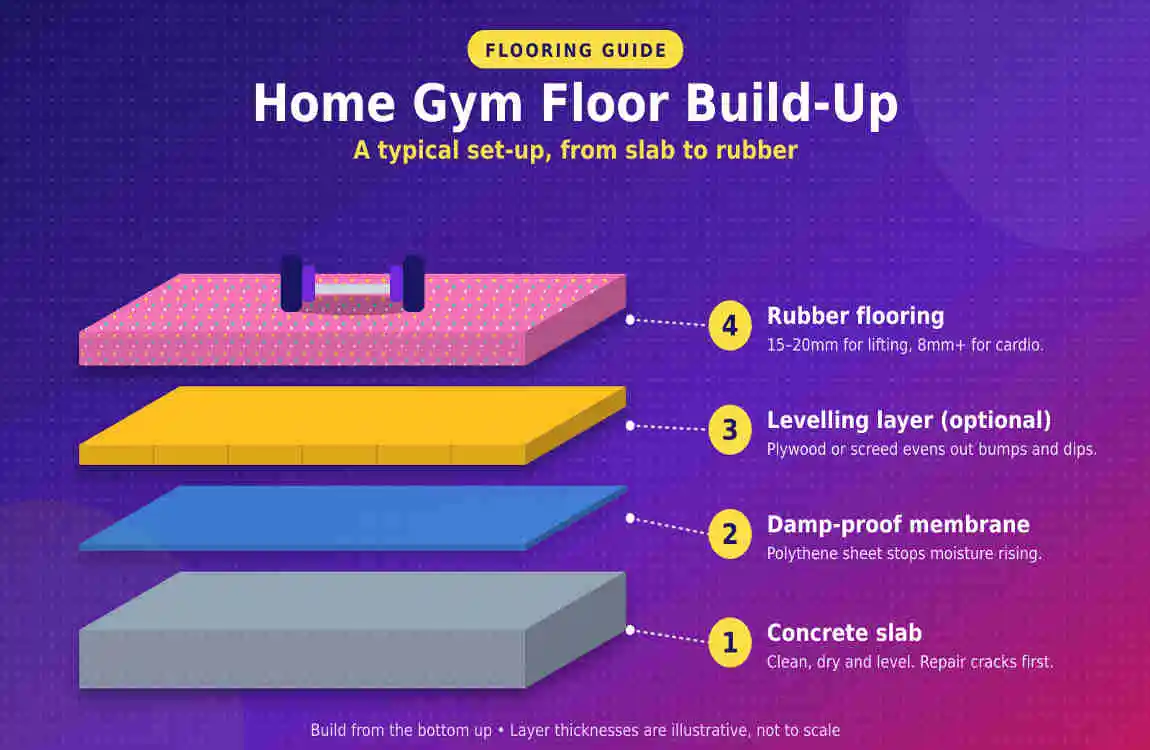
Rubber suits basements because it is waterproof and shields your feet from cold concrete, according to Lowe’s. But no thickness fixes a damp slab. The U.S. Environmental Protection Agency states plainly that the best way to control mold growth is to control moisture, and recommends keeping indoor relative humidity below 60 percent, ideally between 30 and 50 percent. A CUNY open-textbook chapter on home fitness adds that you should never hide a structural, moisture or surface problem beneath gym flooring.
If your basement is prone to dampness, consider tiles what thickness rubber flooring for home gymwith a raised base. Greatmats says these allow better drainage and airflow. Rep Fitness also suggests that for basement or concrete installations a subfloor may be necessary to prevent moisture issues.
Upstairs room or wood floor: 12 to 25 mm plus an underlay
Upstairs, your biggest concern is noise and vibration traveling through the structure. Greatmats says 1″ flooring offers maximum vibration and noise reduction. Over hardwood, Rep Fitness recommends a layer of paper or foam underlayment to protect the wood. As a practical rule, avoid heavy dropping upstairs altogether, whatever the thickness.
Should You Use Rubber Rolls, Tiles or Stall Mats?
Format affects how thick a floor you can realistically install.
- Rolls are typically the thinner option and give a near-seamless surface that stays put under heavy equipment. Rep Fitness favors rolls where you want efficiency and uniformity.
- Interlocking tiles suit awkward shapes, door ways and basements, and individual pieces are easier to replace.
- Horse stall mats are the budget route to 3/4″ thickness. A Yahoo Lifestyle gym flooring roundup includes a 4′ x 6′ vulcanized stall mat at 3/4″ thick, and Gear Patrol warns that such mats weigh nearly 95 pounds each and can carry a strong rubber smell at first, so plan for two people and good ventilation.
How to Save Money: Zone Your Floor
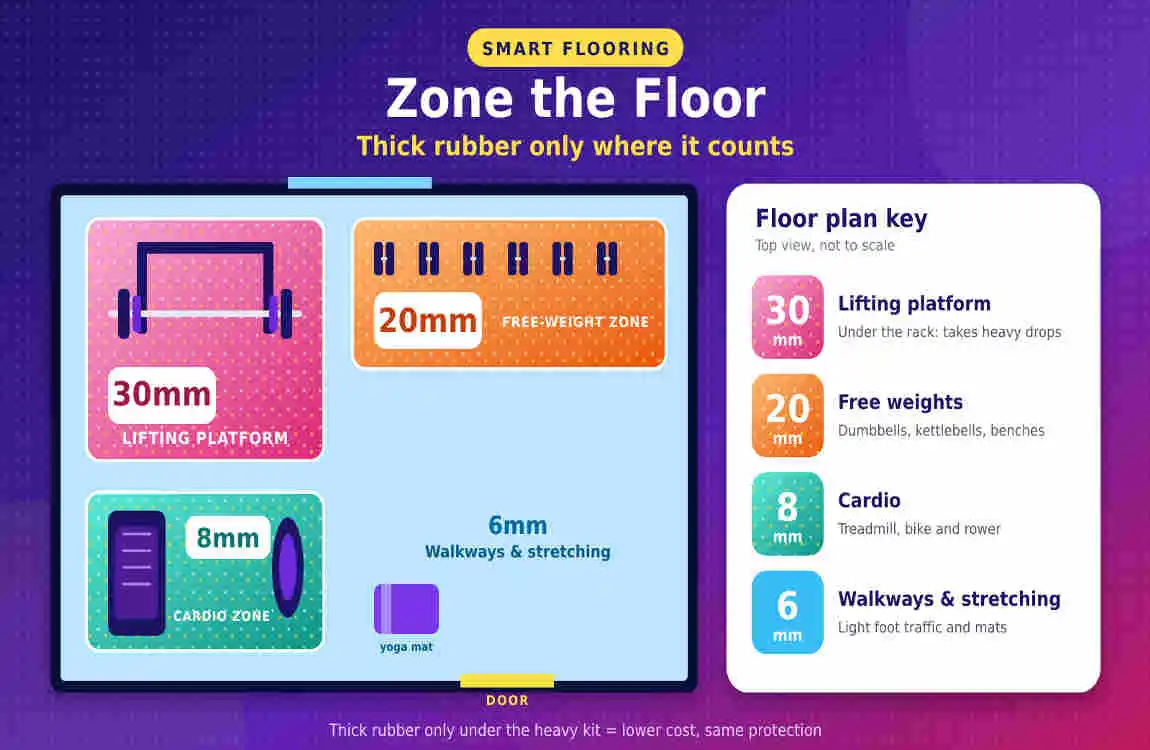
You rarely need 19 mm rubber wall to wall. A smarter plan is to put thick rubber where the weight lands and a thinner layer everywhere else. A 3/4″ platform under the barbell, 1/2″ around the rack and bench, and 1/4″ to 3/8″ under cardio gear keeps costs down and your ceiling height intact.
Installation Checklist Before You Buy
- Prepare the subfloor. Make sure it is clean, dry and level before laying anything, as Rep Fitness advises.
- Measure the space. Add 5% to 10% for cuts and waste.
- Allow the rubber to air out. New rubber can smell strongly for days.
- Clean it gently. Greatmats recommends a pH-neutral cleaner when mopping rubber, and otherwise simply vacuuming.
Frequently Asked Questions
What is the best thickness for rubber flooring in a home gym?
For most home gyms, 8 mm (3/8″) to 12 mm (1/2″) rubber works well. If you deadlift, do Olympic lifts or drop weights, choose 19 mm (3/4″).
Is 8 mm rubber flooring enough for a home gym?
Yes, for general training where weights are carried and set down, not dropped. Suppliers call 8 mm the standard, but it is not recommended under barbells that will hit the floor.
Is 1/2 inch rubber flooring thick enough for deadlifts?
It handles controlled heavy lifting. If you regularly drop the bar, 3/4 inch is the safer choice for your floor and equipment.
Do I need thicker rubber flooring over concrete?
Concrete is hard, so garage and basement gyms usually benefit from 12 mm or thicker, with 19 mm under the lifting platform.
Can I put rubber gym flooring over a wood or upstairs floor?
Yes. Choose a thicker mat, add an underlay to protect the wood and reduce noise, and confirm the subfloor is clean, dry and level.
Is thicker rubber flooring always better?
No. Thicker rubber costs more, weighs more and can be harder to install. Match thickness to your heaviest regular activity and the subfloor, and zone the room rather than covering everything in the thickest option.
The Bottom Line
Match the rubber to what you actually do. Choose 6 to 8 mm for cardio and light training, 12 mm for heavy free weights over concrete, and 19 mm wherever a barbell gets dropped. Check that your subfloor is dry and level, and zone the room to keep costs sensible. Do that and your home gym floor will stay safe, quiet and good looking for years.
Sources
- Greatmats: Rubber Flooring Thickness Guidelines
- Greatmats: Best Thickness for Home Gym Rubber Flooring
- Greatmats: When Do You Need 3/4 Inch Thick Gym Mats?
- Greatmats: Best Rubber Flooring for Home Gyms
- Garage Gym Reviews: How Thick Should Gym Flooring Be?
- Living.Fit: Gym Flooring Thickness Guide
- LX Hausys: How Thick Should Your Home Gym Flooring Be?
- Lowe’s: How to Choose Home Gym Flooring and Garage Flooring
- Rep Fitness: How to Install and Maintain Gym Flooring
- Rep Fitness: The Floor Is Yours, a Guide to Gym Flooring
- U.S. EPA: Mold
- U.S. EPA: Mold Course, Moisture Problems and Humidity
- CUNY Pressbooks: Home Gym Flooring and Surface Protection
- Yahoo Lifestyle: 10 Best Gym Flooring Options
- Gear Patrol: The Best Home Gym Flooring
